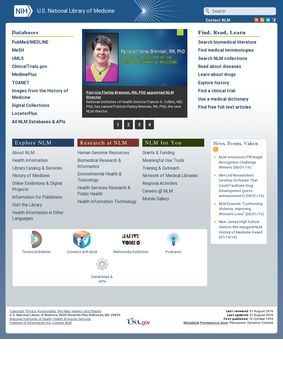
Most people who have ever read a health article citing a study have already used the National Library of Medicine without knowing it. Run by the National Institutes of Health and based in Bethesda, Maryland, it is the largest biomedical library in the world, and a substantial portion of the internet's medical information traces back to infrastructure it maintains. PubMed, MEDLINE, MedlinePlus, ClinicalTrials.gov, GenBank: these are household names inside research and clinical communities, and they all live here. The scale is easy to underestimate precisely because the access is free, and because the National Library of Medicine rarely inserts itself between the user and the information.
PubMed and MEDLINE
The citation record for biomedical and life sciences literature is held in PubMed and the underlying MEDLINE database. These are the tools researchers use to find what has been published, check precedent, or trace how a field developed over decades. Free, open access to that kind of depth is easy to take for granted until you spend time trying to work around it elsewhere. Paywalled alternatives exist, but they are downstream of the National Library of Medicine in more ways than one.
Consumer health information
What makes the catalogue here genuinely useful is how differently the tools address different audiences. MedlinePlus pivots toward the general public, offering consumer health information in plain English and Spanish, which extends real value to households that English-only resources leave behind. ClinicalTrials.gov is a worldwide registry of ongoing and completed studies, the place to confirm whether a treatment is being tested and where. These are not marginal tools; they are daily reference points for doctors, patients, journalists, and advocates.
Research tools for scientists
Below the consumer surface sits machinery working scientists depend on. MeSH, the Medical Subject Headings vocabulary, is the controlled terminology that makes precise searching possible. BLAST handles sequence analysis for anyone comparing biological sequences. The Unified Medical Language System ties together the tangle of biomedical terminologies that would otherwise resist interoperability. There is also Open-i, an experimental multimedia search engine, and the LocatorPlus catalogue for the library's own physical and digital holdings. The spread in practical terms runs from a teenager reading about asthma to a bioinformatician parsing genomes, and the National Library of Medicine manages to serve both without obviously compromising either.
Genomics and biotechnology
I find the genomics side particularly striking, because the National Library of Medicine houses the National Center for Biotechnology Information, and NCBI maintains GenBank along with a long roster of genomics and bioinformatics resources. A single institution holding both the consumer health front door and the sequence databases underlying active research is unusual. It explains why so many separate fields end up routing through the same address, and it gives the National Library of Medicine a breadth that few publicly funded resources anywhere can match.
Finding the right interface
The search tools themselves vary in how accessible they are to a casual visitor. Someone arriving for a single health question will likely find MedlinePlus responsive and clear. The same person landing in BLAST or the UMLS would reasonably be lost. That is the honest price of breadth, and it is worth flagging because new users sometimes bounce off the more technical interfaces before reaching the layer that would actually help them. Spending ten minutes on the site map before diving in pays off.
Historical collections and archives
Beyond the live databases, there is depth that does not always get attention. The National Library of Medicine holds extensive digital and historical medical collections, technical publications, and the NIH MedlinePlus Magazine, so it functions as an archive as much as a search service. For anyone studying the history of medicine, or trying to trace how a field developed, that material is a resource in its own right and one that is easy to overlook on a first visit.
Health IT infrastructure
The work also reaches into health IT and data standards, the unglamorous but necessary infrastructure that lets medical systems exchange information coherently. There are biomedical informatics training programs, intramural research through the Lister Hill National Center for Biomedical Communications, and support aimed at publishers and librarians. That last group is worth noting: the National Library of Medicine props up the professionals who in turn serve everyone else. Editors, cataloguers, and database managers all draw on standards and tools maintained here, which means the institution's practical reach is considerably wider than the public-facing websites suggest.
Serving multiple audiences
The audience, taken together, is broad in a way few institutions can honestly claim. Researchers use the genomics and literature tools. Healthcare professionals use the clinical databases. Educators and librarians use the catalogues and training. Publishers use the standards. The general public uses MedlinePlus and the trial registry. Each of those groups could make the case for the National Library of Medicine independently. Serving all of them under one roof is what gives the institution its weight in practice.
The verdict is strongly positive, with one practical reservation. The sheer number of tools can disorient a first-time visitor who only wanted one thing, and knowing which door you need before you walk in makes a real difference because the building behind it is large enough to get lost in. For literature searching, clinical trial lookup, consumer health reading, and deep genomics resources, the National Library of Medicine is a foundation rather than a convenience, and most alternatives in each of those categories are either narrower in scope or built on top of what the National Library of Medicine already provides. That combination of depth, breadth, and open access at no cost is, put plainly, hard to replicate.