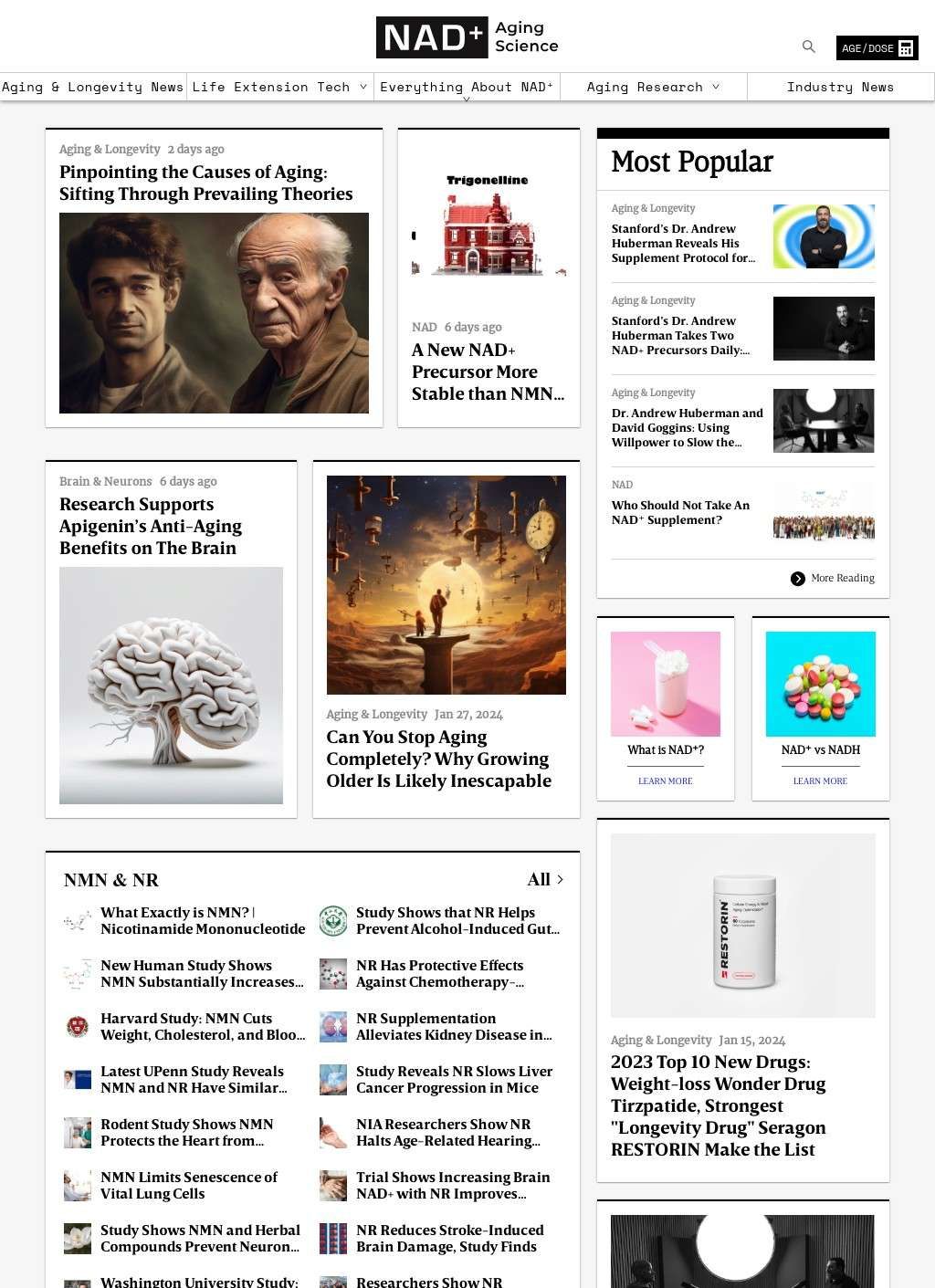
NAD is an education site about nicotinamide adenine dinucleotide, the coenzyme found in every living cell, and the research linking its decline to aging. It does not diagnose, prescribe, or sell anything. No clinic, no pharmacy, no telehealth. The verdict: a solid, well-built primer on one corner of aging biology, held back by the fact that no outside source vouches for it. Useful for learning. Not enough on its own to act on anything clinical.
Biochemistry and cellular mechanism
The brief is narrow, narrower than the usual longevity-site sprawl, and NAD holds to it. The content opens with the biochemistry: what NAD+ is, why cellular levels fall with age, how the body makes and burns through it. Mechanism first, recommendation second, all the way through. Someone with no background gets enough grounding to judge what comes next instead of being handed a supplement ranking up front. That ordering is the right call, and it makes the practical material downstream easier to read with a critical eye.
Life extending tech
From the fundamentals, the site fans into a section called "Life Extending Tech." It covers NMN and nicotinamide riboside supplements, prescription compounds, lifestyle interventions, and next-generation therapeutics that turn up in longevity research. Grouping the experimental and the commercially available under one heading is defensible. In this field the two overlap constantly, and pretending they are separate would confuse more than it clarifies.
Aging research by organ system
The "Aging Research" section is split by organ system and topic. Brain aging, cardiovascular function, immune health, cancer, and clinical trials each get a thread. Most people come to longevity content worried about one system, not aging in the abstract. The taxonomy lets them go straight to the cardiovascular material or the immunity research without reading past everything else. It is a more granular map than the field usually offers anywhere.
News feed tracks developments
A news and articles feed runs alongside the static pages and tracks developments as they land. Longevity science moves fast. A static explainer can go stale within months when a new trial reframes the picture, so the feed gives NAD a reason to be checked more than once. It also shows someone is following the field rather than leaving the pages to rot.
Supplement reviews without commercial interest
The supplement reviews compare NAD+ precursor products against each other. That market is crowded and labelled inconsistently, so a comparison resource fills a genuine gap. The thing that makes these reviews worth reading: the site has no storefront and sells nothing. Editorial and commercial interest are kept apart. That does not prove any single review is accurate, but it strips out the obvious reason to tilt a verdict toward one brand. The comparisons read like assessments made at arm's length from the market they describe.
Medical disclaimer placement
NAD carries an explicit disclaimer that all content is informational only and is not medical or professional advice. Plenty of health-adjacent sites bury that line. Here it sits up front, before the reader gets deep into supplement or prescription material. The supplement and prescription drug sections need exactly that framing, since following either thread into clinical territory should involve a clinician. The site states as much. That is a sensible way to draw the line between education and care.
The site also supports user account registration. For a reference resource that updates on its own schedule, an account that lets returning visitors save or track topics makes sense. The listing does not spell out what registration unlocks. The core content does not need it; casual visitors can read freely without creating anything.
Listed under medicine or health, NAD needs to be filed honestly. It is an education resource, not a care provider. It delivers knowledge and nothing else. Anyone running a search for a service provider will not find a clinic, a pharmacy, or an infusion service here, and should not expect one.
Checking authority and corroboration
There is no independent rating for this site at all. A search for reviews of nad.com mostly turns up unrelated outfits sharing the name: an electronics maker, assorted supplement brands, at-home NAD+ infusion clinics, a hair-removal product. None of that bears on this site. So the only evidence of quality is the content itself. The pages are accurate-looking and well structured, but nothing external confirms that. For a primer that someone uses to orient early-stage research, the internal coherence carries it a fair distance. For anything a reader might act on, the lack of corroboration is a hard ceiling.
Contact is a form with a working link and nothing else public. No phone number, no physical address. For a content resource that ships no products and fulfils no orders, a light contact footprint is less odd than it would be for a vendor, and the form covers the practical need to reach someone. Still, there is no named author, no organization, no location. Who is behind NAD and where it operates from stays unanswered, and for health-adjacent content that is the more telling blank.
NAD is a coherent, well-organized primer on a specific slice of aging biology. The organ-system breakdown works as a navigation tool. The separation of editorial from commerce is observable in practice, verifiable by the absence of a storefront. The disclaimer sits where it should. Those are concrete strengths, and the writing earns trust on its own terms. Set against that, no outside party has rated it and no one is named as responsible for it. The content holds up on its own terms; the source behind it remains unverified. Compared with Lifespan.io, which puts named researchers and a registered nonprofit behind its longevity coverage, NAD reads well but stands on far less authority. Use it to get oriented on NAD+ science. Take any clinical thread to a clinician, and do not treat the site's anonymity as a detail.