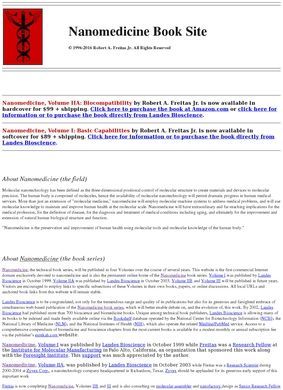
Someone working on artificial red blood cells, or just trying to understand whether such a thing is even physically possible, eventually runs into the same wall: the foundational technical literature is scattered, paywalled, or written for a different field entirely. Nanomedicine answers that directly. The site is the online home of Robert A.
Freitas Jr.'s multi-volume book series on the application of molecular nanotechnology to medicine, and the central feature is that the books are readable here in full, free, with nothing held back. Volume I, covering basic capabilities, and Volume IIA, on biocompatibility, sit on the site as complete free text, with hardcover and softcover editions of both available to buy through Amazon and Landes Bioscience for anyone who wants a copy on the shelf. Few technical projects of this scope put the whole thing in the open like that.
That decision to publish the full text openly shapes everything about how the resource is used. A graduate student can read the entire first volume without a library subscription. An engineer can check a specific design figure against Freitas's calculations before lunch. The series is planned to reach four volumes, with Volumes IIB through IV mapped to cover physiological systems and clinical applications, so what Nanomedicine posts now is a foundation rather than a finished set. The site is upfront about that, presenting the project as work still being built. Knowing the later volumes are still to come matters because it tells you the available text concentrates on groundwork: the capabilities and biocompatibility questions that any clinical application would later have to build on. A reader who understands that going in will not feel shortchanged by the gap.
Artificial cells designed as engineering problems
The substance that keeps people coming back is the detailed engineering analysis of theoretical medical nanorobots. The respirocyte concept, an artificial red blood cell intended to carry oxygen and carbon dioxide far more densely than natural hemoglobin, gets a full technical treatment. So does the microbivore, a proposed artificial white blood cell designed to clear pathogens from the bloodstream, and the clottocyte, a nanorobot conceived to act as an artificial platelet.
These are not sketches with a paragraph of hopeful prose attached. Each comes with design specifications, performance estimates, and the physical reasoning a real device would have to satisfy. Reading the three side by side, you start to see the logic of the whole program: Nanomedicine treats the body's existing cellular machinery as a benchmark and asks, system by system, what an engineered counterpart would need to match or exceed it.
From theory to quantified specifications
What I find genuinely useful about this material is that it commits to numbers. Freitas works through the geometry, the transport rates, the performance limits in a way that lets a reader argue with the conclusions instead of merely admiring them. That is the difference between a speculative essay and a reference you can cite. For anyone who has tried to find a source that treats medical nanorobots as an engineering problem with quantifiable parameters, Nanomedicine is close to the only address worth bookmarking. The estimates are presented as estimates, with the assumptions visible, which is the honest way to do it.
Visual aids for complex nanodevice designs
Supporting the written analysis are image galleries of the nanodevice concepts that help make the designs legible. A diagram of a respirocyte does work that several paragraphs cannot, giving a sense of scale and structure that text alone misses. These are aids to the technical content rather than the main event, but they pull their weight because the subject is so hard to picture from prose alone.
Curating research on medical nanotechnology
Beyond the books themselves, the site collects research papers and reports on medical nanotechnology and maintains links to related Nanomedicine articles. That curation has real value in a field where credible material is easy to lose among hype. A researcher can lean on Nanomedicine as a hub: read the foundational chapters here, then follow the outbound links to adjacent work without having to vet a dozen unknown sources first.
FAQs for visitors without technical background
There is also a set of FAQs, which keeps the door open for visitors who arrive curious but without the full technical background. That mix of original analysis, curated outside reading, and plain-language answers is part of what makes Nanomedicine work as a hub and not a lone document. A listing in a medical technology business directory might bring someone to the site cold; what they find is considerably more than they expected.
Exploratory science, not deployable products
It is worth being clear about what Nanomedicine is and is not. This is theory and design, the physical and chemical groundwork for medicine that does not yet exist as deployable technology. Freitas builds the case for what should be buildable given known physics, describing plausible future nanodevices instead of products you can order or clinical services anyone offers. Readers expecting treatment results will not find them, and that honesty about the exploratory status of the work is part of why the analysis holds up. Nanomedicine reads as a serious scientific argument, not a pitch for a future that has already arrived. The restraint is deliberate, and earns the content its credibility with a technical audience.
The audience for Nanomedicine is fairly specific. Academic researchers, graduate students, biomedical engineers, and professionals in nanotechnology and medicine are the people who will get the most from the dense chapters, and the writing assumes a comfort with physics and biochemistry that a casual visitor may not have. Still, the open full text means a motivated general reader can wade in too, picking through the more approachable introductory sections and the galleries to get a grounding in what the field is even claiming. The depth is there for specialists; the door is left open for everyone else. It is a balance Nanomedicine strikes without watering anything down.
The organization is functional and built around the text. Chapters are navigable, supporting resources are grouped sensibly, and Nanomedicine behaves like a reference archive: you arrive looking for a specific argument or specification and you can get to it. Nothing clutters the page or competes with the science. For a resource whose entire value is the depth of its content, that restraint is the right call. This entry rewards patience more than a quick scan.
A fair summary is that Nanomedicine does one thing and does it with rigor that is rare anywhere online. Nanomedicine hands you the complete reasoning behind a set of proposed medical nanodevices, lets you read the framing books at no cost, and points toward where to buy the print editions if the work earns a permanent place among your references. The theoretical, unfinished nature of the project is a real limit, but Nanomedicine states it plainly enough that no reader should feel misled about what they are getting.
The early-career researcher entering molecular nanotechnology, the engineer wanting to sanity-check a concept against established physical limits, the educator looking for rigorous primary material: all three will find the hours paid back. Start with the free full text of Volume I, work through the respirocyte and microbivore analyses to see how the design estimates are built, then follow the related links to connect the framework to current work. That is the practical path in, and it works.