Every article on Everyday Health that carries a medical claim is checked by a board-certified reviewer before it publishes. The site keeps an in-house Health Expert Network for exactly this, and it names every reviewer, listing credentials and specialty on a public directory that runs to more than a hundred physicians, registered dietitian-nutritionists, and other clinicians.
The operation behind that promise has a long lineage. It started as Agora Media, a consumer health publisher, merged with Streetmail.com to form Waterfront Media, then adopted the Everyday Health name to match its flagship property. It now runs as a brand of Everyday Health Group, a division of Ziff Davis, the publicly traded parent (NASDAQ: ZD) that bought the company for 465 million dollars. That trajectory, several name changes and an acquisition wrapped around one publishing operation, is unremarkable in digital media, where consolidation has folded countless independent sites into a handful of larger parents.
The health expert network
The Health Expert Network that Everyday Health maintains reaches across dozens of specialties. Cardiology, dermatology, endocrinology, gastroenterology, allergy and immunology, and clinical genetics all sit on the roster, and registered dietitian-nutritionists work beside the physicians. Every reviewer appears by name with credentials attached, so a reader can trace who signed off on a given piece of guidance rather than trusting an anonymous byline.
Board-certified means the reviewer has passed specialty board examinations and holds active certification, and pairing those physicians with dietitian-nutritionists puts the clinical claims and the everyday-eating claims both in front of someone qualified to judge them. A grid of more than a hundred named headshots amounts to Everyday Health staking its credibility on real, checkable people, kept up front where any reader can find them.
Editorial policies
The published Editorial Policies page spells out the route a piece takes before it goes live. A subject-matter writer drafts it, an editor shapes it, a board-certified medical reviewer checks the facts, and a copy editor closes it out. The same page states that any AI-assisted content runs through the identical medical review, fact-checking, and copy-edit steps as everything else on the site, since generated drafts have become common across publishing and Everyday Health holds machine-assisted work to the same standard as anything written from scratch. The board-certified reviewer step is the load-bearing one, the point where a claim stops being plausible copy and gets checked by a clinician who could be held to it.
Conditions, nutrition, and self-care
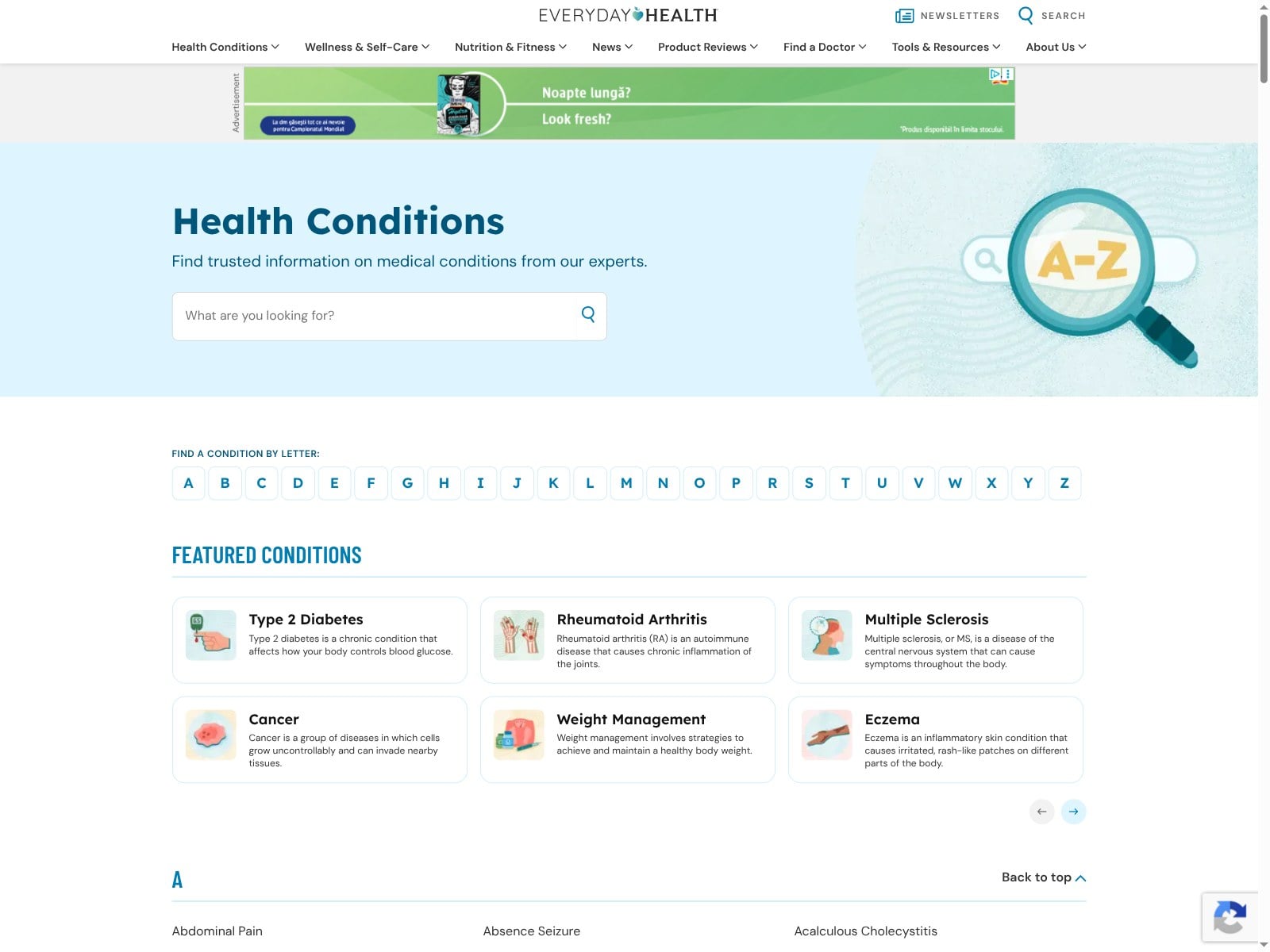
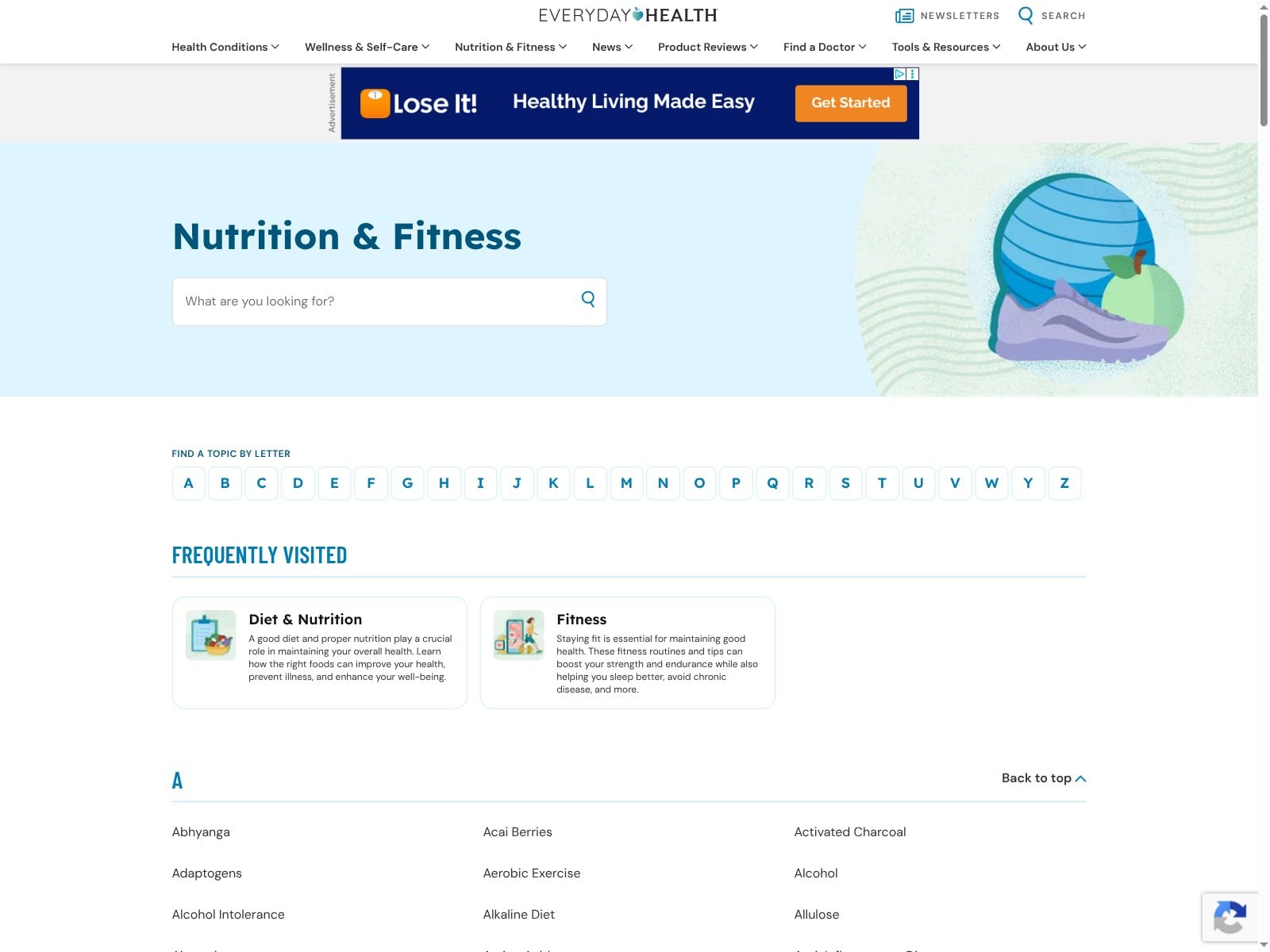
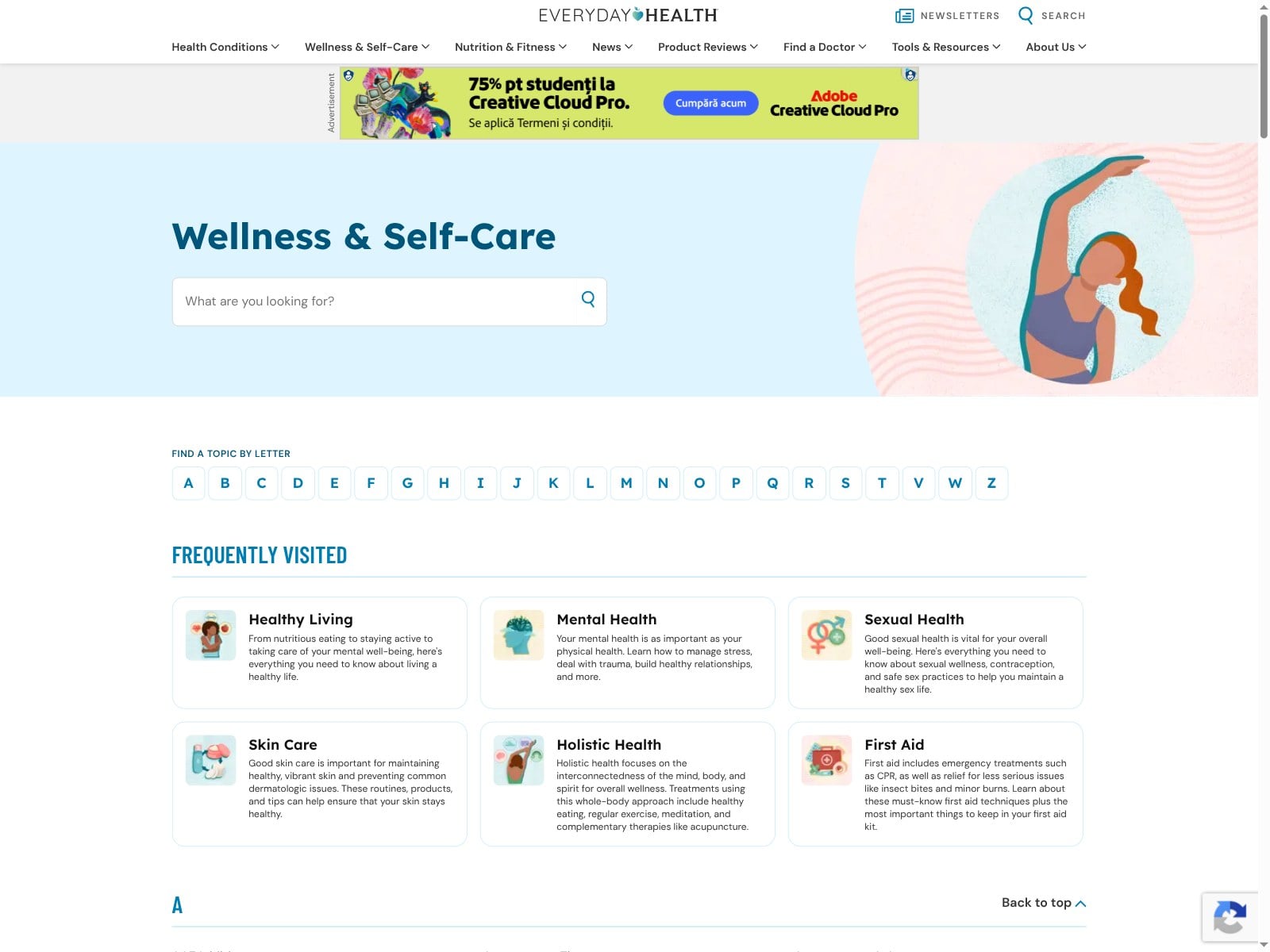
Everyday Health sorts its reading into a handful of large hubs, each fronted by its own grid of topic photography. Health Conditions is the deepest, a sprawl of condition pages organized around symptoms and treatment. Nutrition & Fitness carries the diet and workout material. Wellness & Self-Care takes the lifestyle, mental-health, and self-care side. News runs a steady stream of health developments, and the structure lets a visitor arrive from almost any direction and still land somewhere sensible.
Someone arriving with a specific diagnosis lands in the Conditions hub, while someone rethinking how they eat heads for Nutrition & Fitness, and neither has to wade through the other hub's pages along the way. The map Everyday Health has drawn keeps those routes from blurring, and each hub leads outward into deeper pages instead of dead-ending at a headline the way a lot of health sites still do.
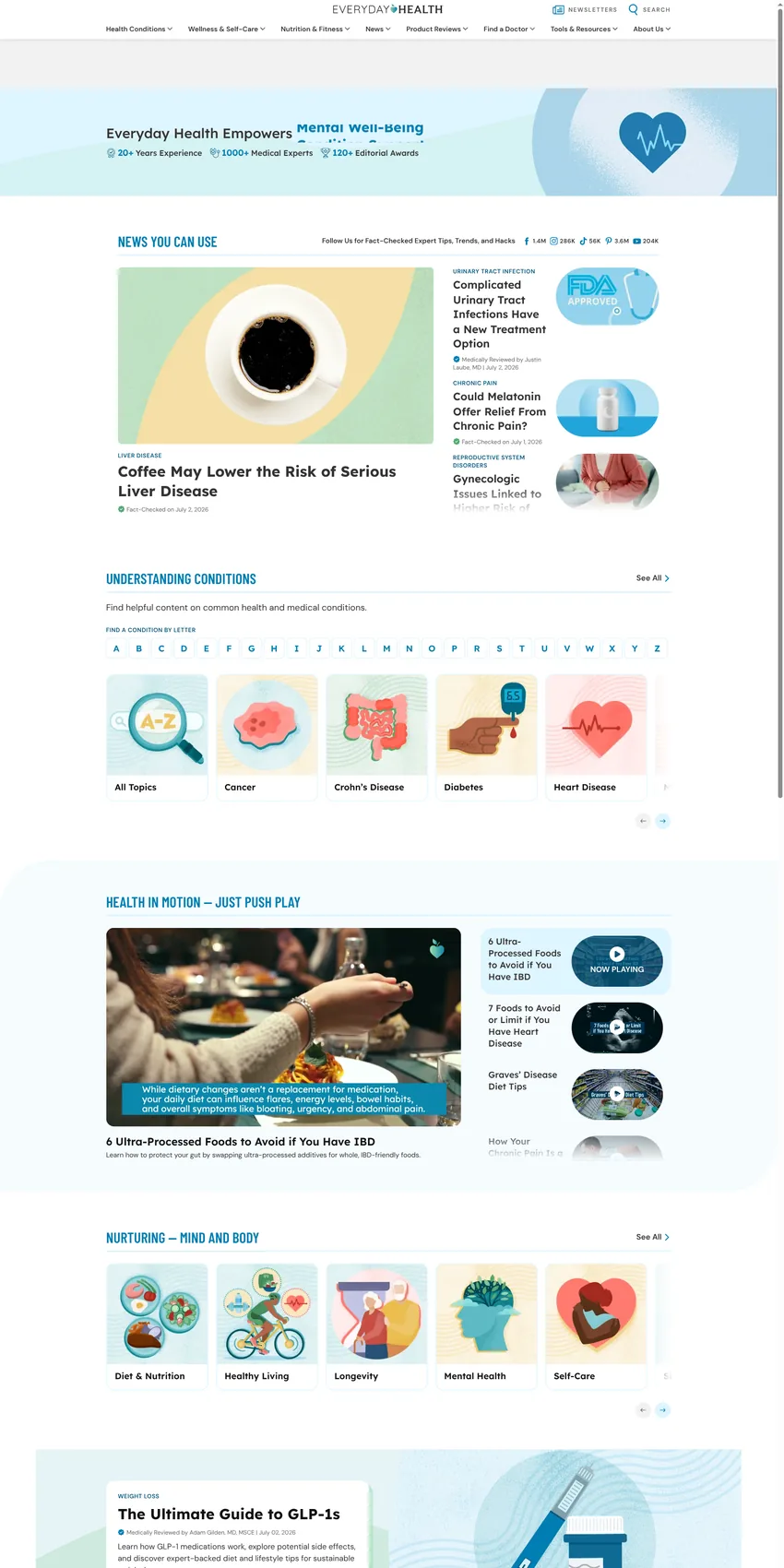
Everyday Health treats more than the articles as destinations. Product Reviews, Find a Doctor, and a Tools & Resources shelf each get their own front door in the top navigation, and the homepage opens on a hero image and a featured-story photo grid that pulls from across those hubs. The effect is a site a visitor can browse loosely or aim straight at a single answer.
Tools and resources
Past the articles, Everyday Health hands visitors a set of interactive tools that turn passive reading into something they can act on. A Symptom Checker works through complaints, a Body Type Quiz sorts a user into a category, and calculators for fiber, protein, hydration, and weight loss attach real numbers to a person's own intake and goals. A "Check In, Check Up" tracker and a tips assistant called Tippi fill out the self-service side. These are the features that give a health site repeat use rather than one glance and a close.
Find a doctor and product reviews
Everyday Health also runs a separate provider-search directory, Find a Doctor, on its own dedicated domain, listing cardiologists, dermatologists, OB/GYNs, pediatricians, and primary-care physicians among other specialties. Pairing that lookup tool with the condition articles means a reader can go from reading about a diagnosis to finding someone nearby who treats it, covering both ends of the same problem in one place, and the provider listings pair specialty and location with every name on the page.
The Product Reviews vertical is the commercial edge, covering supplements, wellness devices, and buyer guides to GLP-1 medications, all held to a stated Product Testing Policy. Given how much marketing money runs through supplements and weight-loss products, a written testing policy behind the recommendations counts for something. Everyday Health has the corporate weight to keep an editorial apparatus of this size running, sitting as it does inside a publicly traded media parent with the resources to fund it.
News and the discover feed
The News section pushes a live Google Discover feed off Everyday Health's own feed infrastructure. It is valid RSS, fifty items deep, with clean plain-text headlines like "Best Exercises for Hypertrophic Cardiomyopathy," the sort of specific, condition-level story the site trades in. Running its own distribution pipe, and syndicating that content across the major social platforms, points to an operation with real engineering and reach behind the writing. Maintaining that pipeline costs more than running a simple blog feed, which is why plenty of health publishers skip it entirely.
Put together, the sections, the calculators, and the named review layer make the site a reasonable first stop for a symptom worth understanding, a nutrition question, or a product decision, with the sourcing exposed clearly enough that a reader can gauge how far to trust any single page. The verdict on Everyday Health rests less on its polish than on that visible chain of named, board-certified people standing behind the words.


Verified social profiles
Business address
Everyday Health, Inc. (Everyday Health Group, a division of Ziff Davis, Inc.)
360 Park Avenue South, 17th Fl,
New York,
NY
10010
United States
Contact details
Phone: (800) 497-9907
PSA testing may be the first step in prostate cancer screening, but benign factors may contribute to high PSA, including aging…
Learn when back pain may signal cancer, key warning signs, and which cancer types are most likely to cause persistent or severe…
The influenza virus can cause serious problems for people at risk of¬¬ heart disease. Learn how the flu shot can lower that risk.