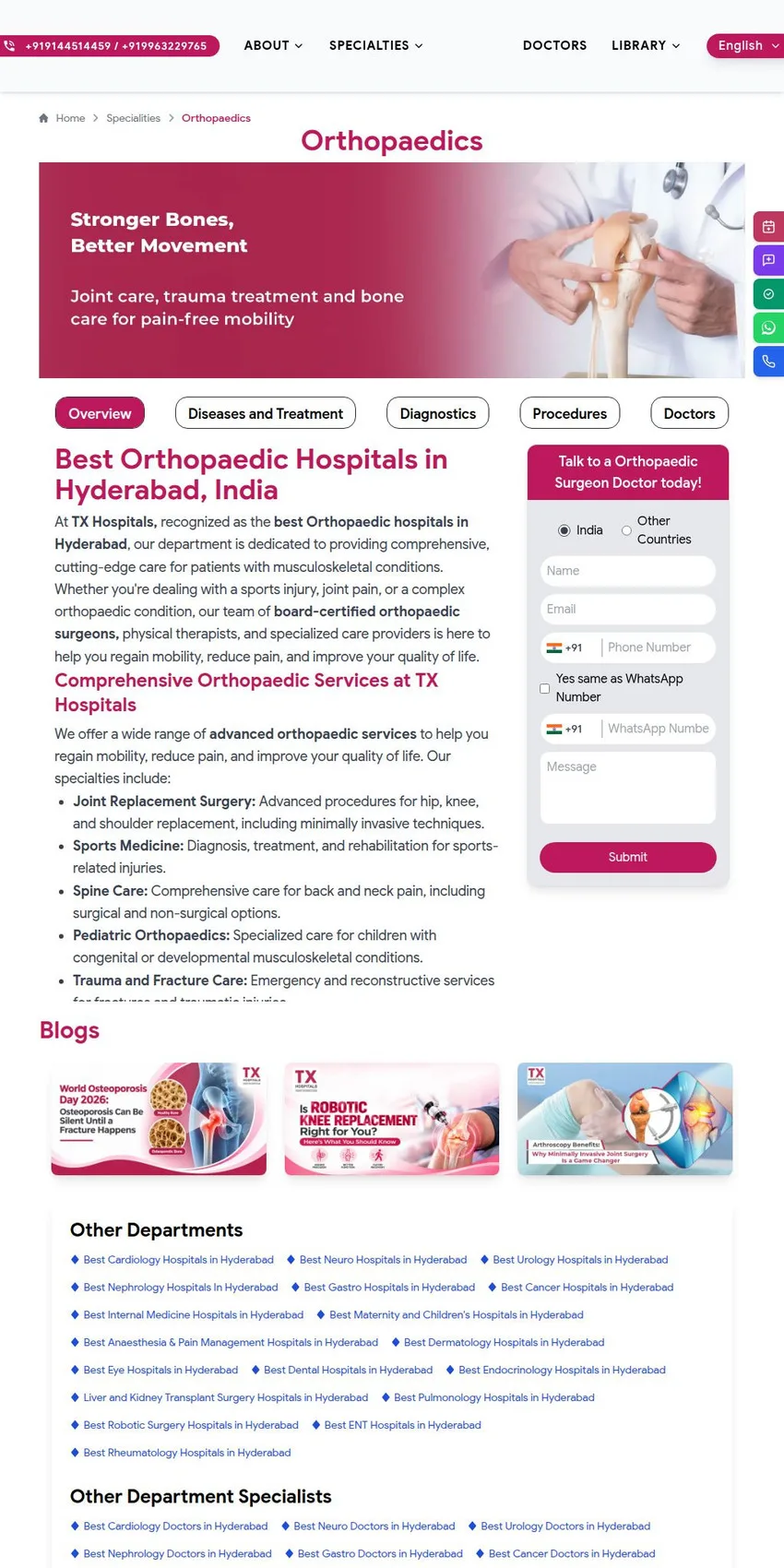
TX Hospitals is a network of private hospitals in Hyderabad, India. The orthopedics page introduces the department that treats disorders of the musculoskeletal system—that is, bones, joints, muscles, and ligaments. The network has facilities in Uppal, Kachiguda, Banjara Hills, and Miyapur, plus a children's hospital in Banjara Hills.
What exactly do they treat?
The department focuses on eight areas. The first is joint replacement—for the hip, knee, and shoulder—including minimally invasive techniques. Sports medicine covers diagnosis, treatment, and rehabilitation, while spinal care offers both surgical and nonsurgical options for back and neck pain.
Pediatric orthopedics deals with congenital and developmental conditions in children. Traumatology handles fractures, ranging from emergency care to reconstruction. Other areas include the management of arthritis—including osteoarthritis and rheumatoid arthritis—and care for the hand and upper extremity, from the fingers to the shoulder.
The list of conditions treated will sound familiar to many people. These include osteoarthritis, rotator cuff tears, anterior cruciate ligament injuries, herniated discs, and spinal stenosis. Next are carpal tunnel syndrome, tendinitis, fractures, dislocations, and scoliosis. It's a sort of atlas of the aches and pains familiar to anyone over 40 or who has played soccer on the weekends.
What procedures are on the list?
The page lists 22 procedures. The major ones are total knee, hip, and shoulder replacements. For fractures, the procedures include closed reduction, external fixation, and open reduction with internal fixation (ORIF), in which the bones are aligned and secured with plates and screws. Bone grafts round out the chapter.
Arthroscopy is performed on the hip, shoulder, wrist, and ankle. The surgeon works with a thin camera through small incisions. It's similar to a plumber repairing a pipe through a coin-sized hole, rather than breaking through the entire wall. This also includes repairs of the cruciate ligaments, meniscus, tendons, and rotator cuff.
Some procedures on the list do not require a scalpel. Arthrocentesis removes fluid that has accumulated in a joint, and viscosupplementation involves injections made directly into the joint. Other options include prolotherapy, shockwave therapy, cartilage restoration, and stem cell therapy. For many cases of joint pain, treatment often begins with these methods before any discussion of surgery.
Who will care for you?
The team includes board-certified orthopedic surgeons, physical therapists, and specialized nursing staff. They work alongside pain management specialists and radiologists. The website refers to this as a multidisciplinary approach, in which the patient is seen by multiple doctors, each specializing in their own area.
Each patient receives a personalized treatment plan. The page mentions advanced diagnostic tools, modern surgical technologies, and minimally invasive options that allow for a faster recovery. The network's orthopedic surgeons have a separate page, accessible via the "Doctors" menu.
The website summarizes in five points the reasons why patients choose the department. These are the experienced team, up to date with new techniques; patient-centered care; modern facilities; interdisciplinary teamwork; and minimally invasive procedures. For someone comparing hospitals, it's a concise list that's easy to compare with others.
In my opinion, the inclusion of rehabilitation in the department's services is what matters most. Physical therapy offers personalized strength and mobility programs. A knee replacement without rehabilitation is like a new bicycle you haven't yet learned to ride.
And what if you want a second opinion?
TX Hospitals offers a second medical opinion service, with its own section on the website. Among the procedures listed there is knee replacement. Before major surgery, a second opinion is like getting a second estimate for a home renovation: you find out if the plan holds up.
For those who just want a checkup, there are health checkup packages. One of the eleven is dedicated to orthopedics, called the Orthopaedics Health Checkup Package. The Library section compiles guides on diagnoses, medications, symptoms, treatments, and procedures—useful for anyone who wants to understand the terminology before their consultation.
Where are the hospitals?
All five facilities are in Hyderabad, and the page displays a rating between 4.8 and 4.9 for each one. Orthopedics is one of the network's more than thirty specialties, alongside cardiology, gastroenterology, neurology, oncology, nephrology, rheumatology, and robotic surgery. A patient with multiple health issues can thus remain within the same network. Patients from other countries have a dedicated page, International Patient.
How do you make an appointment?
As a reviewer, I noticed how easy it is to use the action buttons: Book Appointment, Second Opinion, Book Health Checkup, and Call Us. The form on the page is short. It has a country selector and a phone number field with a checkbox in case the number is also the WhatsApp number.
The page displays phone numbers and a direct WhatsApp link, with no email address or business hours listed. For many patients in India, WhatsApp is the most natural way to ask a quick question. The FAQ section has six questions, ranging from available services to how to make an appointment. The network has accounts on Facebook, Instagram, LinkedIn, X, and YouTube.