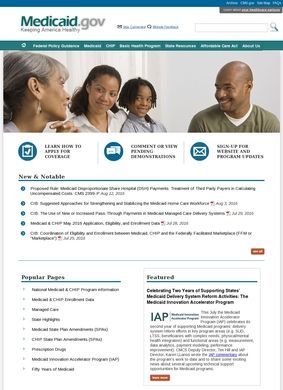
Someone trying to figure out whether a child qualifies for free or low-cost coverage, or what a state has to pay for versus what it can choose to pay for, lands here with a fairly narrow question and usually a tight deadline. Medicaid.gov is built to answer exactly that kind of question.
Structure of medicaid.gov
It is the official site of the Centers for Medicare and Medicaid Services, run through the Center for Medicaid and CHIP Services, and it sits over the whole joint federal-state apparatus that covers health costs for low-income people. Medicaid is, after all, the larger of the two programs CMS oversees, and the volume of material here reflects that scale. The structure of the place follows the structure of the program itself, which is to say it is split by who is asking: a person who needs coverage, a state running its own plan, a provider billing the program, or a researcher chasing numbers.
Comparing mandatory and optional benefits
The coverage information is where most ordinary visitors will spend their time, and it is laid out with a useful distinction that the program turns on. Some benefits are mandatory, meaning every state has to provide them: inpatient and outpatient hospital services, physician services, lab and X-ray work, home health. Others are optional, left to each state's discretion, and that bucket holds the things people often assume are guaranteed but are not, prescription drugs among them, along with nursing home care, personal care services, and similar long-term supports.
Eligibility rules by population
Seeing the line drawn between the two is what stops a reader from making a wrong assumption about their own Medicaid coverage. The eligibility material works the same way, walking through the covered populations one at a time: low-income adults, children, pregnant women, the elderly, and people with disabilities, each with its own criteria.
How CHIP fits alongside Medicaid
CHIP gets its own treatment instead of being folded into the general pages, which is the right call given that the Children's Health Insurance Program has separate eligibility and enrollment rules. A family whose income sits just above the Medicaid threshold often finds the answer there, and the site keeps that path distinct enough that you do not have to untangle it from the adult Medicaid rules. There is also a clear explanation of how the Affordable Care Act's unified income-counting method works, and how a single application now runs across Medicaid, CHIP, and the Marketplace at once, so the same form that tests for Medicaid also tests for the alternatives. That last point matters in practice, because it is the mechanism that routes an applicant to the right program without making them apply three times.
Submitting state plan amendments
A large part of what this site does has nothing to do with individual coverage and everything to do with administration, and that is the half that gives it real weight. States do not run their Medicaid programs in a vacuum. They submit State Plan Amendments and eligibility and enrollment templates through MACPro, the program portal hosted here, and that submission process is the formal channel by which a state changes how it operates. The site documents the templates, the rules, and the technical assistance around eligibility, enrollment, and the renewal process that states have to manage every year.
Waivers that reshape state coverage
Waivers and demonstrations sit alongside that, and they are not a footnote. Section 1115 demonstrations let states test approaches that depart from standard federal rules, and the home and community-based services waivers, the HCBS authority, are how a lot of states fund care that keeps people out of institutions. Anyone trying to understand why two neighboring states cover wildly different things will eventually end up reading about waivers, and this is the place those are explained from the federal side. CMCS acts as the national focal point for all of it, which is why the guidance here carries the authority it does: it is the source the states themselves answer to.
Where Medicaid data lives
The data side deserves its own mention. There are monthly Eligibility Operations and Enrollment Snapshot reports, and the underlying datasets live on Data.Medicaid.gov for anyone who wants the raw figures instead of the summary. I went looking for how granular that data runs, and the separation of a readable monthly snapshot from a full downloadable dataset is a sensible split, since a policy researcher and a curious member of the public want very different things from the same numbers. Managed care guidance, material on community engagement requirements, and policy notes tied to working families tax legislation round out the picture, so the site is not frozen on the basics; it tracks the program as the rules around it shift.
Finishing enrollment at the state level
What you will not find is hand-holding of the kind a commercial insurer offers, and that is worth setting expectations on. This is a federal information and regulatory hub, so the actual act of enrolling in Medicaid almost always happens at the state level, and Medicaid.gov repeatedly points people back toward their own state agency for the final step. The federal pages tell you what must be true, what may be true, and how the program is supposed to work; the state decides the specifics and processes the application. For someone expecting a single button that signs them up, that hand-off can feel like an extra hop, though it reflects how the program is actually built rather than any failing of the site.
Reading the program's technical language
The writing throughout leans technical, with the program's own vocabulary, the section numbers, the template names, the acronyms, used freely. That suits providers, state staff, and researchers, who need the precise terms. A first-time applicant may have to read more slowly, and the glossary-style framing of mandatory versus optional benefits helps with that, but nobody should expect plain-language marketing copy. The trade-off is accuracy: when the stakes are eligibility for health coverage, a site that uses the exact statutory term is more trustworthy than one that smooths everything into reassurance.
Four audiences the site serves
For the four audiences it names, the material does what it needs to do. A beneficiary can find what is covered and who qualifies. A state can reach the submission tools and the technical assistance it needs. A provider can check what the program pays for. A researcher can pull the Medicaid snapshots and the datasets behind them. The CHIP and waiver sections fill the gaps that a coverage-only site would leave, and the income-counting and single-application explanations tie the whole thing back to how a real person gets routed into care. Treat it as the authoritative reference for what the federal rules require and where the optional pieces sit, then follow it to your own state to finish the job.