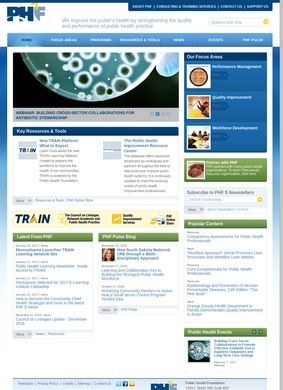
The TRAIN Learning Network run by the Public Health Foundation (PHF) carries more than 5,000 courses. That single figure reframes what the organization is: less a think tank issuing the occasional report, more a piece of national training infrastructure that health departments plug into every day. It has been doing this since 1970, a long run in a field where funding and priorities rarely sit still for two years together.
The Public Health Foundation (PHF) is a nonprofit, and its remit is capacity-building and workforce development for public health. The audience is narrow and specific: health departments and the professionals working inside them, across the country. Everything in the catalogue is shaped around that reader, so nobody wanders onto this site by accident, and the design makes no attempt to court anyone else.
Building capacity for the public health workforce
The offering splits across three things that overlap heavily: self-service training, direct consulting, and a set of standing programs that shape the field itself. A health department can take a course, hire the Public Health Foundation (PHF) to run an improvement project, or join a longer-term collaborative.
In practice those routes feed one another, and the structure rewards an agency willing to commit to more than a single piece of it. That interlock looks deliberate rather than accidental.
The TRAIN Learning Network and its workshops
TRAIN is the flagship product of the Public Health Foundation (PHF), a learning platform holding that library of more than 5,000 courses spanning the breadth of practice. Around it sit live offerings: virtual workshops on quality improvement, a workshop built around leadership, communications, and innovation, training on the field's core competencies, and immunization-specific instruction for the staff who administer it. A practitioner can grab one short course or work through a structured competency track over months.
For a public health workforce that is chronically stretched and hard to backfill, a deep on-demand library is a practical answer to the problem of training people without pulling them off the job for days at a stretch.
The site posts client testimonials calling the work engaging and innovative, and praising TRAIN's flexibility and its data reporting. Those are the organization's own chosen quotes, so they read as encouragement rather than independent proof. The recurring note about reporting is worth registering anyway, because a platform a department can measure and document counts for a great deal to a manager working toward accreditation.
Consulting for performance and quality improvement
Beyond self-guided learning, the Foundation works hand in hand with agencies. Its consulting spans performance improvement technical assistance, quality improvement training, accreditation support, and wider workforce development consulting, plus eLearning development for teams that want to build their own courses in house. This is applied work for a health department chasing an accreditation standard or repairing a process that has quietly broken down, and it is the practical core of what the Public Health Foundation (PHF) sells.
The consulting and the courses are designed to be bought together, one diagnosing the problem and the other closing the skill gap it exposes.
The Council on Linkages and standing programs
A cluster of longer-running programs gives the Foundation its institutional weight. The Council on Linkages Between Academia and Public Health Practice ties universities to frontline work, and the core competencies used widely across the field trace back to it. Foundational Public Health Services sets out the baseline capabilities every health department is expected to hold. The Academic Health Department Learning Community and the Immunization Center fill out the set, with the latter connecting straight back to the immunization training on the learning side.
Frameworks like Foundational Public Health Services matter in a very concrete way, since agencies use them to argue for budget and to organize their own operations, so a set of definitions written here can ripple outward into how a county actually structures its health department.
These are the parts that make the Public Health Foundation (PHF) more than a vendor. They are field-shaping efforts that other institutions cite and build their own programs on top of.
The turn toward AI in public health
The newest thread is artificial intelligence. The Public Health Foundation (PHF) lists AI and problem-solving assistance among its consulting services and runs a named AI in Public Health initiative alongside it. On paper that puts the Public Health Foundation (PHF) ahead of a corner of government that has been slow and cautious about touching the technology at all.
What the site does not make clear is how far that work actually reaches. An AI in Public Health initiative can mean serious tooling and honest guidance for departments nervous about the risks, or it can mean a webinar and a position paper wearing a fashionable label.
The rest of the Public Health Foundation (PHF) catalogue has decades and a visible record behind it; this strand has a name and not much else on display yet. That gap between the billing and the demonstrated substance is the one soft spot in an otherwise solid record, and it is worth watching closely as the initiative matures.