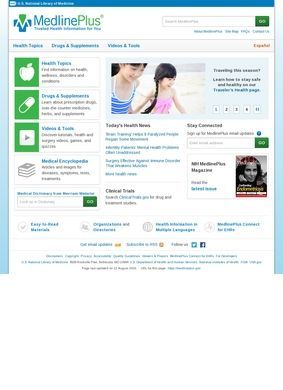
MedlinePlus is the public-facing health portal run by the U.S. National Library of Medicine, part of the National Institutes of Health, and it carries no advertising, a fact that becomes obvious the moment you compare how the pages read against anything commercially funded. The core material organizes into Health Topics, a Medical Encyclopedia, a Medical Tests section, and a Drugs and Supplements database, each drawing on the same NIH editorial standards and pitched explicitly at patients and families rather than clinicians.
Inside the drugs and supplements database
The Drugs and Supplements section is the part I return to most, because it covers prescription medications, over-the-counter products, herbs, and dietary supplements in plain language without steering toward any product. You can look up a drug and read what it treats, how it is taken, and what side effects to watch for without wading through pharmaceutical marketing or jargon written for prescribers. That tone holds across the whole site. The Medical Tests section in particular fills a gap most people only notice the moment a doctor hands them a lab printout: it explains why a test gets ordered and what the numbers actually mean, in a register anyone can follow. The encyclopedia adds clinical images alongside its articles, and a labelled diagram often lands faster than a paragraph trying to describe anatomy in words.
Accessibility features for diverse readers
A deliberate effort runs through MedlinePlus on accessibility. Easy-to-read materials written for lower health literacy are treated as proper editorial content, not summaries tacked onto the main articles. A large share of the content is available in Spanish, and additional languages are covered to varying depth. There is even a Healthy Recipes section, which sounds peripheral until you see it sitting next to the nutrition and chronic-disease topics it connects to. The audience the site is aimed at is wide: a parent at midnight trying to understand a child's new diagnosis is a very different reader from a medical student, and the writing accounts for that.
Genetics section and magazine updates
The NIH MedlinePlus Magazine extends the same editorial approach into a periodical format, and RSS feeds let people follow specific topics without checking back manually. The Genetics section covers inherited conditions and explains how genetic variants connect to health outcomes, which is useful territory that most public health sites skip or cover only in passing.
Connecting MedlinePlus to clinical systems
MedlinePlus Connect is an integration service that pipes site content directly into electronic health record systems, so patients can receive vetted reading at the point of care instead of being sent to a general web search. Developer APIs let third parties pull the content into hospital apps and patient portals, which is why MedlinePlus material turns up inside tools run by health systems that have no visible connection to the NLM. That distribution matters: it means the quality of the source reaches people who never type medlineplus.gov into a browser.
Comparing MedlinePlus to research databases
The site also threads outward through the NLM ecosystem. Links go to ClinicalTrials.gov for trial enrollment information and to PubMed and MEDLINE for the underlying biomedical literature. A curious reader can move from a plain consumer summary to the actual research behind it in a few clicks, with no paywall in the path. Behind the consumer portal, the parent organization runs UMLS Terminology Services, the MeSH controlled vocabulary used to index medical literature, BLAST for genomic sequence alignment, Open-i for multimedia biomedical image search, and the LocatorPlus library catalog, along with training programs in biomedical informatics and intramural research. Most visitors to MedlinePlus will never touch those tools, but they explain where the consumer content comes from and why the editorial standard is higher than a typical health page.
The volume of cross-linking can become a maze. Start on one Health Topics page and you can end up several clicks deep across encyclopedia entries, drug records, and outbound research databases before you find the specific answer you came for. The design is functional and unflashy, prioritizing information density over visual polish, which suits the purpose but will feel dated to anyone used to slicker consumer health apps.
Because the writing is careful and consensus-driven, it also tends toward the general. Someone with a complex or unusual case will eventually reach the limit of what a public reference can responsibly say. MedlinePlus is clear about this; it points toward clinicians and primary sources rather than trying to cover ground it cannot responsibly cover. That honesty about scope is part of what makes the rest of it reliable.
No advertising, no commercial interest, and a direct line to the underlying biomedical literature: MedlinePlus holds to those three things consistently, and they make a real difference for anyone trying to sort credible health information from noise. The Spanish materials and easy-to-read layer widen access beyond the audience most health sites quietly assume. For day-to-day questions about a medication, a test result, or a newly named condition, it is among the first places worth checking, and the path from a plain summary to the clinical source behind it stays open throughout.