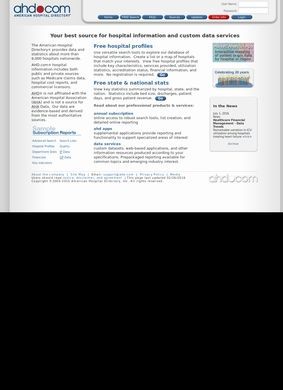
Pulling up a hospital profile on ahd.com costs nothing, and that free access is the reason most people find American Hospital Directory at all. American Hospital Directory covers more than 7,000 U.S. hospitals, and searching any of them returns a full page of characteristics, service lines, utilization figures, and financial indicators assembled from Medicare claims data, CMS hospital cost reports, and commercial sources. If you have ever tried to make sense of a cost report pulled directly from the federal source, you know how much work that translation saves.
Free profiles and data sources
The data underneath is the part worth dwelling on, because it determines whether any analysis built on top of it is trustworthy. Cost reports and Medicare claims are public, but they arrive in formats built for regulators, not readers. American Hospital Directory parses those filings and presents fields a working analyst recognizes: bed counts and other facility characteristics, the service lines a hospital runs, volume and utilization statistics, and financial metrics drawn from the same CMS records that auditors use. Because the inputs are documented government sources, a number on a profile page can be traced back to where it came from. That traceability separates a reference like American Hospital Directory from a site that simply asserts figures without revealing their origins.
Parsing government filings for analysts
Beyond individual profiles, the free side includes tools that make the collection usable in aggregate. State and national statistics summaries let you step back from one facility and look at totals across a region or the country. A hospital mapping feature places facilities geographically, useful when the question is about coverage or proximity rather than a single building's numbers. List creation lets you assemble a set of hospitals to work through rather than clicking each one individually. None of these are flashy, and that is fine; they do specific jobs that a market analyst or researcher runs into constantly, and American Hospital Directory keeps the interface focused on getting that work done.
Tools for aggregate analysis
The paid subscription is where American Hospital Directory shifts from reference to working instrument. Subscribers get advanced search filters and comparative analytics aimed at competitive intelligence, the kind of slicing you need when the task is benchmarking one hospital against its peers or mapping a market's competitive structure. The free profiles answer "what does this hospital look like"; the subscription answers "how does it stack up, and against whom." For a hospital administrator sizing up a service area, or a strategist deciding where new capacity would serve an underserved population, that comparative layer is the main product, and the free tier functions as the sample that demonstrates its value.
Subscription and specialized modules
Sitting alongside the subscription are the AHD Apps, a set of specialized reporting modules that go deeper than the general profiles. One covers ambulatory surgery centers, a corner of the market that the main hospital data does not fully capture, which makes its inclusion genuinely useful to anyone tracking outpatient procedural volume. Another handles clinical cost data. A third focuses on MS-DRG coding analysis, the diagnosis-related groupings that drive so much of how hospitals get paid and how their case mix gets measured. These are narrow instruments for people who already know what an MS-DRG is and need to work with the numbers behind it, and that specificity works in their favor.
AHD Apps for narrow use cases
For needs that fall outside the standard tools, American Hospital Directory also offers custom data services for tailored research. The availability of that option implies the platform expects requests it cannot anticipate, a realistic posture for a data shop serving analysts whose questions tend to be one of a kind. It also implies the underlying dataset is broad and clean enough to support extraction in shapes the standard interface does not expose. A reference that can be queried on demand is more valuable than one frozen into a fixed set of screens.
Custom data services
It helps to be clear about who American Hospital Directory is built for, because that shapes whether the site will feel useful or opaque. Hospital administrators, market analysts, healthcare researchers, and professionals who need comparative hospital performance and financial metrics are the intended audience. A patient trying to pick a hospital for a procedure is not the intended reader and would likely find the financial and utilization framing beside the point. Someone studying a market, modeling competition, or auditing performance is exactly the right reader, and for them the depth that looks intimidating to a casual visitor is the whole appeal. American Hospital Directory does not pretend to be a consumer health portal, and that clarity of purpose is a strength.
Intended audience and sourcing discipline
What gives American Hospital Directory its credibility is the discipline of its sourcing. Healthcare data online is crowded with summaries that smooth over their origins, and the value of this platform is that it stays close to the primary filings. Medicare claims and CMS cost reports are the materials regulators, researchers, and the hospitals themselves rely on, so a reference built directly on them inherits that standing. The free profiles make the data approachable; the subscription and apps make it operational. Across both tiers the throughline is consistent: figures you can point to a federal source for, presented so a working professional can use them without first becoming a cost-report archaeologist.
CMS versus American Hospital Directory
The natural comparison is to going straight to CMS itself, where every cost report and claims file ultimately lives, free and authoritative. The trade is straightforward. CMS gives you the raw material and nothing else; you supply the parsing, the geographic context, and the peer comparisons by hand. American Hospital Directory does that assembly and adds search, mapping, and benchmarking on top, with the paid tiers and AHD Apps reaching into ambulatory surgery, clinical cost, and DRG analysis that would take real effort to reconstruct from the source files. For an occasional one-hospital lookup the federal portal may be enough. For regular work where comparison and turnaround matter as much as the underlying numbers, the structured version American Hospital Directory provides is worth the time it saves, and the free profiles let you judge that directly.