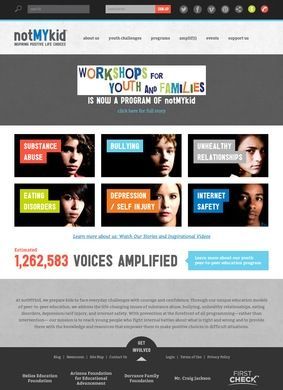
NotMyKid.org belongs to a Scottsdale nonprofit that has spent more than two decades on a single, uncomfortable premise: the parents most sure their child would never touch drugs, starve themselves, or think about suicide are often the ones caught most off guard. The organization behind NotMyKid.org, notMYkid Inc., took its name from exactly that reflex. It builds behavioral health and prevention education for teenagers and the adults around them, and the whole property is pitched at people who suspect they are in over their head.
The subject matter is heavy, and NotMyKid.org does not pretend otherwise.
What the programs cover
The range of issues named across NotMyKid.org is wide for a single organization. Substance abuse among adolescents sits at the center, which fits the group's origin, but the material also reaches into eating disorders, suicide prevention, ADHD, depression, and the general category of teen mental health.
That breadth could read as unfocused. It reads more like an honest reflection of how these problems cluster in real families, where a kid struggling with one thing is rarely struggling with only that thing.
Tailored programs for parents in the thick of it
Much of what NotMyKid.org publishes is built around what it calls tailored programs, and the framing throughout is practical. The pages aimed at parents lean toward tools and guidance for handling a teenager whose behavior has already started to worry them, so the audience is less the abstract concerned adult and more the parent who is already past the point of wondering. There is a difference between a site that lectures about warning signs and one that assumes you have seen them, and NotMyKid.org mostly assumes you have seen them.
I could not confirm the full catalogue of program names or downloadable curricula, because the site's deeper pages resisted automated retrieval and returned only partial text. So the granular list stays open. What is visible is a consistent orientation toward the family unit instead of the teenager in isolation, which is the sensible way to run prevention work with minors.
Early-action prevention and its reported numbers
Beyond crisis response, NotMyKid.org puts real weight on early-action prevention, the part of the work that tries to reach kids before a crisis rather than during one. The organization's GuideStar profile reports that 83 percent of youth participants showed increased protective factors after taking part. That is a specific, checkable-sounding figure, and it is the sort of outcome measure a lot of prevention nonprofits gesture at without ever quantifying.
Worth keeping the usual caution in mind: a protective-factors score is a proxy, self-reported program impact is not the same as an independent trial, and one statistic cannot carry an entire mission. Still, the fact that a number exists at all, tied to a public filing, counts for something.
Whether it holds up on credibility
For a resource asking parents to trust it with adolescent mental health, the picture around NotMyKid.org is mixed but mostly reassuring. Charity Navigator lists Not My Kid Inc. under the same EIN with a three-out-of-four-star rating, which places it in decent standing on the metrics that rater cares about, finances and accountability chief among them. GuideStar carries the program-impact profile mentioned above. Between the two, the organizational paper trail is stronger than what most small nonprofits leave behind, and it beats what a plain business directory listing would ever tell a parent.
Consumer or beneficiary reviews are another matter. There is no meaningful trail of them.
The gap in beneficiary feedback
Searches turned up no review counts on Google, Yelp, Trustpilot, Facebook, the BBB, or Tripadvisor. For a service that works with families in distress, that absence is understandable. People rarely file a public star rating after a suicide-prevention program, and privacy alone would discourage it.
The upshot is that a parent weighing this organization cannot lean on a crowd of past participants the way they might when picking a restaurant. On NotMyKid.org the Charity Navigator score has to do more of the reassurance work than it ordinarily would, and that is a fair thing for a reader to know going in.
What the staff reviews add
The one pool of public commentary comes from employees, not families, and it is uneven. Glassdoor shows six reviews, at least one of them sharply critical, with language about a toxic environment and workplace culture. Indeed is mixed, holding both a strongly positive account and a strongly negative one, with the friction pointed at management and leadership.
This is internal noise, and it does not speak directly to the quality of the programs a family would receive through NotMyKid.org. It is the kind of thing that surfaces at plenty of organizations of this size, and a reader should treat it as a note on the workplace rather than a verdict on the services.
Finding your way to a human
On the accessible portion of NotMyKid.org, contact information did not surface clearly. The landing content that could be retrieved did not put a phone number, address, or an obvious contact route front and center, though the retrieval itself was partial, and a full manual visit would very likely turn up a standard contact page that an established Scottsdale nonprofit would be expected to maintain.
That caveat matters more here than it would elsewhere. A parent who lands on the site is often in a hurry and frightened, and the distance between reading about a program and reaching a person who can help should be as short as possible. If the reachable path to a phone or an intake form is buried, that is a real friction point for the exact audience the site exists to serve. It does not undercut the organization's substance, but it is the one thing I would want smoothed before sending a worried parent there cold.
Weighed as a whole, NotMyKid.org is a credible, purpose-built resource with an unusually broad remit and a rare habit of publishing outcome numbers, held back mainly by the near-absence of public feedback from the families it serves and a contact path that did not present itself easily. A parent who wants the sheer reach of a national help line might start with SAMHSA's hotline instead, which answers around the clock and routes to local treatment anywhere in the country.
What NotMyKid.org offers that a federal hotline does not is a single Arizona organization built specifically around adolescents and the parents standing next to them, and for a family in that state's orbit, that focus is the reason to choose it.