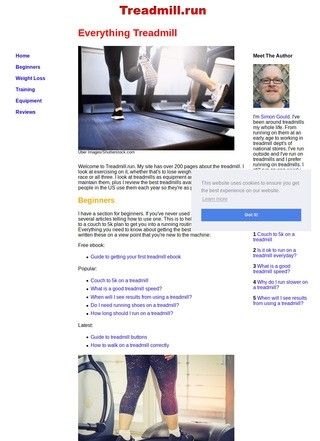
Where do you go when you want to buy a treadmill but have no idea which one fits a small spare room or a beginner budget? Treadmill.run builds its whole identity around that question, staying locked on one machine and the habits that go with it. The site is editorial, not a shop: it reviews equipment, breaks down models for different experience levels, and tries to walk you through the decision before you spend money anywhere else.
Buyer's guides with specific model picks
The buyer's guides are the core of it. Coverage runs across beginner machines, mid-range options, and professional-grade equipment, with named picks doing real work. The Horizon 7.0 AT, for instance, is held up as a standout. That specificity counts. Plenty of fitness sites stay safely vague about which model to actually get, and a guide that commits to a real recommendation gives a reader something to act on. The framing assumes you are choosing a machine for the first time, which fits the audience the rest of the content keeps returning to.
Weight loss guides and training programs
Around the equipment reviews sits a large library of weight loss material, more than thirty guides covering different methods and approaches. There are structured training programs too, plus introductory pieces aimed at people who have never used a treadmill and want to know how to start without hurting themselves or quitting in a week. Cardio technique, walking and jogging routines, and notes on setting up a home gym round out the editorial side. Read together, the pieces form a reasonably complete path from buying the machine to using it consistently.
Manufacturer directory and repair contacts
A couple of features go beyond the usual content fare. Treadmill.run keeps a manufacturer directory with repair phone numbers for various treadmill brands, which is exactly the sort of thing you scramble to find the day a belt starts slipping and the warranty paperwork has vanished. It is a small, genuinely useful piece of reference work, the most unexpected part of the site. The same section flags manufacturer discounts, which fits the affiliate-and-advertising model the whole operation seems to run on.
Free downloadable first-time buyer guide
There is also a free downloadable e-book, "Guide to Getting Your First Treadmill," offered to visitors. The title makes the target audience plain: someone at the very start, weighing a first purchase. Whether you want to hand over an email for it is a personal call, but it lines up with everything else the site is trying to do, which is to be the resource a first-time buyer leans on.
Affiliate model and no direct sales
No e-commerce was evident on Treadmill.run, no checkout, no products sold directly. That keeps the relationship simple. The site earns through affiliate links and ads, so the recommendations carry the usual incentive that any review site does, and a careful reader should keep that in mind when a particular model gets singled out. It is not a reason to dismiss the advice, only to read it with eyes open.
Contact options and social media presence
On contact, the picture is partial. There is no phone number, no email, and no physical address shown on the homepage or in the metadata. Reaching the people behind it means using a contact form or the social channels, and Treadmill.run does maintain a spread of those: Facebook, Instagram, Twitter, LinkedIn, and Telegram. For an editorial site with no storefront, a form plus active social presence is a defensible setup, though a visible address or phone would add a layer of trust that a content business asking for newsletter signups could use.
No third-party ratings or reviews
A search turns up plenty of competing treadmill review outfits, the big names in the niche, but nothing in the way of Google, Trustpilot, BBB, or Yelp listings for Treadmill.run itself. No star rating, no review count, no third-party signal at all. That is not damning for a site of this kind, since editorial resources often operate without ever collecting customer reviews. But it does mean the content has to stand on its own, with no crowd verdict to borrow from.
Focus as the site's main strength
So what do you actually get from a single-topic site like this one? Focus is its strongest feature. By refusing to be a general fitness portal and staying locked on treadmills, Treadmill.run can go deeper on model comparisons, repair logistics, and beginner programming than a broader site usually bothers to. Looking at it as a business directory entry, the thirty-plus weight loss guides and the structured programs reflect a real volume of work behind it, not a page assembled to catch ad clicks. The repair numbers in particular read like something put together by people who actually field that question.
The caveats are plain. The affiliate model means the buying advice is not disinterested, the absence of any verifiable outside reputation leaves you trusting Treadmill.run on faith alone, and the limited contact disclosure is a minor mark against a site that wants your email. None of these sink it. They set the terms on which you should use it: as a starting point for research, cross-checked against your own measurements of your space, your budget, and what an independent owner says about the model you land on. The Horizon 7.0 AT recommendation and the brand repair numbers are the two things a visitor is most likely to actually use and remember.
Business address
Treadmill.run
3501 Jack Northrop Ave, #Suite ARB436,
Hawthorne,
CA
90250
United States