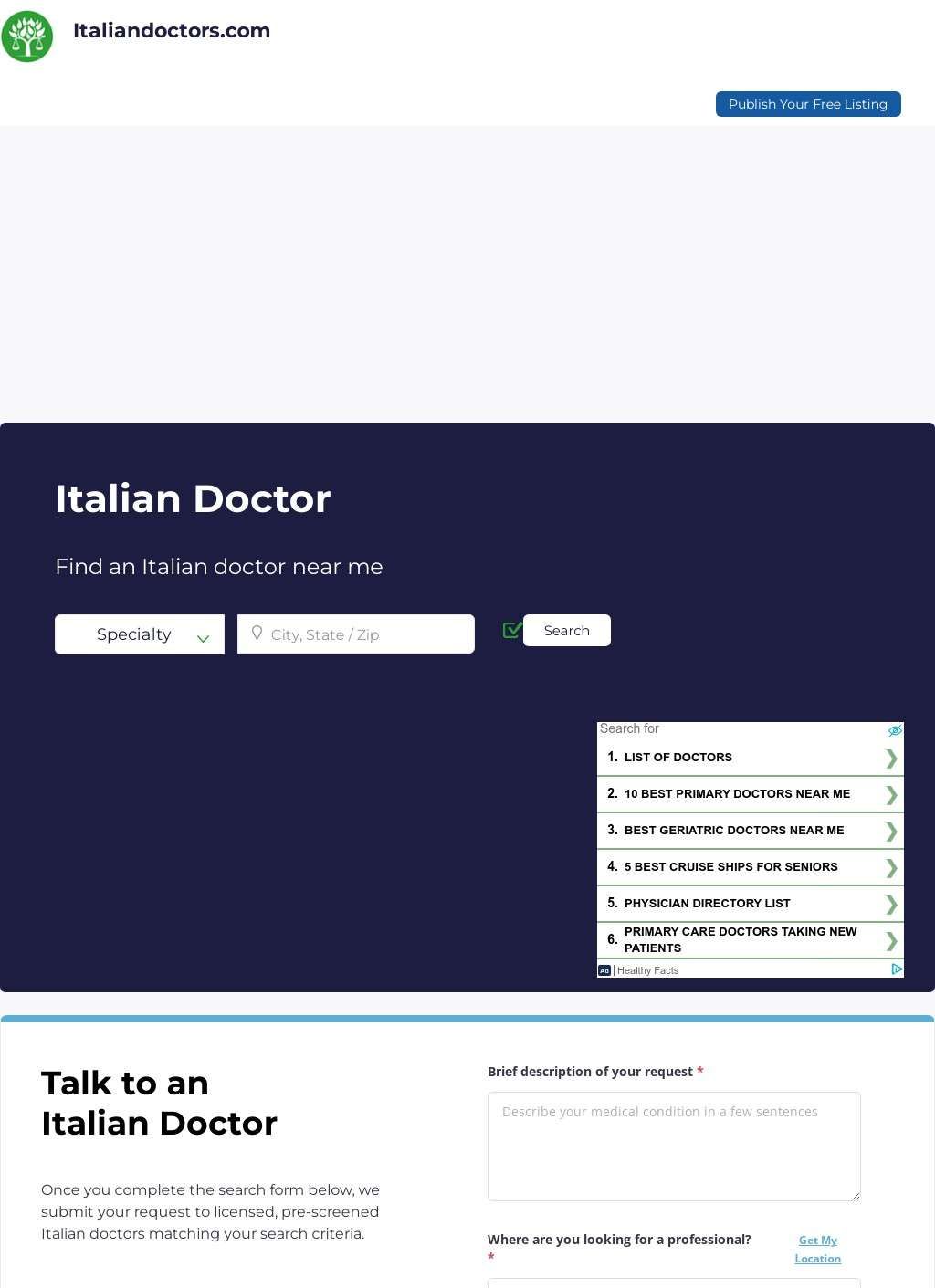
What does an outside reader actually know about Italian Doctors before handing it a relative's medical request? Almost nothing that the site did not write about itself. A search for reviews tied to italiandoctors.com returns no Google profile, no Trustpilot page, no Yelp entry, no BBB record. The results that do surface belong to other operations: doctorsinitaly.com, bookimed.com, idoctors.it, clinicsoncall.com. There is also a Facebook page for italiandoctors.co.uk, a separate UK company with a handful of reviews and no aggregate score, which says nothing about the US-facing platform under review here. So the public ledger on Italian Doctors is empty, and for a service that proposes to route patients toward people who will handle their health, that emptiness is not a footnote.
Screening claims lack independent verification
The screening claim is where the weight of this should sit. Italian Doctors describes its listed practitioners as licensed and pre-screened, which is a stronger promise than a directory that just scrapes whatever is publicly listed. Stronger, but unaccompanied. The screening method is nowhere explained in what an outside visitor can see, and there is no external audience confirming that any patient ever got matched, treated, or satisfied. For most products a quiet review page is a minor demerit. For a health-referral service it removes the one thing a cautious person would lean on, the experience of strangers who went first, and leaves the visitor with a set of self-described commitments and no way to check whether they hold in practice.
None of this is a claim that Italian Doctors is dishonest. It is a claim about evidence. Every load-bearing statement here originates with the operator: the screening, the response time, the coverage. A reader who needs to be confident before involving family members in a referral cannot get there from the page alone.
The premise is genuinely specific, and worth stating fairly. Italian Doctors pairs an online directory with a patient-matching service aimed at Italian speakers in the United States, Canada, and Italy who want a clinician they can talk to in their own language. General physician finders such as Zocdoc, Healthgrades, or the NPI registry will surface a cardiologist near you who takes your insurance; none of them filters for whether that cardiologist can take an elderly parent's history in Italian. That is the lane Italian Doctors occupies, and it occupies it alone.
Directory design shows patient-centered thinking
The category structure is the most credible part. The list runs past forty specialties, and the dental section is split into seven separate roles instead of one catch-all: general dentist, endodontist, oral surgeon, orthodontist, pediatric dentist, periodontist, prosthodontist. A patient needing an endodontist does not have to read through general-dentistry entries to reach one. Beyond teeth, the platform spans dermatology, cardiology, ear, nose and throat, ophthalmology and optometry, fertility specialists, internists, acupuncturists, and home healthcare. That is genuine breadth for a niche directory, and the clearest evidence that Italian Doctors was designed by someone who understood how patients search.
Matching process and coverage remain unproven
The transaction itself is straightforward. A user submits a form describing the need, the location, and the specialty; Italian Doctors states it forwards the request to licensed, pre-screened practitioners and quotes a two-business-day response window. A profile dashboard persists after submission, so a single lookup is not the whole relationship. For someone arranging care from a distance, that managed hand-off beats cold-calling names off a list. Still, every benefit in that paragraph is a stated benefit. The forty-plus specialties across three countries could be deep in one city and a single name in another, and a visitor cannot tell which until a live search is run for a specific place and specialty. Spread that wide tends to be uneven, and there is nothing on the page to show otherwise.
Company contact information is difficult to find
Contact with Italian Doctors as a company takes some inference. No phone number, no physical address, and no direct email appear when the site loads. A Contact link sits in the footer, though its destination is not visible from outside. The intended channel is plainly the on-site request form, consistent with the way Italian Doctors is built, where every engagement flows through the matching system. That is internally coherent, but it also means a user is asked to enter health-related details before any human point of contact has been established. Someone who wants to ask a question, gauge a response, or simply confirm a person is on the other end has no way to do that first.
Put the pieces together and the honest read is that Italian Doctors does not give an outsider enough to act on with confidence. The concept is sound and the taxonomy is built with care, but the screening claim is unverified, the company hides its own contact details, and there is no independent record of a single completed match.
Verify practitioner credentials through state boards
A directory of real businesses includes weak entries, and on the evidence available this one asks for a great deal of trust while offering very little to earn it. If a patient or a family member does proceed, the only safe path is to treat every responding practitioner as unvetted by this platform and to confirm that person's license and standing directly through the relevant state medical or dental board before any care is arranged. The board record is public, it is current, and unlike anything Italian Doctors publishes about itself, it does not require taking the platform's word.