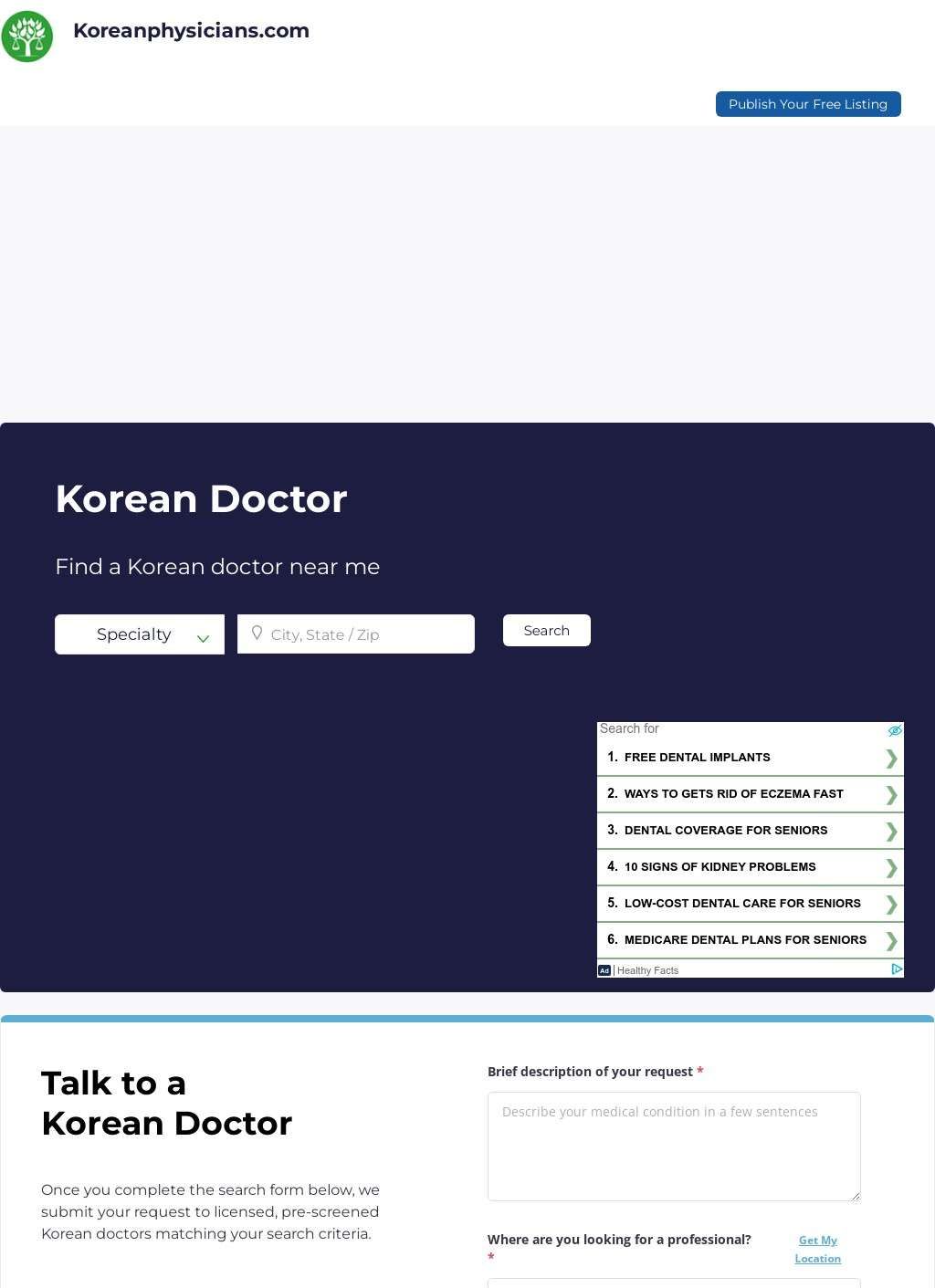
No phone number is visible on the homepage of koreanphysicians.com, and the only contact path routes through the same request form patients use to find a physician. That is a meaningful constraint before anything else is considered, given that this platform positions itself between people and medical care. Whether it disqualifies Korean Doctors depends on what the rest of the evidence shows.
Matching patients with Korean-speaking physicians
The core function is matching Korean-speaking patients with Korean-speaking licensed physicians in the United States, Canada, and Korea. A patient picks a specialty, enters a location by city, state, or zip code, submits the form, and receives matched providers within two business days.
That turnaround is a stated commitment, not instant, but it sets a defined expectation: an answer is coming and patients know roughly when. The filtering happens before any provider name appears, which is exactly what a standard search engine will not do: it will surface licensed doctors in any zip code but will not reliably identify which of them can conduct a full patient history in Korean or recognize the care preferences many Korean patients bring to a consultation. Korean Doctors handles that qualification step upstream, which is the design choice that justifies the service existing at all.
Specialty coverage and geographic reach
The specialty list runs to more than forty fields. Cardiology, dermatology, ophthalmology, ENT, surgery, fertility care, and dentistry are all present alongside acupuncture and home healthcare. Acupuncture and home health are not incidental additions; they reflect the care patterns many Korean families use, and including them extends Korean Doctors past the standard Western clinical categories most directories default to. The geographic coverage spans major U.S. cities and extends internationally to Korea itself, which is useful for patients coordinating care across borders or for families in Korea seeking a referral to a U.S.-based specialist.
Provider payments and profile maintenance
The platform is two-sided. Patients request matches at no cost; physicians create free listings and then pay for leads and referral tracking through a provider dashboard. A Pricing section lays out the cost structure for practitioners, and a Help section is also present. That commercial arrangement gives providers an active reason to keep their profiles current, a structural advantage over directories where a listing is set up once and then left to go stale. It also means Korean Doctors has an ongoing relationship with listed physicians rather than a one-time data collection.
License verification claims
The credibility claim Korean Doctors leans on most directly is annual license verification against state licensing agencies. One-time signup verification, the common default for directory-style services, leaves a profile intact even after a license lapses. Annual re-checking, if it runs as described, closes that gap in a way patients cannot easily replicate independently. The problem is that this claim rests entirely on the platform's own word.
Limited external review evidence
Outside the site, independent review coverage is nearly absent. A single botw.org entry references the listing; it is marked unverified and carries no rating for the site itself. No other third-party platform turned up anything substantive. A niche service with a narrow, specialized audience will not accumulate the same review volume as a broad consumer platform, and a service that launched and grew quietly may never have attracted the kind of review attention that high-volume transactional businesses do. Neither of those observations exonerates Korean Doctors, but they explain why the low count is not, by itself, a red flag. What it does mean is that the annual verification claim is doing most of the trust-building work with nothing external to reinforce it. Prospective patients should weigh that accordingly.
All-digital contact model
The all-digital contact model, no phone number and no physical address listed anywhere on the site, compounds this. It suits patients comfortable with asynchronous communication; it creates real friction for those who want to ask a direct question before submitting personal health information to an unfamiliar platform.
Who this service serves best
Korean-speaking adults searching for a physician for an elderly parent, or recent immigrants navigating an unfamiliar healthcare system, are the people Korean Doctors is most directly built for, and the language-first filtering logic addresses a gap that general search tools leave open. The honest limitation is that annual license verification is a process claim Korean Doctors makes about itself, and with no outside corroboration, a patient has no independent way to confirm it is running as described. That said, the two-business-day turnaround is a falsifiable promise. Submit a single request for a specific specialty, note the quality and timing of the match that comes back, and that result will tell you more about how the service performs than any third-party listing currently can.