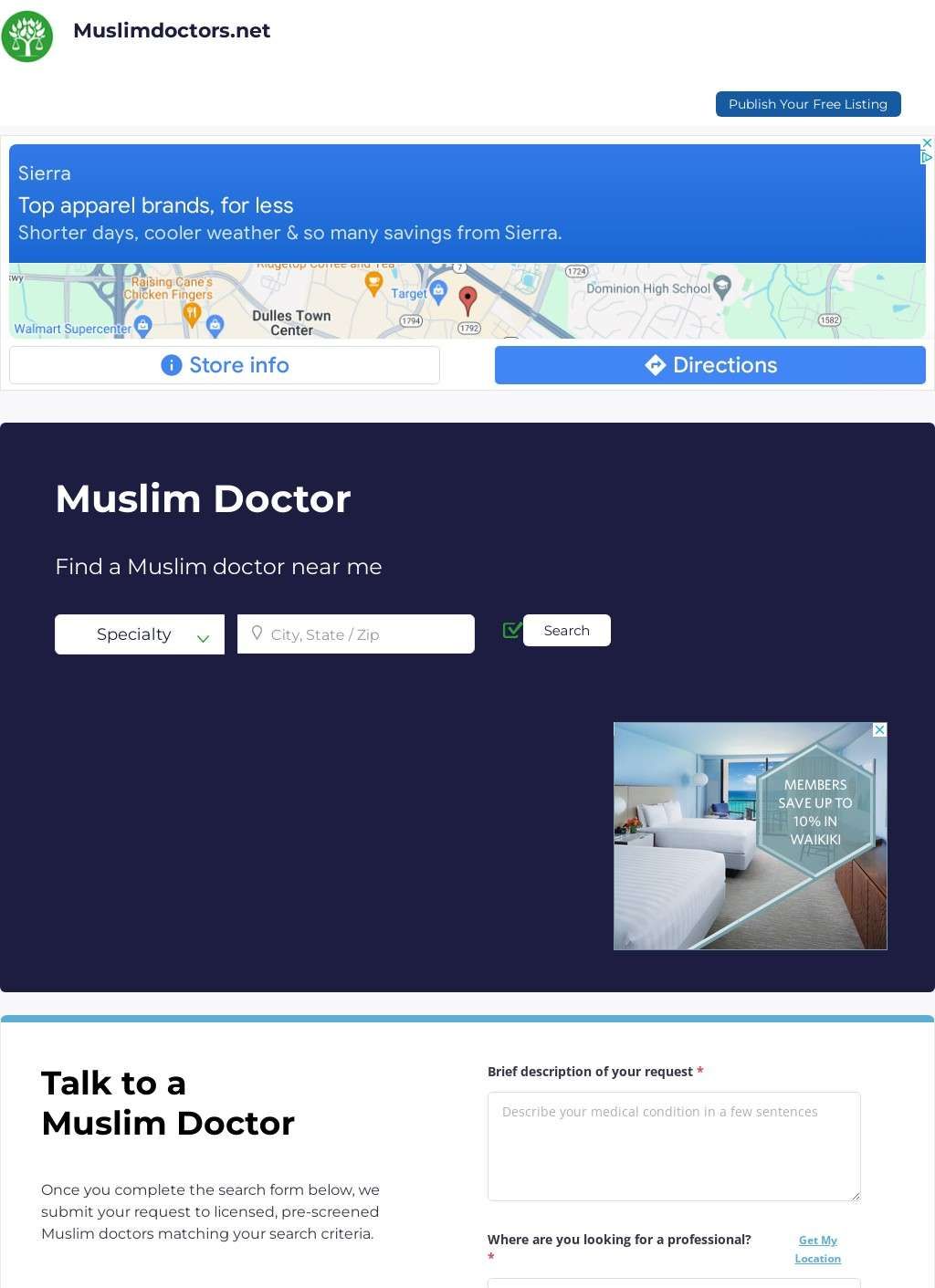
Muslim Doctors does one thing most provider directories will not do at all: filter by Muslim identity. Whether that is enough depends entirely on whether enough providers in your city have bothered to register, and in a meaningful number of markets the answer appears to be no.
Specialty categories and geographic scope
The specialty breadth is the strongest argument in the site's favor. More than forty categories are listed, running from cardiology and OB-GYN through acupuncture and chiropractic, all searchable by city, state, or zip code across the United States and Canada. That range is wider than you would expect from a community-specific directory, which often top out at a handful of primary-care options and call it done. The cross-border U.S.-Canada coverage is also unusual; most niche medical directories pick a jurisdiction and stop.
Verification process for provider listings
Listings go live only after email and phone verification, which is the structural credibility mechanism the whole site is resting on. General provider directories frequently skip this step, and the result is dead numbers and missing practitioners. Here, verification is the operating premise, because a directory whose listed numbers do not connect defeats its own purpose. The platform underlying the site is HeritagWeb, visible through the support URL at help.heritageweb.com. That affiliation is the clearest evidence the infrastructure is being maintained rather than parked and forgotten.
Patient matching and provider tools
Beyond the directory function, the site offers a request-and-match form that routes patients to relevant providers without requiring them to browse category by category, plus direct in-site messaging and a provider dashboard for managing listings and handling referrals. Provider listings are free to create. Social presence runs across Facebook, X, LinkedIn, and Instagram, which at minimum indicates the operation is active in some form.
Contact options
Phone and street address for the organization itself are not displayed at the site level, which is standard for a directory platform. General inquiries route through the HeritagWeb help system. Questions will reach someone, though not through a direct channel specific to Muslim Doctors.
Coverage by region
Location coverage reflects U.S. Muslim physician demographics: New York, Chicago, Denver, Baltimore, and several Florida metros are among the better-represented areas, while smaller markets produce sparse results. That distribution is predictable given how the underlying population concentrates, but it means Muslim Doctors is a useful tool for some patients and nearly useless for others depending on geography alone.
External reviews and institutional transparency
Third-party assessments of the platform as a whole are absent. Searches across Google, Trustpilot, Yelp, and the BBB return nothing meaningful for Muslim Doctors as a directory product. Note that muslimdoctors.org is a UK-based NHS professional association with no connection to this site; any ratings attached to that organization do not transfer here. Niche community directories operating at modest scale often accumulate no external profile at all, so the absence is not inherently damning, but it does mean there is no independent record to consult when sizing up the site's reliability. The founding date, funding structure, and team are not disclosed anywhere on the site, leaving the institutional history a blank. The HeritagWeb platform affiliation is the only external anchor available, and it is an infrastructure note, not an institutional endorsement.
Pricing structure
No pricing information is disclosed for any premium or featured listing tiers that may exist. Free registration is mentioned for providers, but whether the site monetizes through upgraded placement or data access is not addressed publicly, which is a minor transparency gap in a service where patients are trusting the ranking of results.
Muslim Doctors fills a specific gap that general directories leave open, and the verification step and specialty depth are genuine advantages over a hand-compiled list with no quality controls. But the site has no public review record as a platform, no disclosed organizational history, opaque monetization, and geographic utility that varies dramatically by market.
When Muslim Doctors works well
A patient in a well-represented metro with a specialty need inside the listed forty-plus categories may find Muslim Doctors a useful starting point, keeping in mind that any candidate should be independently verified through a state medical board before booking. A patient outside those metros, or in a specialty the directory covers in name but not in registered providers, will find the search stops almost before it starts. At that point the general alternatives, which carry far more provider depth in most cities, are simply more complete. Muslim Doctors is not a bad product for what it is; it is a narrow one, and the gap between its geographic ambitions and its actual coverage in smaller markets is wide enough to disappoint most people who try it outside the major metros.