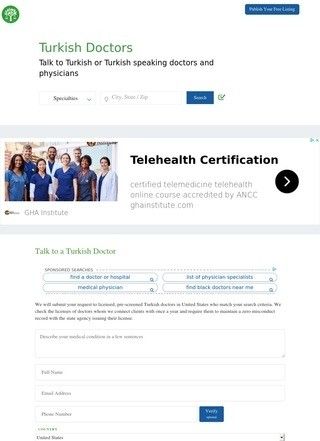
Turkish Doctors is a specialty-matching directory, operated by Heritage Web LLC, built around one premise: connecting Turkish-speaking patients with Turkish-speaking doctors across more than forty clinical fields. Dentists, cardiologists, dermatologists, surgeons, endodontists, orthodontists, chiropractors, allergists, acupuncturists. Geographic coverage reaches US cities, Canadian cities, and locations in Turkey, the latter included because Turkish Doctors serves two distinct populations simultaneously: North American patients seeking culturally compatible local care, and prospective medical tourists who need to vet providers before traveling. Those are genuinely different problems, and the site's browse structure acknowledges both without collapsing them into one.
How the matching process works
There is no way to browse a full list of practitioners. A visitor enters a specialty and a location, and Turkish Doctors routes the request to pre-screened doctors who qualify on both clinical and linguistic grounds. The word "pre-screened" appears in the interface, not buried in fine print, which at least commits the platform publicly to a standard. Whether that standard holds in practice is another question entirely, and nothing on the site lets an outsider answer it. Turkish Doctors is asking patients to trust a process it describes but cannot demonstrate.
Trust without external verification
No ratings on Google. No review count on Trustpilot, Yelp, or the BBB. A search for third-party opinion on Turkish Doctors surfaces only the site's own pages. For a platform whose entire value proposition rests on trust between a patient and a matched practitioner, arriving at the service with no accumulated public record from prior users is a meaningful problem, not a minor footnote. The patient deciding whether to submit a medical matching request is working entirely from what Turkish Doctors says about itself. In a field where institutional trust is slow to build and quickly lost, that starting position demands more than feature-building can supply.
This is not the same as saying Turkish Doctors is fraudulent or poorly run. It is saying that the confidence a new user can reasonably extend here is structurally limited, and no amount of content on the site compensates for an absent external record when the transaction involves personal health information and provider selection. A specialist directory that cannot point to any aggregated user feedback after however long it has been operating has a credibility ceiling that the site itself cannot raise.
Ask a Doctor and practitioner articles
The "Ask a Doctor" section is the most distinctive element Turkish Doctors offers. Users post medical questions anonymously, and verified Turkish medical professionals respond, free and without prior commitment. It lowers the threshold for concerns people are reluctant to attach their name to, and it gives a first-time visitor a real, observable data point before sending a formal matching request. The articles section runs alongside it: bylined pieces written by listed practitioners, which means a prospective patient can read specialist writing and gauge a doctor's approach before deciding to make contact. A practitioner who puts their name to clinical content is demonstrating accountability in a way a credential list alone cannot. Both features are genuinely unusual for a niche directory of this kind, and they are among the better arguments for taking Turkish Doctors seriously as a platform.
Free listings and vetting responsibility
A monthly newsletter and a free listing option for qualifying doctors round out the set. Free listings shift the quality-control mechanism: when a directory charges nothing to appear, vetting becomes the only lever controlling who surfaces. Turkish Doctors leans entirely on its pre-screening claim to carry that function. Whether that vetting is rigorous enough is something the site cannot prove to an outsider, only demonstrate over time through the practitioners it produces.
Operator transparency and contact access
Contact visibility is partial. Heritage Web LLC is named on the contact page linked from the footer, so the operator is not hidden. There is no public phone number in any location a visitor naturally looks first. Everything routes through the matching form or the contact-page form. That design follows from what Turkish Doctors is: an introducer, not a clinic, so the practitioner you get matched with is the relevant contact, not the platform itself. The logic holds as far as it goes. A phone number would still add confidence, and its absence does not help.
Turkish Doctors addresses a genuine access gap: the patient who needs a specific clinical specialty and Turkish language or cultural familiarity in a single provider. General-purpose directories handle that combination badly. The specialty breadth across forty-plus fields and the Ask a Doctor channel are features, not promises. The problem is that the platform's usefulness depends entirely on whether the practitioners it surfaces are well-screened, and there is no external evidence bearing on that question. A patient extending trust here is doing so without a floor.
Comparing Turkish Doctors to general directories
Zocdoc reaches Turkish-speaking doctors through standard filters, but buries the linguistic match under general-purpose search logic; Turkish Doctors starts from the cultural need, which for a patient who already knows exactly what they are looking for is a practical advantage. That advantage means nothing, however, if the pool of matched practitioners has not been audited by a party outside the platform.
The one claim that cannot be resolved from anything Turkish Doctors publishes: whether any meaningful volume of patients has used the service and found the match quality acceptable, or whether the community that would generate that record simply has not formed yet.