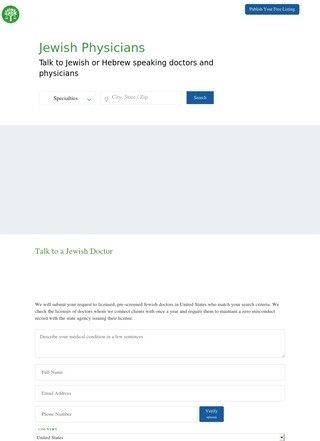
Picture someone just handed a referral to a cardiologist, wanting a doctor who shares their background and understands the religious practices that can shape care around a treatment. That is the specific need Jewish Doctors sets out to meet. The site runs as a matching service: a patient enters what they need and where they are, and the platform promises to connect them with licensed, pre-screened Jewish physicians drawn from its network.
Matching a patient to a doctor
The whole thing turns on one interaction, and the site keeps it front and centre instead of burying it under content. Everything else on Jewish Doctors, the specialty pages, the city pages, the free listings, feeds that single request.
The people it aims to serve are patients who care about being treated by someone of shared faith, whether for the ease of a common frame of reference or for practical questions about observance and care.
The talk to a Jewish doctor form
The headline feature is a request form labelled Talk to a Jewish Doctor. A patient submits their search criteria, and the platform says it matches them against licensed, pre-screened practitioners. It is a lead form at heart. What a patient cannot see is what pre-screened means in practice, who checks the licences, or how any match gets chosen, and that opacity sits right at the centre of the service. The convenience is genuine; the verification behind it is taken on trust.
For a patient short on time, one form beats calling clinic after clinic to ask whether a physician fits, and that shortcut is the real product Jewish Doctors is selling.
Specialties and the location pages
Coverage is where Jewish Doctors looks most substantial. The site lists more than 40 specialties, and the spread is unusually wide for a niche directory: dentistry, dermatology, cardiology, surgery, pediatrics and OB-GYN sit alongside a deep bench of dental fields like endodontics, orthodontics, periodontics, prosthodontics and pediatric dentistry, plus acupuncture, ENT and ophthalmology. Geography reaches across major U.S. cities such as New York, Los Angeles, Chicago, Boston and Miami, then extends to Canada and Israel, each with its own location page.
A patient in New York lands on a page built for New York, which is a sensible way to narrow a search down to something local.
Whether every one of those pages is filled with real, vetted names is a separate question, and Jewish Doctors does not answer it anywhere a visitor can see.
Who runs the platform
The footer tells a quieter story than the homepage does. Jewish Doctors carries About, Pricing and Affiliate sections, and its help center lives at a Heritage Web address, which places the site inside a broader listing network run by that company. Doctors can publish free listings, with paid tiers implied by the pricing page and an affiliate track sitting beside it.
That structure points to a lead-generation model, a platform that gathers and monetises listings, not a medical group with physicians of its own. The standard security, cookie and sitemap pages round out a site built to the template of a listing network more than that of a clinic.
None of that is disqualifying. Plenty of useful services run on referrals and paid placement. It does change how a patient should read the promise, though. The incentive here is to grow the roster and route enquiries, and whether a listing is free or paid says nothing at all about the doctor behind it. A directory that earns from volume has every reason to be generous about who gets in.
What stands behind the promise
Outside validation barely exists. A search turns up no notable third-party reviews of Jewish Doctors. The one directory listing that exists, on Best of the Web, invites visitors to rate and review but shows the business as unverified, with no rating and no review count behind it. Other results that mention Jewish physicians point to unrelated hospitals and directories, so they lend this site nothing. For a health-adjacent service, where a wrong match carries real stakes, that absence of any track record is a genuine weakness, and Jewish Doctors offers nothing on the page to make up for it.
Contact follows the same low-key pattern. There is no phone number or address shown up front. Reaching a person means using a contact form tucked into the footer, alongside a message feature and a newsletter signup. A form is a legitimate contact route, and plenty of businesses run on one. Still, for a service that asks patients to hand over their health needs and their location, keeping the people behind it this far out of view is a fair thing to weigh against it.
So the offer is easy to describe and hard to verify. Jewish Doctors gives a patient a clean way to ask for a Jewish practitioner in a chosen specialty and city, backed by a claim that everyone in the network is licensed and pre-screened. The catch is that no outside review, rating or verification exists to test that claim, and the platform that makes it earns money by growing the very list it vouches for. Trusting the match still means trusting a name neither Jewish Doctors nor anyone else has put through independent scrutiny.