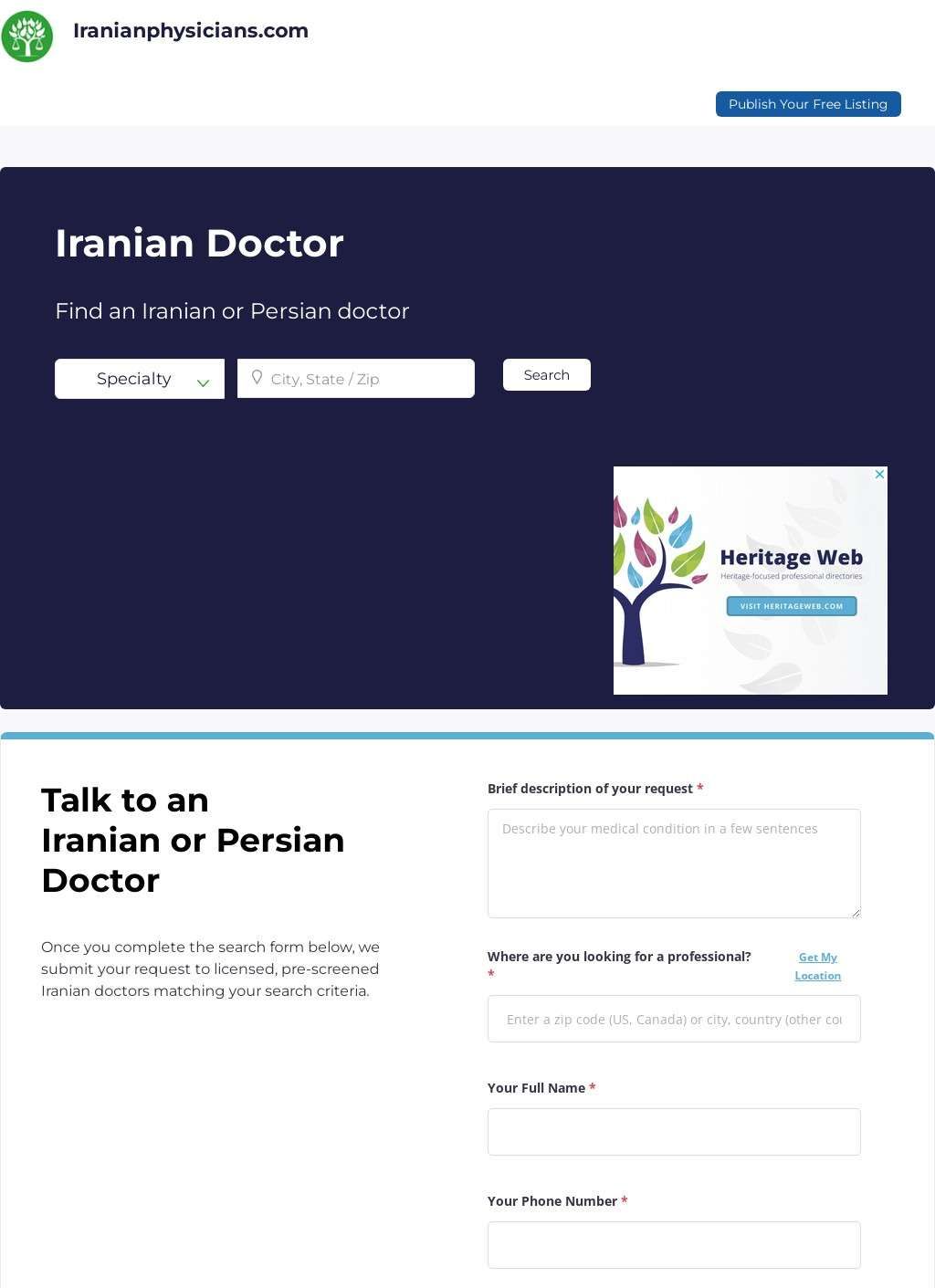
Every provider on Iranian Doctors shares one thing beyond their medical license: Persian heritage, and the whole site is built around helping patients find a doctor who speaks their language and understands their background. That is the premise. A user picks a specialty and a location, or fills out a short request, and Iranian Doctors connects them with a screened physician of Iranian or Persian descent somewhere in the United States. It is a narrow idea, but it is executed with more structure than the concept alone implies.
Specialty coverage across medicine and dentistry
The specialty coverage is the most surprising part. This is not three or four fields dressed up to look comprehensive. The directory reaches across dental work (dentists, endodontists, oral surgeons, orthodontists, pediatric dentists, periodontists, prosthodontists), the eye specialties (ophthalmology, optometry), and a long run of internal medicine subspecialties: cardiology, endocrinology, gastroenterology, hematology, nephrology, oncology, pulmonology, rheumatology. Add dermatology, ENT, fertility, OB-GYN, neurology, radiology and interventional radiology, several surgical branches (hand, orthopedic, plastic), urology, physical therapy, primary care and family medicine, geriatrics, pediatrics, home healthcare, and even veterinary services, and the range starts to look like a genuine attempt at a full-service medical referral network for one community.
Search by practice area and location
Search runs by practice area combined with city, state, or zip, which is the right way to build something like this: a patient in Massachusetts does not want a cardiologist in California. The individual listings carry a handful of concrete data points rather than a wall of marketing. A profile shows the provider's name, city, specialty, and years licensed, plus a verified listing badge. One example on the site is Maryam Fattahy, an optometrist in Natick, Massachusetts, listed with 28 years of experience. That "years licensed" figure is a useful, easy-to-scan detail, since it lets a patient gauge seniority at a glance without digging through a separate bio.
Verification badges and license verification
The verified badge deserves a note of caution alongside the credit. Verification badges are only as meaningful as the process behind them, and Iranian Doctors does not spell out, in plain view, exactly what gets checked, so a patient choosing a doctor is left taking the badge partly on faith. It still means something, but anyone using Iranian Doctors should confirm a provider's license and standing through their state medical board before booking, the same as they would with any referral source.
Lead routing through request forms
The main way patients engage is a request form headed "Talk to an Iranian or Persian Doctor." A visitor writes a short description of what they need, adds their location, name, phone, and email, and submits. Iranian Doctors then forwards that request to matching pre-screened providers, and users are told to expect a reply within two business days. This is a lead-routing model, not an instant-booking one. It works well for someone who wants to describe a situation in their own words and be matched, and less well for someone who wants to see availability and book on the spot. Setting the two-business-day expectation up front is honest, and it beats a vague promise of a fast response.
Provider pricing model
Behind the directory sits a provider business. Iranian Doctors runs a pricing page with a free tier and paid tiers for doctors who want to publish or upgrade a listing, plus an account system where providers log in to manage their profile and handle paid leads. That is worth understanding as a reader, because it tells you Iranian Doctors earns revenue partly from the professionals it lists. It does not by itself undercut the value of the matching service, but it explains why a listed provider appears where they do, and it is the sort of thing a careful patient should factor in.
Data protection policies
The legal and data side is more developed than a niche directory usually bothers with. There are Terms, a Disclaimer, and a Security Policy that references HIPAA-standard data protections. Given that the form collects health-related descriptions along with contact details, treating that data seriously is not optional, and it is a point in favor of Iranian Doctors that the policy addresses it at all. Whether the practice matches the policy is not something a review can verify, but the presence of the framework is better than its absence.
Iranian Doctors is one property in a larger operation. Its own about page describes a "Heritage Web" network running more than 300 similar community-professional publications, each presumably built on the same directory-and-lead template pointed at a different community. That context is useful. It explains the polish and the breadth, and it also explains a weakness: the parts that feel generic are generic because they are shared across the network.
Contact options and customer support
The contact experience is where that shows. There is a "Contact Us" page, but the content on it reads as boilerplate about Heritage Web issues and FAQs rather than a direct line to this specific service. Iranian Doctors lists no phone number or physical address that a visitor can easily find. For a patient-facing health referral site, the absence of a plain, obvious way to reach a human, outside the lead form, is a real shortcoming. The form covers the core use case, so a visitor is not left stranded, but someone with a question that is not "match me with a doctor" has no clear route. That gap deserves a plain mention.
Finding independent reviews
Third-party reputation is hard to gauge. A search did not turn up Trustpilot, BBB, or Google review counts tied to Iranian Doctors specifically. What surfaces instead are separate, similarly named directories such as iraniandoctor.org, and individual doctors' pages on sites like RateMDs, none of which speak to this site's own track record. That is not evidence against Iranian Doctors; it is an absence of evidence either way, which for a specialized service in a still-developing niche is not shocking. A prospective user simply cannot lean on crowd feedback here, and should weight the verified-badge and license-check steps more heavily as a result.
Weighing it all, the offering is more substantial than the bare-bones contact page would lead someone to expect. The specialty depth has substance, the search is structured sensibly, the profiles carry checkable details like years licensed, and the data policy is more serious than the category norm. The gaps are worth naming too: light on independent reviews, vague on what verification means, and short on direct contact.
Iranian Doctors is worth trying for patients who want a doctor from their own community, especially in the internal medicine and dental specialties where the listings run deepest. The practical path is straightforward: search for the exact specialty and city needed, submit the "Talk to an Iranian or Persian Doctor" form with a clear description, and once a provider replies, check their license and standing with the relevant state medical board.