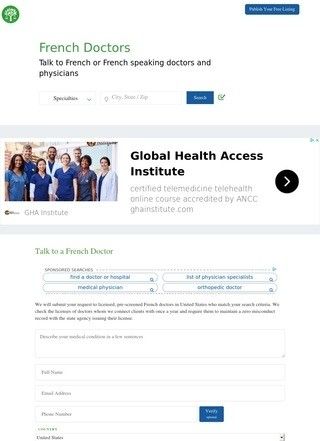
Someone who has just moved to Boston or Montreal and speaks little English, or a French expat who wants a doctor who understands both the language and the way medicine is discussed back home, tends to hit the same wall: how do you find a physician who actually speaks French without cold-calling a dozen offices? French Doctors is built around that exact moment. You tell it where you are and what kind of care you need, and it tries to hand you a name on the other side.
The mechanism is a request form. You enter your name, phone, email, location, and the practice area you are looking for, and that goes to the team, who say they review it and forward it to licensed, pre-screened French-speaking practitioners who fit the criteria. So French Doctors is a matching service. It does not run a clinic, and it does not let you click a doctor's calendar and book a slot yourself.
What the platform connects you to
The range of specialties is the part that surprised me, because it goes well past the general-practitioner list you might expect from a language-focused referral site. Dental is covered in real depth, with dentists, orthodontists, and endodontists broken out separately. Surgery is there too: general surgeons, orthopedic, plastic, and hand surgery all get their own footing.
On the medical side, French Doctors reaches into internal medicine with cardiologists, gastroenterologists, and neurologists, and it covers primary care through family physicians, pediatricians, and geriatricians. Then come the more specialized fields, dermatology, ophthalmology, OB-GYN, and radiology among them. That is a wide net for a service whose whole premise is a shared language.
Whether every one of those categories is populated with actual matched providers in your particular city is something the form answers, not the homepage. French Doctors presents the specialty list as coverage; the request is what tests it.
How the geography narrows things down
Beyond specialty, French Doctors lets you browse by place. It spans multiple US cities and extends into Canada and France, so a user can filter down by location and then by the type of doctor they need. For the audience this is aimed at, French speakers spread across three countries, that cross-border reach is the sensible design choice. A French family relocating to Quebec and a retiree splitting the year between Florida and Lyon are looking for the same thing, and both fit inside the same structure.
What the geographic browsing does not give you is a public roster. You are narrowing search criteria, not scrolling through profiles with photos, bios, and open appointment times. The provider stays behind the match until the team connects you.
The referral model and what it asks of you
It helps to be clear-eyed about what French Doctors is. It is a lead-generation and referral layer that sits between a patient and a provider. Practitioners are described as licensed and pre-screened, but the site does not show you the screening, so you are trusting the platform's word on that step. For a lot of people that trade is fine, and honestly the alternative of vetting French-speaking specialists yourself in an unfamiliar city is the harder road.
The request-based flow also means the experience is not instant. You submit, someone reviews, and a match comes back. If you need care today, this is not the same as an urgent-care line. It is closer to a warm introduction, and it should be judged as one.
Finding your way to a real person
There is a contact page, plus a separate help and support link that routes to a hosted help center. So French Doctors is not a dead end if the form does not fit your question.
The gap worth naming is that the homepage does not put a phone number or a street address in front of you. The main way in is the same submission form, which asks for your details before you get much back. That is a normal pattern for a referral platform, and a form does cover most needs, but a visible phone line would reassure the visitor who wants to ask one quick question before handing over their information. It is a fair thing to weigh.
On outside opinion, there is not much to report. A search for reviews of French Doctors turned up nothing that points at this specific site. What surfaces instead is the noise of a crowded name: general France-based physician directories, a business directory listing with no reviews attached, and an unrelated language center that happens to share the words. None of it is about frenchdoctors.com, so anyone hoping to read past users' experiences before submitting will come up empty for now.
That absence cuts both ways. There is no pile of complaints to worry over, but there is also no independent track record to lean on, which puts more weight on the pre-screening claim French Doctors makes about itself.
Who this fits and who it does not
The clearest fit is a French speaker, new to a US city or moving between the US, Canada, and France, who wants a doctor conversations will be easy with and does not know where to start. For that person, French Doctors turns a scattered search into one form, and the breadth of specialties means it is not limited to routine visits.
It fits less well for someone who wants to see exactly who they are getting up front, or who needs to book directly and quickly. The model asks for a little patience and a little trust up front. French Doctors is a doorway to a provider, not the provider itself, and reading it that way sets the right expectations.
The specialty list runs from dentistry through surgery to radiology, the geography covers three countries, and the entire thing turns on a single form and a promise that the names on the other end have been checked.