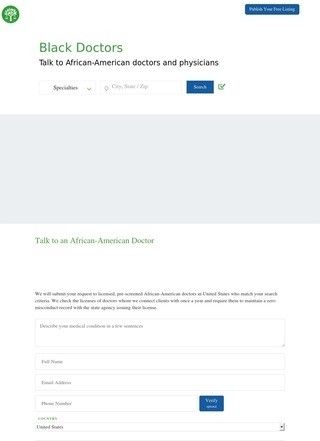
Someone who wants a Black cardiologist in their own city, or a dermatologist who has treated skin like theirs before, usually has no simple way to search for one. General provider directories sort by insurance network and zip code, and the thing that patient cares about most is exactly the filter those tools leave out. Black Doctors is built around that gap. It lets people look for African American healthcare professionals by specialty and by where they live, which is a narrow promise stated plainly and, on the face of it, a useful one.
The coverage is national. A handful of larger markets get pulled out for attention, among them Atlanta, Chicago, New York, Los Angeles, and Miami, but the Black Doctors search itself works anywhere in the country. It runs on two axes at once. You choose the kind of care you need, then narrow the results by city, state, or zip code, so a patient in a smaller town is not stuck scrolling a list built only for the big five cities.
The specialty range on Black Doctors is genuinely wide, more than forty medical fields in all. Dentistry, dermatology, cardiology, surgery, OB-GYN, pediatrics, and physical therapy all sit on the list, which means one household could line up a pediatrician for the kids, a dentist, and a specialist referral from a single starting point instead of chasing each one down separately across town.
Breadth like that is the whole argument for a directory over a lucky web search: the range is what makes it worth returning to for the next appointment as much as the first, which is the difference between a one-time lookup and a resource a family keeps bookmarked for years.
Inside the provider search
What a search returns is a set of profiles a patient can open and read through. Black Doctors is aimed squarely at people who want to be seen by an African American clinician, whether that preference grows out of a past experience, a question of trust, or simply wanting a doctor who shares part of their background. It does not try to be a universal find-a-doctor engine. It has one audience in mind and arranges everything around that audience, which is a cleaner proposition than a general site that treats the preference as an afterthought filter.
That focus is the entire pitch, so what sits behind a profile once you click is where the site has to deliver. Several of the features Black Doctors builds exist to help a patient turn a name on a screen into an actual appointment, and they are worth taking one at a time.
Featured spotlights and free listings
Some providers show up as featured profiles or spotlights, given more room and prominence than a flat alphabetical entry would get. The way Black Doctors surfaces these names can be a shortcut for a patient or a mild distraction, depending on whether the highlighted doctor happens to practice within reach. A spotlight is a promotional slot, and prominence here reflects the site's own placement, not a patient ranking or a quality score. Reading it that way keeps a featured name in proportion.
Physicians can publish their listings on Black Doctors at no charge. Free entry tends to widen a business directory quickly, which is good for raw coverage across those forty-plus fields, and it lowers the barrier for a solo practitioner who would never pay for a paid placement. It also shifts the work of judging fit onto the patient, who has the profile and their own follow-up to go on rather than a visible vetting score attached to each name.
A no-cost model builds volume; it does not, by itself, guarantee that every entry is current or that the doctor is still taking new patients.
The request form and pre-screening
Instead of leaving patients to cold-call one office after another, Black Doctors offers a request-submission form. You describe what you are looking for, and the site says it will connect you with, in its words, "licensed, pre-screened African American doctors." For a patient who finds the open search overwhelming, handing over the requirements and waiting for a match is a gentler way in.
That pre-screening claim is the one part a visitor cannot verify from the outside. The wording is reassuring and may well be accurate, but Black Doctors does not spell out what the screening covers, how a license gets checked, or how often the check is refreshed, so it reads as a promise the reader takes on trust. Set next to the free-listing model, where anyone in the profession can add themselves, the two ideas sit in slight tension. It is the sort of assurance worth confirming with any provider directly, through the state medical board, before booking a first appointment.
Messaging, accounts, and referral tracking
Once a patient settles on someone, Black Doctors supports direct messaging with providers, so an opening question can travel through the platform itself instead of a separate phone call. People who register also get user profiles and account management, which keeps saved searches and earlier contacts together in one place. For anyone juggling care for a whole family, having that history saved instead of retyped each visit is a small practical win. It is what turns a one-off search into an account a patient keeps coming back to.
There is a referral-tracking system layered on top of that, meant to follow a patient from the first request through to the provider they eventually see. For a service like Black Doctors, whose whole purpose is proving it connects people, tracking referrals is a sensible thing to build. The day-to-day benefit to an individual patient is quieter than the search and messaging tools that sit up front, but it is the mechanism that lets the site claim it does more than list names.
Heritage Web and the review trail
Black Doctors is operated by Heritage Web LLC, its parent company, and support is routed through a separate help center on the Heritage Web domain. Contact on the site itself runs through a contact page; the homepage does not print a phone number or an email address, and links to Facebook, Twitter, LinkedIn, and Instagram sit down in the footer. For a web-first directory that is a workable setup, though a plain phone-and-address block would settle a first-time visitor faster than a form and a help center on another domain.
Independent reviews are scarce. Searching for feedback on this specific site turns up almost nothing attached to it. What comes back instead belongs to other names entirely, and the overlap is easy to trip over: BlackDoctor.org, a health-content publisher with more than 2.6 million Facebook followers and its own handful of employee reviews on Indeed; blackdoctorsusa.com, a separate directory with a similar mission; the Castle Connolly "Top Black Doctors" list; and generic Yelp pages that just gather individual physicians under the same phrase.
None of that standing belongs to Black Doctors, and a first-time visitor could easily hand this directory credit that was earned somewhere else.