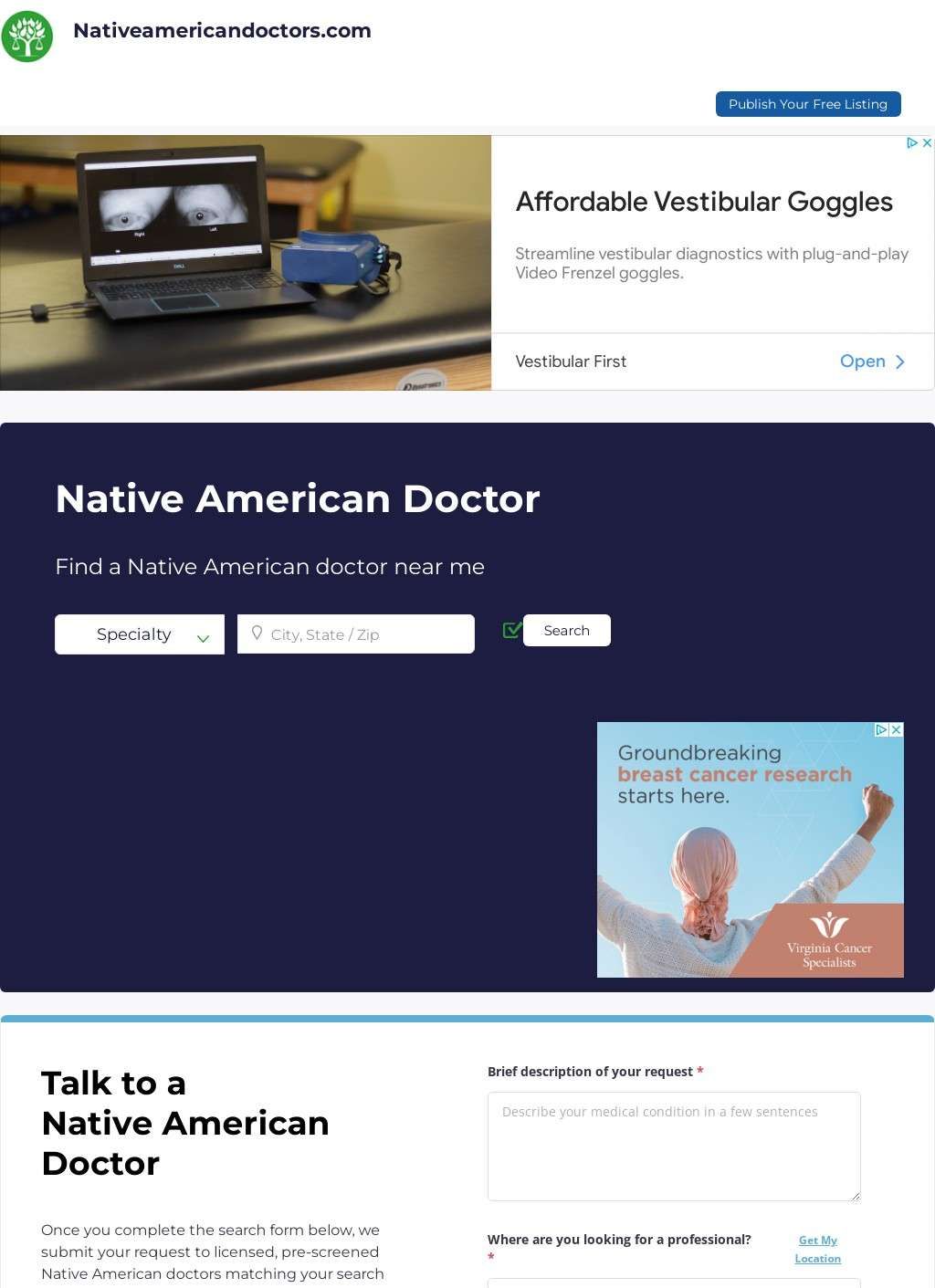
More than forty specialties listed, zero third-party ratings on any external platform: that combination is the starting point for evaluating Native American Doctors, a US-based physician-matching service built for patients who want specifically to find a Native American provider by specialty and location. The absence of an aggregated score anywhere, not Google, not Healthgrades, not a single aggregator, does not mean the platform is inoperative, but it does mean the case for or against Native American Doctors rests entirely on structure and internal claims.
Specialty categories and search structure
Forty-plus specialties is a number that requires unpacking. Dentistry alone breaks into seven distinct subtypes: dentist, orthodontist, oral surgeon, endodontist, periodontist, prosthodontist, and pediatric dentist. Medical specialties include cardiologists, dermatologists, neurologists, pediatricians, ear nose and throat doctors, and ophthalmologists. Surgery covers orthopedic, plastic, and urological. Allied health adds physical therapists and home healthcare. This is not a padded count; each category represents a real filterable search path on Native American Doctors. A patient who already knows what kind of care they need can use Native American Doctors the same way they would a mainstream platform, without landing on a three-entry generic list.
Forty-plus filterable specialties
Geography follows a two-layer structure. The primary scope covers the US and Canada, with city landing pages built out for Chicago, Dallas, Houston, Los Angeles, New York, Phoenix, San Francisco, and Seattle, among others. Country pages for the UK, France, and Australia are also present. Whether the provider density in those international markets justifies dedicated pages is not visible from outside, but the construction of city-level pages at all is an operational decision with some cost behind it, not a weekend placeholder.
Geographic coverage across regions
Native American Doctors states that provider licenses are verified annually against the issuing state agency. No independent audit of that process is available, and the claim cannot be confirmed from outside. Writing down a specific annual cadence and naming the check source puts Native American Doctors ahead of directories that say nothing on the subject, but a stated standard and a proven one are different things. A patient with chronic-care needs, where an unverified or lapsed license creates real risk, should not let a policy statement substitute for their own lookup via the relevant state licensing board.
License verification process
The patient flow on Native American Doctors is request-based, not browse-and-call. A patient enters a specialty, a city or zip code, and a contact number; Native American Doctors routes the request to pre-screened licensed providers matching those criteria. No provider profile page appears immediately; the platform mediates the connection. This suits patients who are comfortable submitting a request and waiting for a routed response. It is less suited to patients who want to read about a specific physician before making contact.
How patient requests are routed
On the provider side, Native American Doctors allows free listings, which likely explains the breadth of specialty coverage. The paid tier adds account dashboards, referral tracking, and a leads-management feature, plus a monthly newsletter. Referral tracking is the feature that most clearly separates Native American Doctors from a static listing page: a static list has no operational reason to build it. An active request flow is the only context in which tracking referrals makes sense. Whether lead volume in a specific city justifies the paid tier is something a physician would have to measure in their own market; the listing offers no numbers.
Provider accounts and paid features
Native American Doctors commits to a three-business-hour response window for form submissions. There is no public phone number and no mailing address. Form-only contact is common in small platforms, and the missing public email is a routine anti-spam measure. The absent phone line is more noticeable for a health-adjacent service, where some patients want a direct conversation before sharing personal information. The three-hour pledge is at least specific and measurable, which is more than some comparable services offer in writing.
Contact methods and response times
No outside review record means the platform's actual performance, how quickly providers respond, whether matched physicians are genuinely available in the patient's city, stays invisible. Native American Doctors has done structural work that goes beyond a placeholder: a granular specialty taxonomy, city-level pages, a stated license-verification process, and provider tools that exceed simple static storage. But structural effort and operational performance are separate questions, and without any posted patient outcomes, reviews, or response-rate data, only the structure is on the table.
What evidence of performance exists?
A patient willing to submit a request and follow up is not without options here. Native American Doctors offers more granular specialty filtering than the Indian Health Service provider finder, which defaults to facility-level search rather than specialty-by-specialty matching. That is the most direct comparison point, and whether the added specialty granularity justifies the request-routing model depends on how important it is to the patient to filter by subtype before making any contact at all.