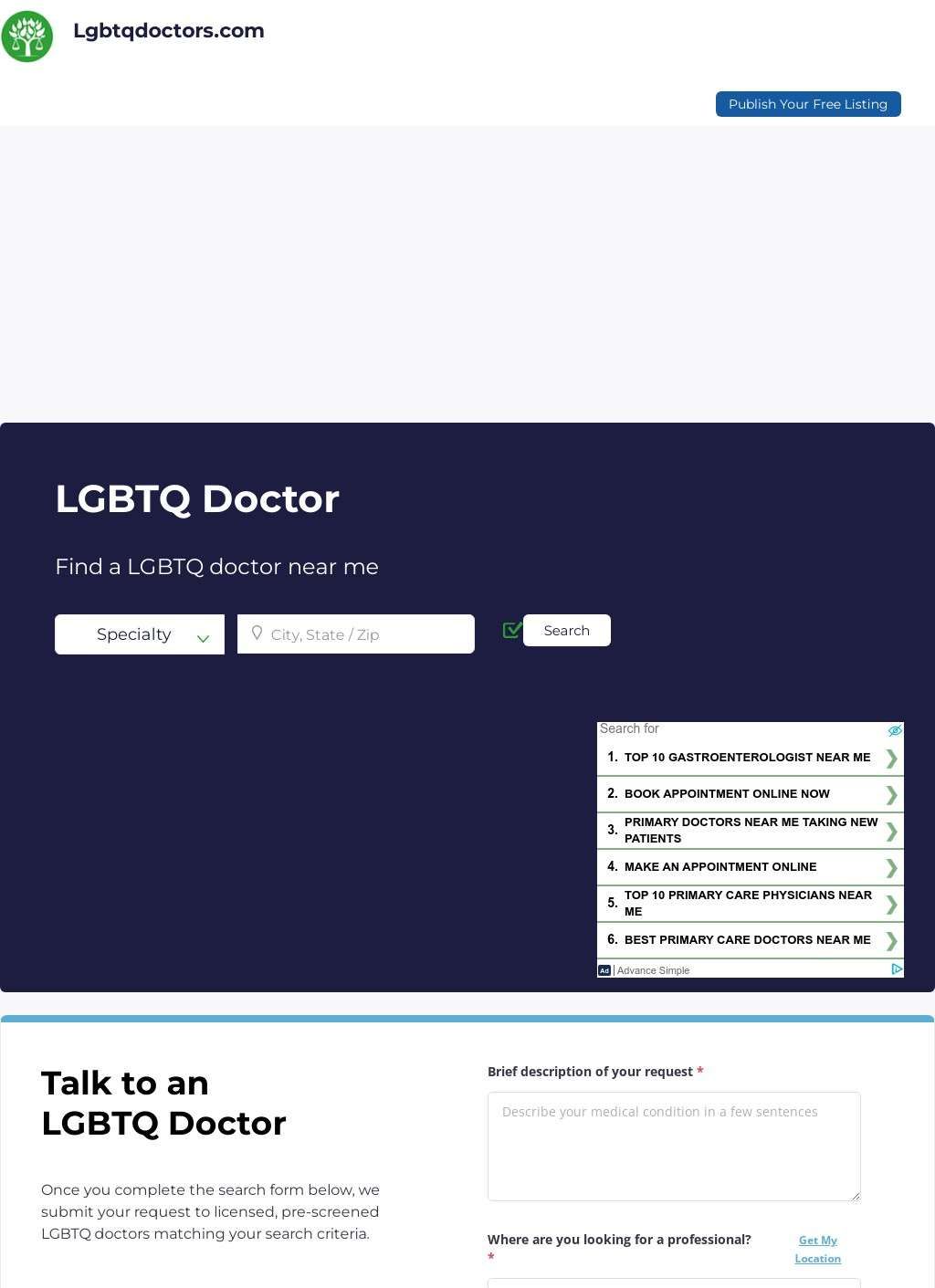
LGBTQ Doctors is a U.S.- and Canada-based directory that connects patients with physicians who either identify as LGBTQ or practice affirmingly. It works as a matchmaking layer: a patient fills in a request form, and LGBTQ Doctors replies within two business days. The specialty coverage is wide, taking in dentists, dermatologists, cardiologists, OB-GYNs, surgeons, and more, with location filtering across U.S. cities and Canada and a stated reach beyond those borders. Someone needing a dermatologist in one state and a cardiologist in another can run both searches through the same tool, and the breadth points toward ongoing care relationships rather than one-off visits.
How the directory matches patients with physicians
The vetting is the most specific thing the platform commits to in writing, so it deserves the most room. LGBTQ Doctors states that it reviews judiciary records in each physician's state of licensure for grievances or formal disciplinary actions, and that it re-verifies licenses annually. The annual cycle is the part that does the heavy lifting. A credential can be clean at sign-up and then lapse or get flagged months later, and a directory that checks once at onboarding would never catch that. Checking every year is the difference between a roster that reflects current standing and one that reflects standing on the day each physician joined.
Annual license verification and disciplinary records
That disciplinary-record sweep reaches past bedside manner into a provider's professional standing, which is the harder thing to assess from the outside. Pairing the affirming-care filter with a formal standards check covers both questions a patient in this position is likely to have: whether a physician will treat them well, and whether that physician is in good standing to begin with. No comparable public directory aimed at this patient segment appears to run the same yearly re-verification. Platforms like Zocdoc and Healthline list affirming-care providers too, but neither runs a background sweep before a physician goes live, and that is the line that sets LGBTQ Doctors apart on process. The combination of an affirming-care filter and an active license check is what LGBTQ Doctors is built around.
Paid endorsements versus independent checks
One disclosure cuts the other way. The legal terms state the platform may receive payment for reviews or endorsements of listed providers. Putting that in writing is the right minimum, and it changes how the on-site copy should be read: the judiciary and license checks are independent verifications, while a glowing endorsement of a particular provider may be paid placement. A patient can trust the first and should discount the second.
Free listings and HIPAA compliance
For physicians who want to appear in searches, there is a genuinely free entry tier with no credit card required, covering a basic listing with contact details and location. Paid tiers, billed monthly or annually, add visibility, and the annual option carries a 20 percent discount. The no-card free tier keeps the roster from skewing toward practices with marketing budgets, which helps coverage spread across specialties and geographies instead of concentrating in larger clinics. LGBTQ Doctors runs on Heritage Web's infrastructure, as the support-portal domain shows. A HIPAA compliance page, a privacy policy, and terms and conditions are all present on the site, and for a service handling sensitive health information a dedicated HIPAA page is not a throwaway detail.
Contact through a generic help portal
Contact is where the site works against itself. The contact link redirects to Heritage Web's FAQ and help portal. No phone number, email address, or street address appears anywhere on the LGBTQ Doctors site. For a platform that asks patients to submit health needs and personal circumstances through a form, routing every follow-up through a generic help portal puts distance between the user and any human reply. The portal will resolve common questions, but it sits oddly against the trust the LGBTQ Doctors screening process is trying to build.
Outside reputation data is the other limit. Searches across Google, Trustpilot, Yelp, and the BBB return the site's own pages and unrelated LGBTQ health resources, with no reviews of the directory itself in any of them. That is not a trail of complaints; there is simply nothing external to read either way. A prospective user has no accumulated third-party feedback to lean on, which leaves the process claims LGBTQ Doctors makes about itself doing all the work.
Those claims are unusually specific, though, and a patient can act on them without waiting for a community verdict to form: the annual re-verification and the judiciary-record sweep are stated plainly enough to take at face value or to ask the platform to confirm in a given case. What a patient cannot do is treat any single listed provider's on-site endorsement as neutral, given the paid-endorsement disclosure. For affirming-care filtering tied to a real credential check, LGBTQ Doctors is the most structured option in this narrow space; the price of using it is accepting an indirect contact route and verifying a chosen provider's licensure independently before booking.