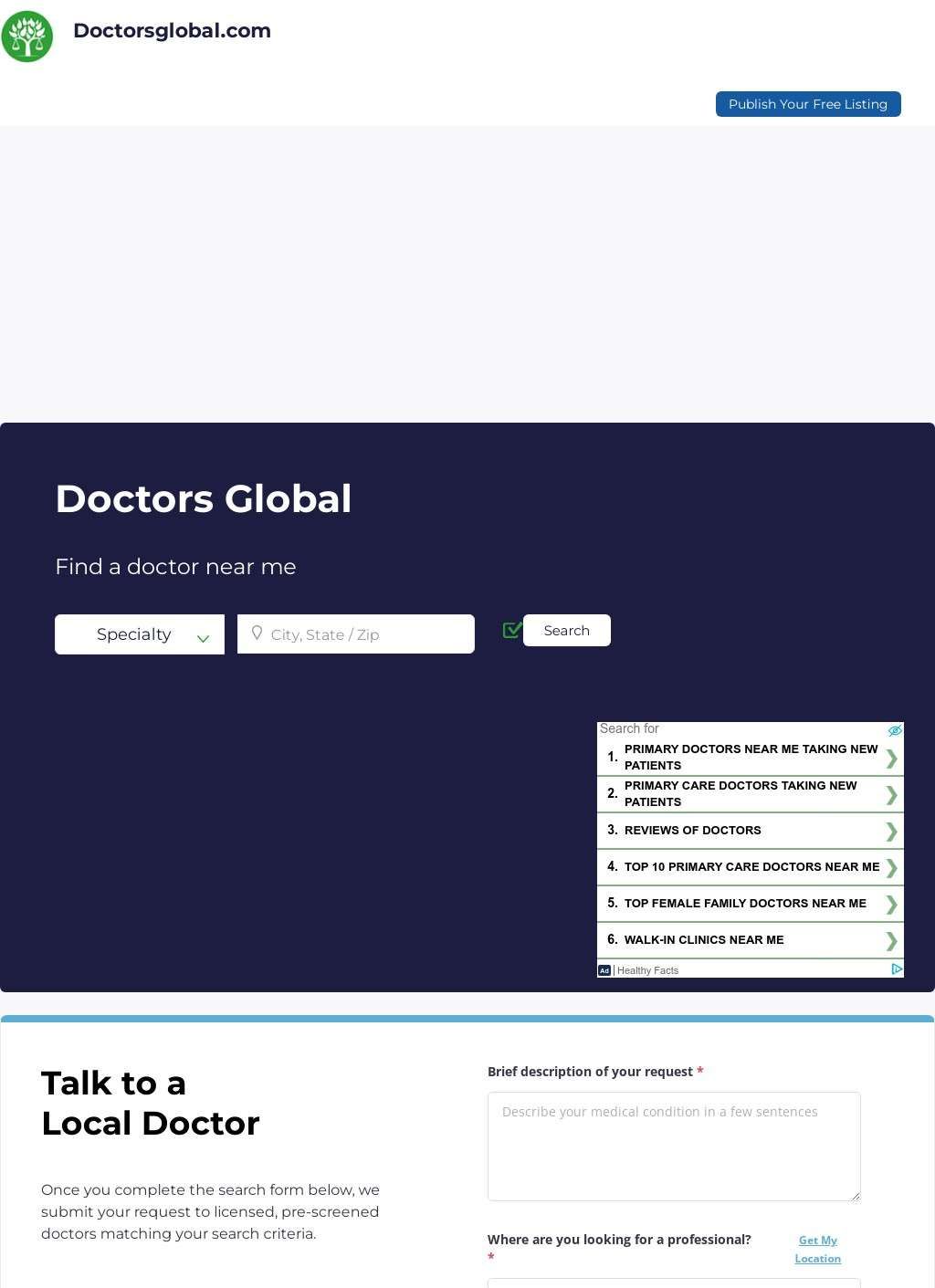
Patient matching is the part of Doctors Global that does the most work. A visitor fills in what they need, and the site routes that request toward a licensed, pre-screened physician instead of leaving the person to cold-call a list of names. Around it sits a more conventional search tool, where you pick a specialty and a location and get back profiles, but the request form is what separates this from a plain phone book of doctors. The two paths suit different visitors. A person who already knows they want a cardiologist in Chicago can go straight to the filtered search, while someone who only knows their symptoms and their city can hand the problem over and let the matching do the narrowing. Offering both is a sensible call, since not every patient arrives knowing the right specialty to type.
How patient matching routes requests to physicians
Doctors Global is run by Heritage Web LLC, a company that has been around since 2011, and the reach is genuinely international. Listings cover the United States, with named coverage in cities like New York, Los Angeles, and Chicago, and the map extends to Australia, Canada, and the United Kingdom. Browsing is organized by specialty, so a person looking for dentistry lands in one place and someone after cardiology or surgery in another. On Doctors Global, each physician gets an individual profile page carrying a messaging feature, meaning a prospective patient can open a conversation through the platform without going offline first.
International coverage and specialty organization
One detail in the vetting process is worth dwelling on, because it is the kind of claim most doctor-finder sites skip. Doctors Global says it runs judiciary checks in each doctor's state of licensure, looking for grievances or formal disciplinary actions, and that this happens before a listing is verified. If that screening is performed as described, it answers the question every patient quietly has when they find a name online: has this person been sanctioned by a medical board.
Judiciary checks for disciplinary actions
A search field is easy to build. Cross-referencing licensure records state by state is a real cost, and advertising the process at all shows the operators understand what gives a medical directory its credibility. The flip side, and it is worth stating, is that a patient cannot independently confirm the screening from the outside. The claim has to be taken largely on trust, since the work happens behind the scenes and the results appear as a verified badge rather than a visible audit trail. That does not make it false. It does mean the value of the check rests on Doctors Global doing exactly what it says, consistently, across every state and every listing it carries.
Verification claims require independent confirmation
For physicians, the proposition Doctors Global makes is simple and low-risk: listings are free to publish. That free entry point explains how a directory builds enough density to be useful, and it is the right model for a platform that wants broad coverage across specialties and countries. A featured physician spotlight gives the front of Doctors Global a rotating human face, and the messaging built into profiles closes the loop between a doctor who has listed and a patient who wants to reach them. Someone searches or submits a request, the platform points them at a vetted name, and the conversation starts inside the site.
Free listings and physician messaging features
Where Doctors Global gets murkier is contact transparency for the platform itself. There is a Contact page at the expected address, but it redirects to Heritage Web's FAQ and support hub instead of presenting the directory's own phone number or mailing address. The homepage and the About page carry none of those details either. A visitor who wants to reach the people behind the site has to follow the trail out to an external support portal at help.heritageweb.com. For a service that sits between patients and medical care, a clearer line back to the company would do a lot to reassure a first-time user. The support portal does exist and is linked, so help is reachable, but it takes a click off-site to find it.
Contact details redirect to external support portal
Outside reputation is harder to read here, and honesty requires saying so plainly. The clearest signal sits on a closely related domain, doctor.global, which carries a four-star Trustpilot rating built on five reviews. Five is a small sample, and the rating attaches to a sibling domain rather than doctorsglobal.com directly, so it should be weighed as a hint and not a verdict. On the major platforms where you would expect to find feedback for a directory of this kind, Google, Yelp, the Better Business Bureau, no reviews surfaced for the doctorsglobal.com address specifically. That is not damning.
Plenty of functional sites operate without an established review record, particularly ones where the real transaction happens between a patient and a physician offline. But it does mean a cautious user cannot lean on a wall of independent feedback, and that is fair to name.
Limited review record across major platforms
Put the screening claim and the limited review trail side by side and Doctors Global reads as a mixed but fair bet. The judiciary check is a strong idea and a real differentiator, the kind of thing a careful patient should value. The lack of corroborating reviews and the buried contact details pull the other way. Neither cancels the other out. What Doctors Global gives you is a competently built, internationally scoped medical directory with a smart approach to vetting and a couple of trust gaps it has not yet closed. The structure is sound, the feature set is coherent, and the free-listing model gives it room to grow its physician base.
Screening strengths and trust gaps
Geographic breadth deserves one more note, because it shapes who this is actually for. A user in a large American city has the best odds of finding a populated set of profiles, given the named coverage in New York, Los Angeles, and Chicago, while someone in Australia, Canada, or the UK is also catered for, if perhaps with lower local depth in smaller metros. The specialty browsing across dentistry, cardiology, surgery and the rest is the fastest way to test that, and it costs nothing to try.
Testing the directory in your location
Run a specialty-and-location search for a specific city first, then submit the patient request form on Doctors Global and see what kind of match comes back and how fast a real doctor responds through the profile messaging. If the screening works the way Doctors Global describes it, the time spent is well rewarded. A user who wants to confirm that for themselves can follow the contact link out to the Heritage Web support portal and ask directly how the state licensure checks are performed, since that detail is the one piece the published page leaves unproven.