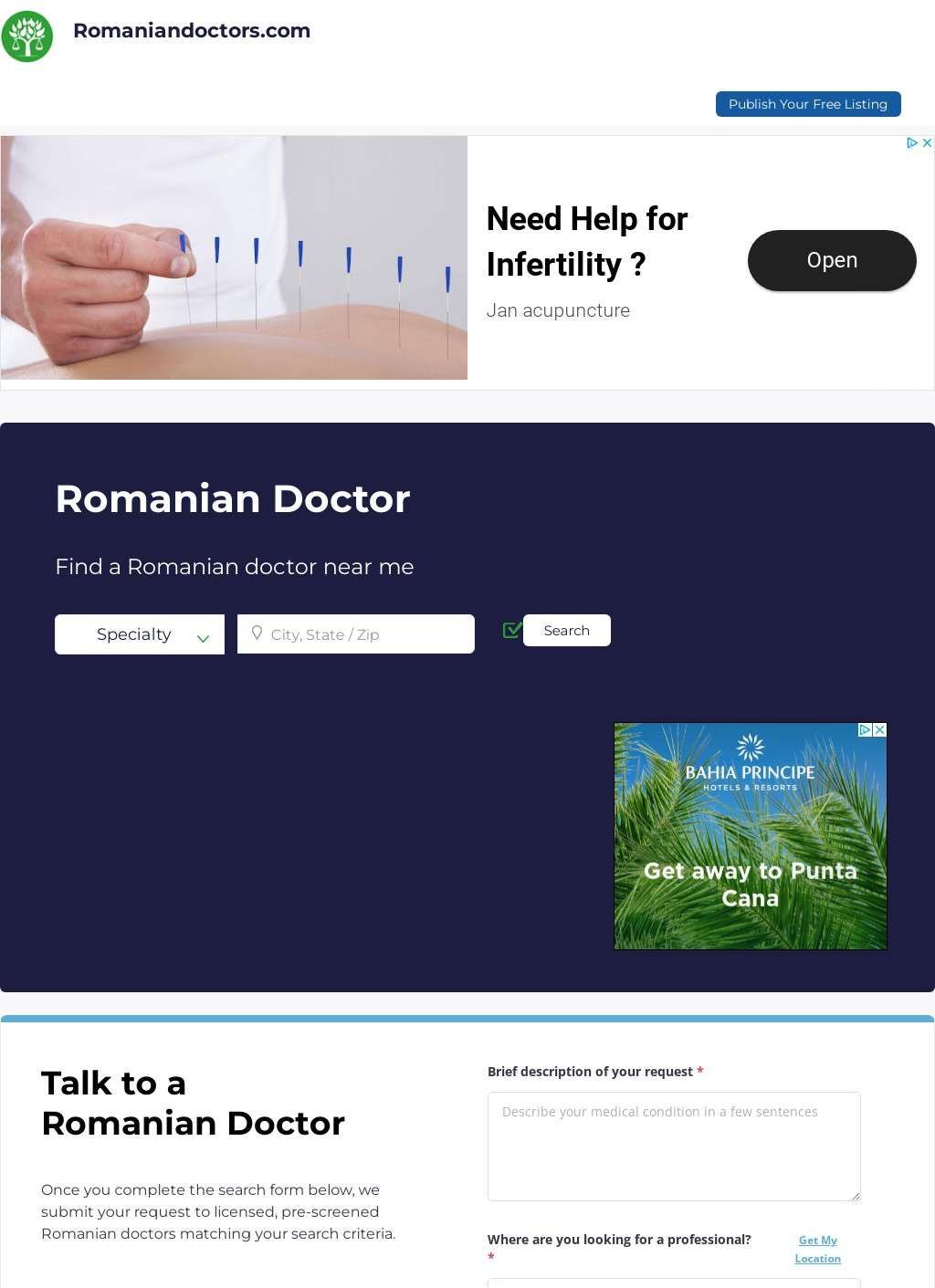
Most physician-search platforms treat language fluency as a checkbox, a filter layered on top of geography, specialty, and insurance, competing against dozens of other variables. Romanian Doctors builds in the opposite direction: language-matching is the founding principle. A Romanian-speaking patient submits a request, and the platform routes it to a pre-screened physician within a stated 24-hour window. No public list to scroll. No guessing whether a listed provider speaks the language well enough to discuss a neurological symptom or a cardiac history.
Language-first matching model
Romanian Doctors covers more than 40 specialties, including dentistry, cardiology, dermatology, neurology, and surgery. That breadth lets a patient managing a known diagnosis search by specialty directly, skipping the primary care referral step. Geographic reach includes New York, Dallas, Miami, Los Angeles, and Queens in the U.S., plus Canada and Romania. That map traces the emigration corridor the Romanian diaspora moves along, so coverage aligns with where the demand plausibly concentrates.
Coverage across specialties and regions
Physicians list at no cost, which lowers the barrier to entry on the supply side. A deeper physician pool over time is the expected result, though whether that has materialised is not visible from the outside. The 24-hour response window is specific enough to test immediately: anyone who submits a request will know within a day whether Romanian Doctors delivers on that commitment.
Physician entry and response commitment
Romanian Doctors publishes an explicit HIPAA statement alongside a Privacy Policy and Terms of Service, accessible in plain view, not buried in a footer. For a platform that handles personal health information, that is the appropriate baseline. An Affiliate program and a Pricing page are both reachable from the homepage, so the commercial structure is visible. The About page is accessible. Social presence covers Facebook, X, LinkedIn, and Instagram.
Data privacy disclosures and transparency
The contact situation is a practical liability. Romanian Doctors offers only a contact form, no phone number, no physical address. For a service where patients submit personal health data and rely on a routed match to get care, the absence of a direct human contact creates a one-sided arrangement: if a match fails or a request disappears, the patient has no escalation path. That asymmetry is not trivial in a health context, and patients should factor it in before submitting any personal information.
Contact limitations for patient support
No Trustpilot profile and no Google review cluster attached to the domain are findable. In a consumer health service, where a poor match can delay care or route a patient to the wrong specialist, zero accumulated patient feedback leaves every central claim, the 24-hour window, the physician vetting, the specialty depth, resting entirely on Romanian Doctors' own account of itself. Nothing in the public record contradicts those claims. Nothing in the public record confirms them.
Where is the patient feedback?
That said, the competitive landscape here offers almost nothing comparable. Zocdoc allows patients to filter by language preference but places all the work on the patient: find the doctor, verify the language fit, book the appointment independently. Romanian Doctors is doing something structurally different, routing on the patient's behalf, and there is no obvious competing platform doing that specifically for the Romanian diaspora. The niche exists, even if performance within it cannot be verified externally.
From niche positioning to practical choice
The compliance foundation is correct, the specialty breadth is wider than a narrow niche would require, and the geographic coverage maps onto where Romanian-speaking patients live. Against that, the contact opacity is a genuine problem for a health platform, and the complete absence of independent patient feedback means the matching quality, physician caliber, and reliability of the 24-hour response are unknowable from the outside. In cities with an active Romanian community network where diaspora members share verified physician referrals by word of mouth, those personal networks carry more evidential weight than Romanian Doctors' self-reported model. Romanian Doctors becomes the more practical option when that local network is absent, slow, or geographically scattered, and the structural compliance work at least sets the right foundation for handling health data responsibly.