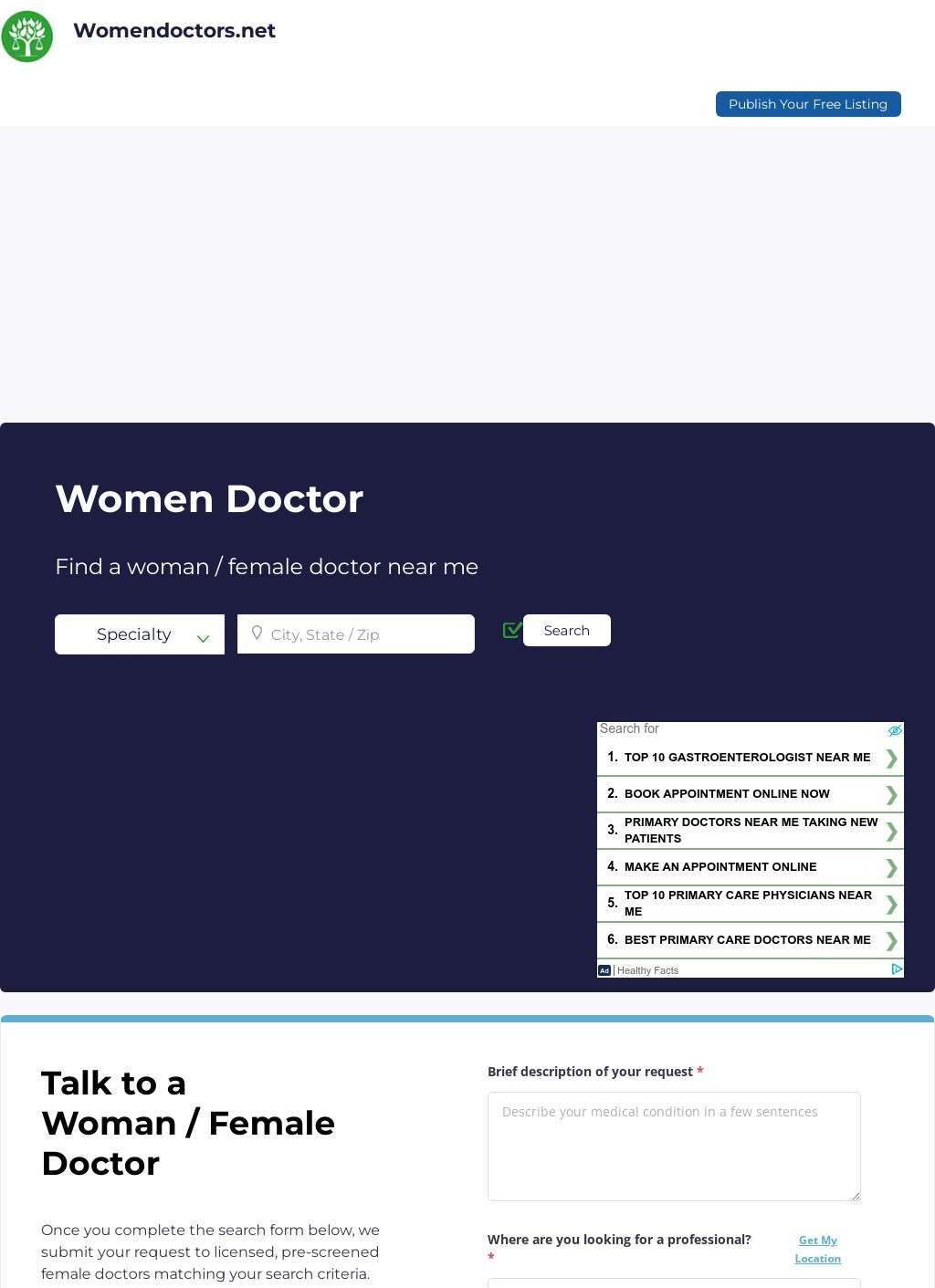
What Women Doctors is built around is a narrow filter, and the narrowness is the whole point. The site lets patients search for female physicians by specialty and U.S. city. Want a woman cardiologist in Denver, an OB-GYN in Houston, a female oral surgeon somewhere close to home? That gender filter answers a question many patients would otherwise have to raise awkwardly with a receptionist. Women Doctors does not try to be a general physician finder, and that restraint is what gives it purpose.
How the directory works
It is run by Heritage Web LLC, a company that operates several hundred other niche professional directories of the same shape. Knowing that changes how you read the place. The copyright line runs from 2011, so Women Doctors is not a weekend project, and the underlying machinery has clearly been built once and pointed at many verticals. The upside is a working, populated platform on day one. The flip side is that a women-doctors directory and, say, a plumbers directory may share the same skeleton, which leaves you wondering how much medical-specific care lives in the data versus the template. The branding of Women Doctors is specific; the engine beneath it is generic, and both facts are true at once.
License verification process
On the data side, the operator makes a claim worth pausing on. Women Doctors says it verifies medical licenses once a year against state licensing agencies, and listings are presented as verified practitioner profiles. Annual checks against actual state boards are the right reference point, and stating that process out loud is more than the industry average. Even so, a once-yearly sweep can lag a suspension, a move, or a name change by many months, and the page does not say when any given profile was last checked. A patient who finds a promising name on Women Doctors should confirm the license directly before booking. The bones of a trustworthy system are here; the freshness is the open part.
Account features for registered users
Beyond plain search, Women Doctors layers on an account system that does more than the usual save-a-favorite trick. Registered users can build and manage their own profile, send messages to practitioners, and submit match requests. The site appears to want to behave like a light referral network rather than a static phone book. A dashboard surfaces referrals, listings, and paid leads, and there is a monthly newsletter for people who want to stay subscribed.
Free listings and paid spotlight options
That dashboard language, referrals and paid leads in particular, tells you who the second audience is. Female doctors are invited to submit free listings on Women Doctors, and the spotlight feature elevates certain verified practitioners above the rest. The platform serves two sides at once: patients hunting for a specific kind of clinician, and women physicians trying to be found and to capture leads. Most directories carry this tension, and Women Doctors is fairly open about it, though the spotlighted names sit at the top because of how the product works, not necessarily because they are the best fit for any given search.
Data handling and HIPAA compliance
Women Doctors also describes itself as HIPAA-compliant in how it handles data. For anything touching health information that is the correct flag to raise, and it is reassuring to see it stated plainly. It remains an unverified self-description with no audit or certificate attached, but the intent is clearly in the right place. A site asking doctors and patients to exchange messages needs to take data handling seriously, and the HIPAA acknowledgment at least shows awareness of that.
Specialty coverage across U.S. cities
Coverage is the quiet strength here. The specialty list is wide, dentistry, cardiology, OB-GYN, surgery and well beyond, crossed against cities across the country. For a category as specific as "female practitioner in this field, near me," that depth is what makes a tool like this usable rather than frustrating, assuming the listings behind those filters are populated in your area. That is the part no description can settle; it has to be tested city by city.
Contact options and support channels
The contact setup is where Women Doctors feels most corporate. The homepage carries no phone number and no physical address. Reaching a human goes through a general inquiry form linked in the footer, with deeper help routed to a third-party portal at help.heritageweb.com. The footer carries social links for Facebook, X, LinkedIn, and Instagram, so the operator is reachable in some form. For a site that handles health-adjacent data and asks doctors to put their professional identity on it, a visible address or direct line would do a lot to settle nerves. The form-and-portal route is routine for a company running this many properties, but it feels impersonal for a service that trades on trust. None of this disqualifies Women Doctors, but it does keep it at arm's length.
Outside opinion is genuinely scarce. A search for independent commentary on Women Doctors turned up the directory's own internal pages and some unrelated academic work on gender bias in how patients rate physicians, which is a different topic entirely. No body of third-party reviews, no rating to point to. For a site asking patients to rely on its license-verification claim and its messaging setup, the absence of independent voices is a real gap. It does not mean the platform is bad; it means users are largely taking Women Doctors at its word, with little outside ballast to check against. A directory built on trusting verified profiles benefits enormously from being trusted in return, and right now that loop is incomplete.
Whether a once-a-year license sweep, run across hundreds of directories by a single operator, is fresh enough for medicine specifically is a fair question to carry into any search on Women Doctors. A lapsed or revoked credential is not a minor administrative detail. The site says the right things about verification and HIPAA, and the intent reads as genuine. The breadth of specialties and cities holds, the dual-sided structure for patients and practitioners is coherent, and the free listing option makes Women Doctors worth considering for women physicians wanting a focused audience. Patients who need a female specialist and are willing to run their own license confirmation afterward will find the search function does what it promises. The gap is the absence of outside voices to back any of that up.