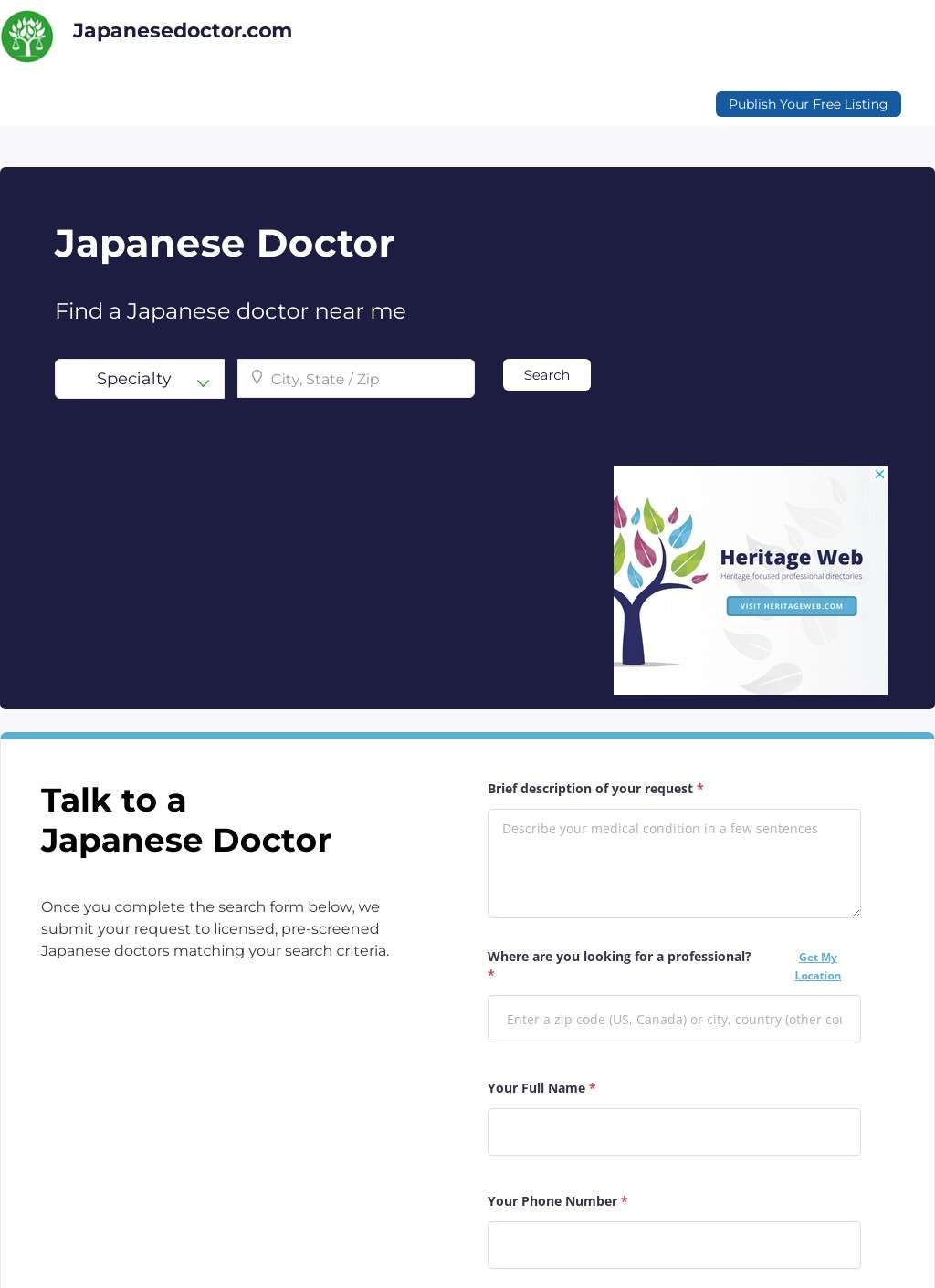
Submit a specialty and a location, and japanesedoctor.com promises a set of matching provider profiles back within two business days. That two-day turnaround is the spine of the whole operation. Japanese Doctors is a matching platform run by Heritage Web LLC, built to connect patients who want a Japanese or Japanese-speaking medical professional with providers who have been pre-screened and licensed. The premise is narrow and clear: language and cultural fluency in the exam room, paired with a credential check the site says it handles before a provider ever shows up in a result.
Browsing specialties across forty medical fields
The browsing options are wider than the request form suggests. A patient who would rather look around than wait for a callback can move through more than forty specialty fields on Japanese Doctors. Acupuncture sits alongside dentistry, dermatology, cardiology, neurology, ophthalmology, pediatrics, and surgery, with a long tail of others. The location side spans US cities, Canada, and Japan, which tells you who the platform expects to serve: Japanese expatriates, second-generation families, and anyone who communicates better about their health in Japanese, scattered across three countries. Pick a field or a city and you get provider profiles, and each profile carries direct messaging so a patient can reach a specific doctor through the platform without hunting for a separate phone number.
How does the matching process work?
There is a second audience here, and Japanese Doctors treats it openly. Doctors can publish free listings, and the platform surfaces featured providers alongside the standard ones. That dual structure, free entry for practitioners plus a promoted tier for visibility, is a familiar economic model for any directory that lives off supply and demand, and Japanese Doctors does not hide which side is which. The help material is not kept in-house: documentation lives externally at help.heritageweb.com, which lines up with the Heritage Web ownership stamped on the copyright running from 2011 through 2026. A platform that has carried the same operator for that span is at least not a weekend experiment.
Free listings and featured provider tiers
The landing page carries no phone number, no email address, and no street address for the company behind Japanese Doctors. There is a contact form linked in the navigation, and that form is the one channel to the operators. Communication with the doctors themselves runs through the in-profile messaging, which is sensible for a matching service since the point is to route a patient to a provider, not to a switchboard. The form covers the basic need to reach someone, so the contact picture is functional, if a little impersonal. A patient who wants to speak to a human before trusting the screening claim will have to start with a written message and wait.
Contact options and operator transparency
The reputation picture outside the site is quieter. A search for outside coverage of Japanese Doctors as a platform turns up nothing of substance: no aggregated ratings, no user reviews on Google, Trustpilot, Yelp, or anywhere else pointed at the site itself. Searching the broader phrase pulls up Yelp pages for individual Japanese-speaking doctors in cities like Los Angeles, Reddit threads about Japanese medical culture, and an unrelated site at a similar-sounding domain, none of which speak to this platform. So the screening and licensing claims rest on the operator's own word, with no outside voice to confirm or dent them. That is not damning on its own, but it is a real gap for a service whose entire value rests on trust in who it lets through the door.
Checking reputation outside the platform
Weigh those two halves against each other and Japanese Doctors reads as competent and under-proven at the same time. The specialty range is genuine, the geographic focus is coherent, and the within-two-days commitment is the kind of concrete promise that is easy to test the first time you use it. Against that, the anonymity of the operating company and the absence of any outside reputation trail mean a first-time user is taking the pre-screening on faith. For a Japanese-speaking family that has struggled to find a cardiologist or a pediatrician who understands them without a translator, the upside is obvious and the downside is mostly the cost of one form submission and a short wait.
Testing the tool for your specific need
Japanese Doctors makes the most sense for a specific person with a specific need: the right language, the right specialty, the right city, and limited patience for cold-calling clinics that may or may not have a Japanese speaker on staff. Browse by neurology in Toronto, or by dermatology in a Japanese city, and the structure does the narrowing for you. The model is sound and the catalogue is broad. What Japanese Doctors has not yet built is a public record of results, and that absence is what keeps the platform at arm's length for anyone approaching it without a personal recommendation. The tool exists; the published proof does not, and for a service built on credential claims, that gap is the thing a prospective patient will have to decide how much weight to give.