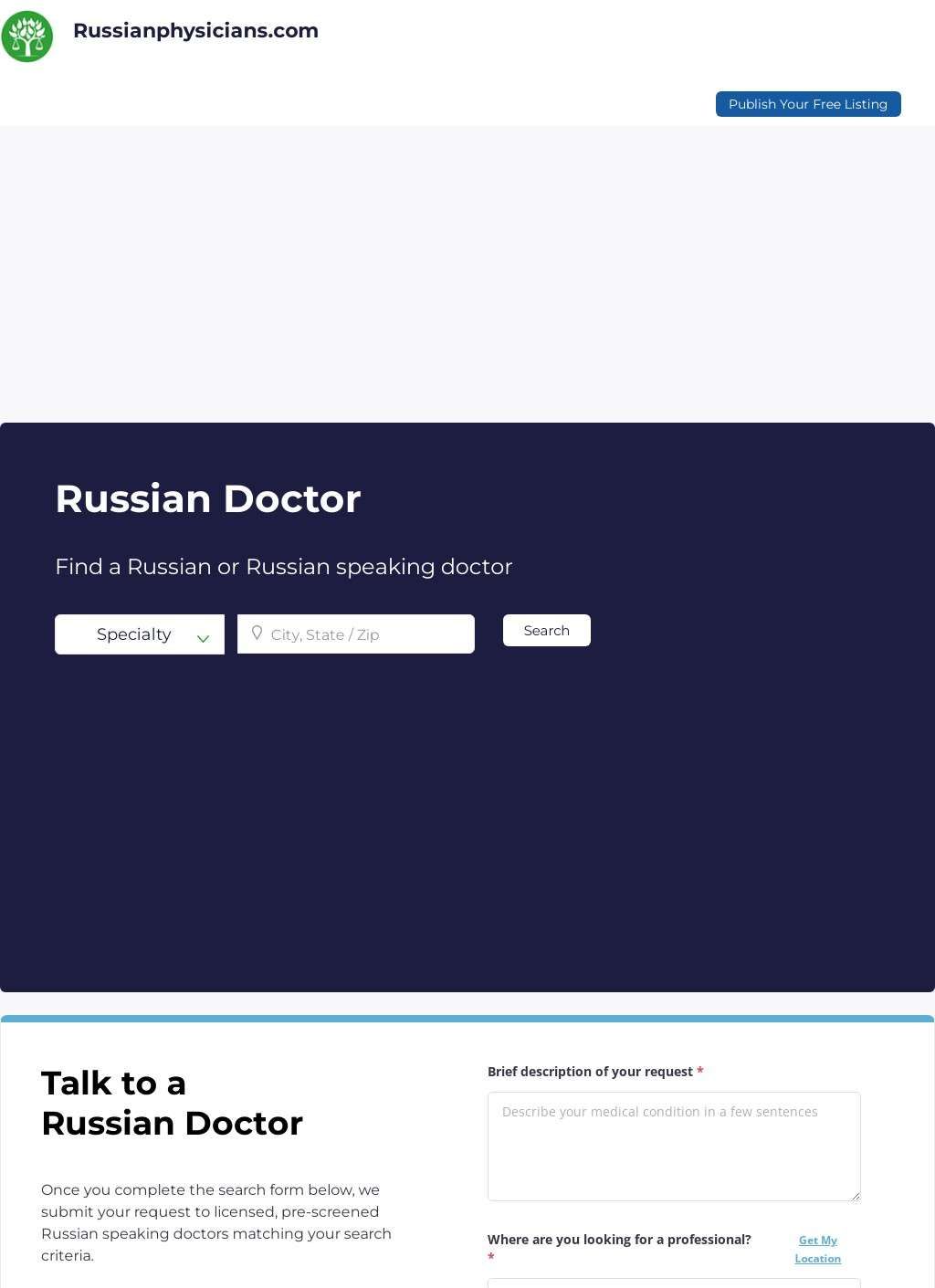
Finding a Russian-speaking doctor in a new city is a search that general health portals handle poorly. Russian Doctors is an online directory built for exactly that gap, connecting patients with Russian-speaking or Russian-trained healthcare professionals across the United States, Canada, and Russia. The premise is narrow on purpose: someone who wants a physician they can speak to in their own language, or who trusts a specific medical training tradition, can search by specialty and by city and find a practitioner who fits. The site addresses that need without wandering into anything else.
Specialty coverage across medical fields
Specialty coverage is the strongest thing here. Dentistry alone is broken out into general practice, endodontics, oral surgery, orthodontics, pediatric care, periodontics, and prosthodontics, which is more granular than general health directories usually bother with. Beyond teeth, Russian Doctors extends to dermatology, ENT, ophthalmology, cardiology, internal medicine, and surgery, among others. That spread means a user is not limited to a single field. Someone looking for a Russian-speaking cardiologist and a Russian-speaking orthodontist can use the same tool for both, which is the practical payoff of a directory that takes its taxonomy seriously.
Geography is the second axis the search runs on. The site organizes providers by location, with concentrated listings in the larger U.S. markets where Russian-speaking communities are densest: New York, Los Angeles, Miami, and Chicago. Pairing specialty with city is the obvious way a directory like this becomes useful, and Russian Doctors treats that combination as the core of the experience. Canada and Russia appear alongside the American cities, which widens the stated scope, though the city-level depth clearly sits in those four U.S. markets. A user in a smaller American city, or one searching from Canada or Russia, may find the results sparser than the headline coverage implies. That is normal for directories of this kind, which fill in densely where the target community is largest and stay sparse at the edges. Worth knowing before a search.
Matching patients with local practitioners
What separates Russian Doctors from a static list of names is a matching layer on top of the search. A patient-request submission system lets a user describe what they need, and the platform routes the request to pre-screened local practitioners instead of leaving the person to cold-call every entry. Direct in-platform messaging to individual doctors sits alongside that option, so contact can happen without leaving the site. Featured provider spotlights and a newsletter round out the engagement side. None of these features is exotic, but together they push the site past a phone book toward something a patient can act on in a single session.
Behind the annual license check
The verification claim deserves attention because it is the detail that decides whether a medical directory is worth trusting. Russian Doctors states that it checks the license information of listed professionals every year. Annual re-verification of licensing is a meaningful commitment for a health directory, where a stale or revoked credential is the failure mode with real consequences for patients. This is the platform's own stated policy, with no outside audit to confirm the cadence, but the fact that it is spelled out at all is better than the silence most directories keep on the question.
Pricing and listing structure for providers
The business model is openly commercial. A separate pricing page lays out a listing structure for providers, meaning doctors pay to appear or to be featured. That is worth knowing because it shapes how a user reads the results: presence in the directory reflects a provider's willingness to pay to list, not an independent quality ranking. This is standard for the format and not a mark against the site, but it does mean the annual license check does most of the credibility work, since the ordering itself is commercial. Help resources are handled off-site at help.heritageweb.com, which points to a shared directory framework, not a fully bespoke build.
On contact options, the picture is functional. The primary routes are a web form plus the direct messaging built into provider profiles. What is absent from the homepage is a phone number or a physical address for the company itself. For a directory whose whole job is routing patients to doctors, a user who prefers to speak to a person before submitting a request does not have that option up front. The form and the in-platform messaging do cover the practical need, and the matching system is arguably the most useful contact channel anyway, so this is a limitation worth noting, not a serious obstacle.
Checking reviews across public platforms
Third-party reputation is where the evidence runs dry. A search for coverage of russianphysicians.com turned up nothing on the usual review surfaces: no Google reviews, no Trustpilot, no Yelp, no Better Business Bureau profile. Niche, community-focused directories often operate below the radar of mainstream review sites, and individual doctors listed here may carry their own reviews elsewhere under their own names. Even so, a prospective user cannot lean on crowd feedback to judge the platform. The license-verification policy and the visible matching mechanics are the only credibility anchors available.
Russian Doctors does something a general search engine does not: it filters for a shared-language trait that general directories ignore, and it does so across enough specialties to be useful more than once. The shared-language filter is not a luxury in a medical setting. A patient who can speak freely with a doctor tends to give a fuller history, which is the foundation of a correct diagnosis. A first-generation immigrant more comfortable describing symptoms in Russian than in English, a parent who wants a pediatric dentist their child's grandparents can also talk to, or someone newly arrived in New York or Miami with no local medical network: those are the users this platform is built for, and for them the specialty-and-city search is more direct than anything a general portal offers.
A tight structure around search and matching
The structure of Russian Doctors reflects that focus. Search runs on two clear inputs, specialty and place, and the patient-request feature acts as a third path for anyone who would rather describe the problem than browse. There is no clutter of unrelated content, no blog sprawl pulling the user away from the task. Russian Doctors keeps its surface area tight around the search and the match.
Russian Doctors compared to Zocdoc
Compared with a broad alternative like Zocdoc, the trade is clear. Zocdoc carries deep appointment booking, insurance filtering, and a large bank of patient reviews, but it does not let you filter for a Russian-speaking or Russian-trained physician, which is the entire reason this site exists. Russian Doctors wins on that one specific filter and on its granular specialty breakdown; Zocdoc wins on volume, booking convenience, and visible user feedback. For the narrow job of finding a doctor who shares a patient's language and medical background, Russian Doctors is the more direct tool.
The annual license check gives it a defensible answer to the trust question most relevant in healthcare. The honest limits are the absence of public third-party reviews and a commercial listing order that rewards payment over independent merit. A user willing to verify any specific doctor through a state medical board will get real value from the specialty-and-city search Russian Doctors provides.