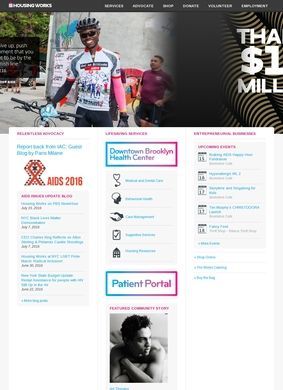
What does a thrift store have to do with HIV care? At Housing Works, quite a lot. The chain of secondhand shops spread across New York City, the online resale store, and the Bookstore Cafe are not side projects; their proceeds pay for the medical, housing, and legal programs at the center of the operation. That structure, where retail funds a social mission, is what makes Housing Works more interesting than the average nonprofit homepage, and it is worth understanding before judging anything else.
Retail funding for social programs
Housing Works started in 1990, during the worst of the AIDS crisis, and its work has stayed close to that origin. It runs a community-based healthcare network covering routine medical care alongside more specialized HIV treatment. It develops and manages affordable and supportive housing aimed at homeless and low-income New Yorkers, the population least likely to find stable shelter on the open market. It trains people for jobs and helps them prepare to actually get hired. It provides legal assistance. Across all of that, the figure Housing Works points to is more than 30,000 people served since it began, most of them experiencing homelessness or living with or at risk of HIV. The reach is broad, and the categories of help are concrete enough to cross-check against public reporting.
Healthcare, housing, legal services
The legal services line is the most telling part of that offering, because plenty of housing charities stop at a bed and a referral. Pairing healthcare, housing, and counsel under one banner suggests an attempt to deal with the tangle a person in crisis usually faces, where an eviction, a missed prescription, and a denied benefit all arrive in the same week. Whether the execution matches that ambition is harder to judge from a website alone, but the intent is laid out plainly, and the organizational history gives it some credibility.
Why pair medical care with legal help?
The social enterprise piece deserves its own attention. The Housing Works thrift stores have been a fixture of the New York donation-and-resale scene for years, and the Bookstore Cafe is a known spot in its own right, not a charity outpost you wander into by accident. An online store extends the same idea past the physical shelves. The pitch is honest: buy a used coat or a secondhand novel, and the margin goes toward someone's care or housing.
Thrift stores and the Bookstore Cafe
Volunteering threads through these venues, with opportunities listed at multiple locations. That gives the operation a second function beyond revenue, pulling in people who want to contribute time instead of money. Advocacy rounds out the picture, with Housing Works pushing on HIV and AIDS funding and legislation at the policy level. That work is the hardest part for an outsider to evaluate, since results there are slow and rarely attributable to a single organization, but it fits the history and the founding mission.
Volunteering and advocacy work
On the practical side, there is a contact page, a separate one for the healthcare arm at its own subdomain, and a locations directory covering the many storefronts and clinics Housing Works operates across the city. The homepage does not put a phone number or email address up front, so a visitor has to click through to reach a person, though that is a minor friction given how many physical sites are involved and how varied the contact needs are across programs.
Contact pages and locations directory
The outside feedback on Housing Works is mostly from employees rather than from the people the programs serve, which limits what it tells you. Glassdoor carries 298 reviews at 3.1 out of 5, with only 45 percent saying they would recommend working there. Indeed shows more than 258 reviews without a clean aggregate score. CareerBliss lists a 3.0 from a sample of two. Those are all workplace numbers, and a middling rating at a large, underfunded nonprofit is not unusual, but it is not flattering either. Worth noting for anyone weighing a job or volunteer placement at Housing Works before they go in with fixed expectations.
Employee reviews and ratings
The number that sits heavier on the donor side comes from Charity Navigator, which rates Housing Works 2 out of 4 stars under its Brooklyn registration. That is a below-average grade from the sector's most-cited evaluator, and it is not something a mission statement erases. Two stars can reflect reporting and finance metrics as much as program quality, so it is not automatically damning, but it does mean a careful giver should read the underlying scorecard rather than stop at the headline figures. A rating that low from that evaluator deserves more than a shrug.
Charity Navigator evaluation
Three decades of work, tens of thousands of people served, a funding model that does not depend entirely on grants, and a service mix that treats a person's problems as connected: Housing Works makes a case that is unusual in its specificity. What does not resolve cleanly is the gap between that mission and the outside scorecards, a charity evaluator parked at two stars and a workforce that, by its own reviews, is split on whether to recommend the place. Neither figure tells you the programs fail the people who walk in. Neither lets you assume they succeed, and a prospective donor would be better served pulling the full Charity Navigator detail page than relying on the star count alone.