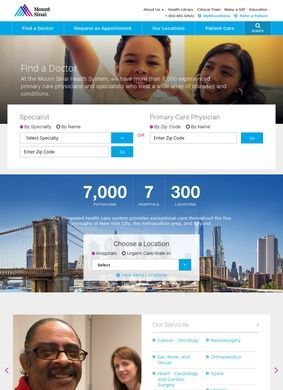
Ranked No. 22 in the world, No. 7 in the United States, and No. 1 in both New York State and New York City by the World's Best Hospitals 2026 list, Mount Sinai Hospital occupies a position that is hard to dismiss. In a city loaded with famous teaching hospitals, finishing first locally is a sharper distinction than it might sound on paper. It means that by the methodology Newsweek and Statista used, Mount Sinai Hospital came out ahead of NewYork-Presbyterian, NYU Langone, and every other major system competing for the same patients in the same metro area. That is not a ranking built on brand history alone; the criteria weight clinical outcomes, physician surveys, and patient safety measures across thousands of hospitals worldwide.
Network of hospitals across New York
The institution dates to 1852, which puts it among the older American medical centers still operating at any comparable scale. The flagship campus of Mount Sinai Hospital sits at 1 Gustave L. Levy Place on Manhattan's Upper East Side, near Madison Avenue and 100th Street, but what the website describes is considerably larger than that single address. Mount Sinai Health System covers multiple hospitals across the New York metropolitan area: the original Mount Sinai Hospital alongside Mount Sinai Queens, Mount Sinai West, and Mount Sinai Morningside, with hundreds of outpatient and community clinic locations extending the reach further. Someone who arrives at the site expecting one hospital finds an entire network laid out instead, which changes how to think about both access and specialization within it.
Clinical specialties and service areas
The clinical range is about as wide as a general academic center gets. Primary care sits alongside cardiology, oncology, neurology, orthopedics, and a surgical program that extends into transplantation. Beyond those headline specialties, Mount Sinai Hospital covers behavioral health, dental care, HIV and AIDS care, and emergency medicine, with urgent care sites positioned throughout the metro region.
HIV and AIDS care as institutional priority
The HIV and AIDS program deserves particular attention, partly because it is a field where Mount Sinai Hospital has a long institutional history going back to the early years of the epidemic, and partly because it shows a hospital that treats chronic and stigmatized conditions as core medicine rather than peripheral services. That commitment to difficult patient populations is part of what academic medical centers are supposed to do, and Mount Sinai Hospital has done it consistently enough that the program is now embedded in its identity.
Teaching hospital with medical school and research
What separates a hospital like Mount Sinai Hospital from a strong community provider is the teaching and research operation running alongside everyday patient care. Mount Sinai Hospital is home to the Icahn School of Medicine, and the system runs extensive biomedical research in parallel with clinical work. For anyone weighing where to seek treatment, that arrangement has real consequences: an academic medical center is usually the institution that takes the rare diagnosis, the complicated transplant case, or the clinical trial unavailable anywhere else in the region.
The research side is not window dressing; it is part of why the rankings place Mount Sinai Hospital where they do, and why the subspecialty depth at the flagship campus exceeds what most regional hospitals can sustain. Programs at that level attract faculty whose primary job is advancing the field, and patients in those programs benefit directly from that concentration of expertise.
MyMountSinai app for appointment booking
The patient-facing experience is meant to be manageable through a single piece of software. The MyMountSinai app lets patients book appointments and manage their care online. That sounds like a minor convenience until you have tried to coordinate appointments across four hospitals and a few hundred clinics by phone, at which point a unified portal becomes the thing that keeps the whole system navigable for the people inside it. Whether the software delivers on that promise consistently is something reviews from actual users would settle better than any inspection of the website, and on that front the picture from outside the institution is limited.
Patient reviews show mixed feedback on campuses
A search of major review platforms turns up relatively few entries for Mount Sinai Hospital relative to its size, with ratings varying considerably across the campuses. The flagship earns mixed feedback, with strong marks for specialist expertise and weaker ones for wait times and administrative follow-through. That pattern is common for large academic systems, where the clinical depth is genuine but operating at scale creates friction that smaller practices sidestep entirely.
The breadth of locations cuts across the whole region in a practical way. Mount Sinai Queens, West, and Morningside put the system's care closer to where people live, and the outpatient and community clinics push that reach further still. A network this distributed is one that expects most of its work to happen outside the flagship tower, which is the right approach for a population the size of New York's. Routine care closer to home, complex care concentrated where the specialists and research infrastructure sit. Mount Sinai Hospital is structured to be both a first door and a last resort, and the website reflects that dual role without overstating either end of it.
There is a tension in any operation this large, and it would be dishonest to ignore it. The same scale that delivers world-ranked specialty care and a medical school can make Mount Sinai Hospital feel impersonal at the front desk, and no amount of web copy resolves that uncertainty. What the site can show, and does show, is the institutional substance: the specialties go deep, the research program is active and well-funded, the multi-campus footprint is genuine, and the digital tools to navigate the network are in place. Those are the things an outside observer can actually evaluate, and on each of them Mount Sinai Hospital presents a credible case.
Founded more than 170 years ago, ranked first in its own city, anchored by a medical school and an active research program, and reachable across the metropolitan area through a system that runs well beyond its Upper East Side flagship, Mount Sinai Hospital is operating near the top of American academic medicine. The 2026 placements are not the whole story, but they align with everything else the system puts forward: concentrated specialty depth, broad geographic coverage, and the teaching infrastructure that tends to accompany serious clinical ambition. That combination does not guarantee any individual visit goes smoothly. What it does mean is that Mount Sinai Hospital has built the structure capable of handling what most systems cannot, and the evidence for that conclusion sits plainly in the published record.
Business address
Mount Sinai Hospital
One Gustave L. Levy Place,
New York,
NY
10029
Contact details
Phone: 212-241-6500