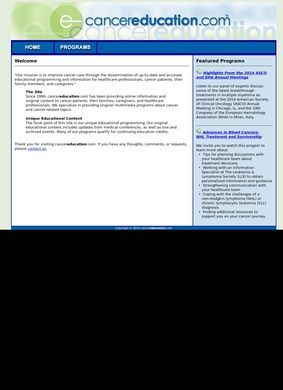
Someone whose mother has just been diagnosed types "cancer education" into a search box at one in the morning, looking for plain explanations of treatment, side effects, what to ask the oncologist. That late-night search is the exact need a domain like this promises to meet. The trouble is that arriving at Cancer Education today, the visitor finds almost nothing of the sort. The page that loads is a quiet front door rather than the library the name suggests, and anyone who came for substance has to leave and look elsewhere within seconds.
History as cancer education resource
The history behind the name is genuinely worth knowing, because it explains the gap. The site went live in 1999 as an online resource built around cancer care and management, with material aimed at four distinct groups: clinicians, patients, family members, and the caregivers who often do the hardest, least visible work. That is a sensible split. A nurse needs different language from a frightened spouse, and a project that recognised this from the start clearly understood its audience. For a stretch of its life, the address carried real educational programming pitched at those four kinds of reader. That earlier version of Cancer Education was a more useful thing than what survives.
Four audience groups served originally
What sits there now is a different animal. The address functions as a foundation page for AOIC, LLC, the company that owns and runs it, and the cancer material that justified the name is not present. There are no articles to read, no courses to enrol in, no symptom tools, no searchable database, no interactive features of any kind on the landing page. A person hoping to learn about a diagnosis will find the door but not the rooms behind it. Going by what is visible on the page, even a single linked guide is absent; what loads instead is the company's own corporate pointer.
Current function as corporate placeholder
AOIC, LLC describes itself as a provider of content creation, technology, and meeting planning services for nonprofit organisations. In other words, the firm builds and supports programmes for groups that lack the in-house capacity to do it themselves, and a cancer education portal is exactly the sort of thing such a shop would have produced for a client or for itself. The fuller picture of that business lives at a separate address, aoic.net, and the copyright on the page carries a recent year, so this is maintained property and not an abandoned shell.
AOIC services for nonprofit organizations
For a nonprofit decision-maker scouting a partner to run an educational programme, the connection has some value. Seeing that AOIC has held a health-focused domain for a long time tells you the firm has been near this kind of work for years, and longevity in the nonprofit services space counts for something. The catch is that the page does almost nothing to make that case. It states the relationship and sends you onward. Anyone serious about evaluating the company would skip Cancer Education and go straight to the corporate site, which makes this address a redirect with a well-known name attached.
Value for business decision-makers
This is where the listing splits into two different verdicts depending on who is reading. As a source of cancer information for patients and families, it does not deliver, full stop. As a corporate placeholder for a services firm, it is functional but slight, and it leans entirely on the destination it forwards you to. Appearing in a business directory under health resources sets a particular expectation, and this page falls short of it for the majority of visitors who arrive with a medical question.
Does the page meet visitor expectations?
Contact follows the same pattern. There is no phone number, no email address, and no postal information on the Cancer Education page itself. A visitor who wants to reach anyone is handed off to aoic.net and a LinkedIn profile, with nothing reachable on the listed URL directly. For a corporate front page that may be a deliberate routing choice, since the parent site presumably carries the real details. For a patient or caregiver who arrived hoping for help, a page that offers neither content nor a direct line to ask a question is a dead end. Judged on the address that carries the Cancer Education name, the contact route is thin and indirect.
Contact information missing from site
On third-party opinion there is little to report, and it is worth being straight about why. A search for the site itself turns up no reviews. What comes back instead is a cluster of unrelated bodies with similar names, the Center for Advancement in Cancer Education and the Cancer Education and Research Institute among them, plus heavyweight references like Mayo Clinic and a Springer journal. None of those speak to this particular page. A reader should not mistake the reputation of those institutions for anything connected to this address. The absence of feedback is not a mark against it on its own, but combined with an empty landing page it gives a prospective visitor very little to work with.
No third-party reviews available
It would be unfair to pretend there is hidden depth that could not be reached. The page is what it is: a maintained marker that names a worthy subject and then routes traffic to a company. That honesty has a small upside, because nobody is misled into thinking medical guidance waits behind a paywall. But a name as direct as Cancer Education sets a clear expectation, and the current page does not come close to meeting it for the patients, relatives, and caregivers it once addressed. The copyright date suggests the owners have no intention of abandoning the domain, yet there is no sign of plans to rebuild what was there before.
The verdict depends entirely on the visitor. A nonprofit executive curious about AOIC can use Cancer Education as a stepping stone to the company's real site, accepting that the stone is bare. Everyone else, which is almost everyone who would type this phrase into a search box, should treat the listing as a historical footnote. The better destination for practical help is among the very names that crowd out the search results: Mayo Clinic gives exactly what Cancer Education advertises and no longer supplies, free explainers on diagnoses and treatments written for non-specialists, kept current by clinicians. Set the two side by side and the comparison is not close.