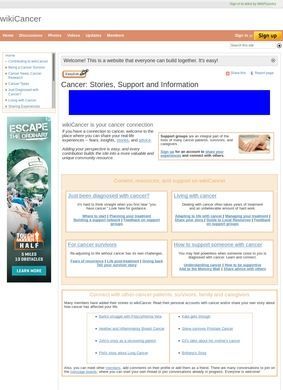
Wiki Cancer is listed under Conditions and Diseases, and the site behind the listing is selling Texas ranch land. Cancer comes up nowhere on the page.
The domain resolves to a marketing operation for Eagle Mountain Reserve, a 118-acre master-planned community in Burnet County, Texas, set on the northeastern foothills of Lake Buchanan. The navigation bar reads Home, Overview, Location, Community, Recreation, Contact Us, Master Plan, and Builders/Realtors, and every tab works toward the same end, which is selling homesites. The switch is total. The layout and wording give no hint of the address's earlier use. Whatever the Wiki Cancer name once meant, the page wearing it now promotes hilltop lots above a Texas lake, with no trace of anything medical left in the material.
That mismatch settles most of what can fairly be said about Wiki Cancer.
The Eagle Mountain Reserve pitch
Eagle Mountain Reserve is presented as lake-country acreage within reach of central Texas towns: about 13 miles from Burnet, 27 from Georgetown, and 70 from Austin. Those figures do a lot of work, since they frame the development as weekend or retirement territory for Austin and Georgetown households, close enough for a routine drive and far enough out to feel rural. The page that answers for Wiki Cancer is organized around lead capture from the top.
An inline form greets the visitor immediately, and builders and realtors get a tab of their own, which says plainly enough who this material is for. None of this is unusual for rural land sales; the surprise sits entirely in the address it occupies.
A visitor who came for patient stories finds a sales funnel instead. Nothing here bears any relation to cancer or to the Wiki Cancer name.
Hilltop homesites above Lake Buchanan
The product is high ground. Homesites sit on hilltops with views over the lake, and the community material adds a recreation center and a private boat ramp reserved for the development. The location content places the acreage on the northeastern side of Lake Buchanan in Burnet County, hill country where elevation and water access carry the sales case on their own.
The Location and Overview tabs handle the geography, the Community and Recreation tabs handle the amenities, and a master plan section shows how the 118 acres are laid out for anyone who wants to study the shape of the place before calling.
Lake Buchanan anchors the whole sell. Views of the water justify the hilltop siting, and the private ramp puts residents on the lake. The recreation center fills in the rest of the leisure picture. The figures give a buyer something to test, too: the acreage and the three drive times are stated outright, and each can be checked against a map before anyone picks up the phone. Whether any of this belongs under the Wiki Cancer name is a separate question, and it never stops being a strange fit.
A Land Buyers Guide and a self-directed IRA angle
Two hooks do the heavy lifting. The first is a free Land Buyers Guide, sent by email to anyone who completes the lead form; the form collects full name, email, phone, and comments or questions, the standard trade of contact details for a document. The second is material on buying land through a self-directed IRA, aimed at people weighing raw acreage as a retirement asset.
That second hook deserves a careful read. Whether a self-directed IRA is a sensible vehicle for raw land is a question for a financial adviser, and this page is the seller's half of that conversation, so the homework belongs on the buyer's side of the table. A guide sent by email costs the seller nothing and gains a contact record, which is the whole architecture of the page in miniature.
Reaching the seller takes no effort. A Contact Us tab, a toll-free phone line, and the inline form give a prospective buyer three plain routes to the sales operation. Judged purely as land marketing, that openness counts in its favor. The catch is who answers. Every route on this page belongs to the real estate operation, and none of them reaches anything resembling the old Wiki Cancer project, which is the whole problem for an entry filed under a health category.
Stray links left on the page
The page also carries baggage. Mixed into it are links with no connection to Texas real estate: one leads to a trading-education article, and a cluster of Russian-language links points to birthday-greeting text, an affiliate-marketing piece, a checklist, a meal-delivery service, and a children's bed.
That mix is what a parked, repurposed, or spam-injected domain looks like, and the Wiki Cancer address fits the pattern. The damage runs both ways. As a health reference the address is dead weight, and a careful land buyer has reason to pause as well, since serious money changes hands in acreage deals and the condition of the storefront is part of the diligence.
Whoever manages the domain either placed those links or failed to notice them, and neither reading is reassuring. A recycled domain carrying injected links is an odd home for a development with lake views and a boat ramp to sell.
A form that asks for a buyer's name and phone number should not sit beside a Russian ad for a children's bed.
What became of Wiki Cancer
A trace of the original project survives in a research-resource catalog under the identifier RRID: SCR_001824. That record describes the site as "a place where people connected to cancer can share real-life experiences," a description that fits the name and the category here far better than anything now on the domain. That community is the Wiki Cancer this entry was written for, and it is no longer at this address. The record reads like the last remaining evidence of what the domain was before it was repurposed.
One caution about names. A separate project called My Child's Cancer maintains a database of pediatric cancer testimonials on its own domain, and despite the similar name it is a different site run as its own operation. Whatever its merits, it is not the Wiki Cancer under review, and the two should not be mixed up.
No rating or validation on file
The catalog record is blunt about standing. It reports that no rating or validation information was found, and it says so about Wiki Cancer in its original incarnation, back when there was a patient community here to rate. Searches on the current occupant do no better.
No notable third-party reviews surface for the real estate operation running on this domain, so a reader gets no independent word about either identity, old or new. For a buyer, that silence means the usual homework, title checks and county records and a visit to the land itself, has to do the whole job that outside reviews would otherwise share.
For an entry sitting in a Conditions and Diseases category, one question settles the verdict: does a patient or a caregiver gain anything by clicking through. The answer here is no. The health resource is gone, the replacement sells acreage, and the spam links folded into the page remove even the reassurance of a cleanly kept site. Anyone filing through health resources deserves to land on health resources, and this entry cannot deliver that.
As a cancer resource, Wiki Cancer has stopped existing in any practical sense.
The advice splits by reader. A buyer hunting acreage near Lake Buchanan can treat the page as a land sales channel and judge it on those terms: call the toll-free line, request the emailed Land Buyers Guide, and ask the sales office about lot availability, boat ramp access, and how a self-directed IRA purchase would be handled, plus one more question about why the development markets itself on this particular domain.
A caregiver or a newly diagnosed patient looking for shared experiences should close the tab and search out the My Child's Cancer testimonial database, because the community that gave Wiki Cancer its name is not here anymore.