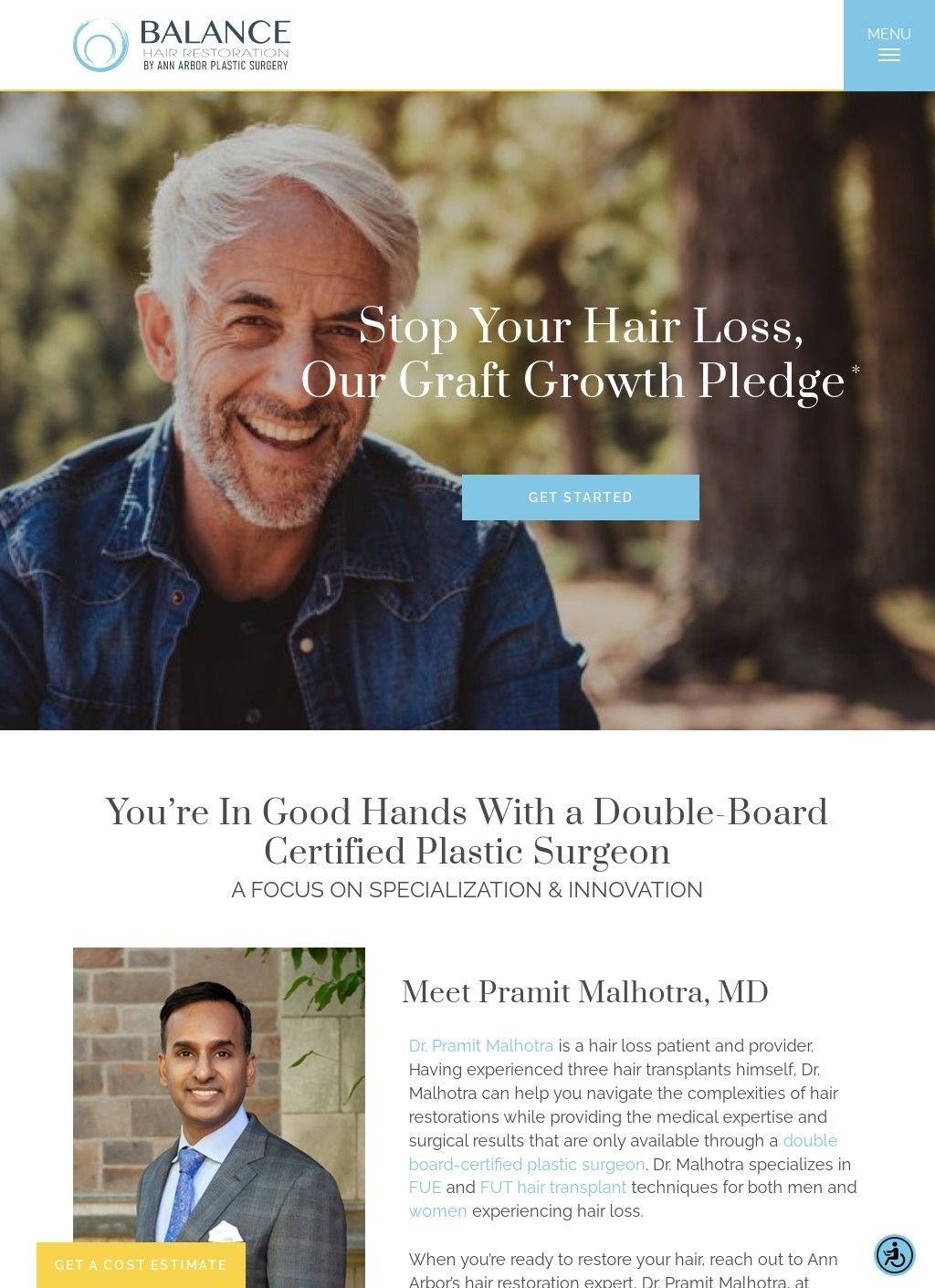
Putting a number on graft survival is something most hair clinics avoid, but Balance Hair Restoration does it anyway: at least 80 percent graft growth, with a stated commitment to address outcomes that fall short. That "Graft Growth Pledge" is the first thing worth pausing on. Graft survival is exactly the variable that separates a good transplant from a disappointing one, and most sites in this field talk around it or frame expectations so loosely they carry no real accountability. Balance Hair Restoration writes it down as a stated standard, and that says something about how the practice wants to be measured.
Board-certified surgeon leads treatments
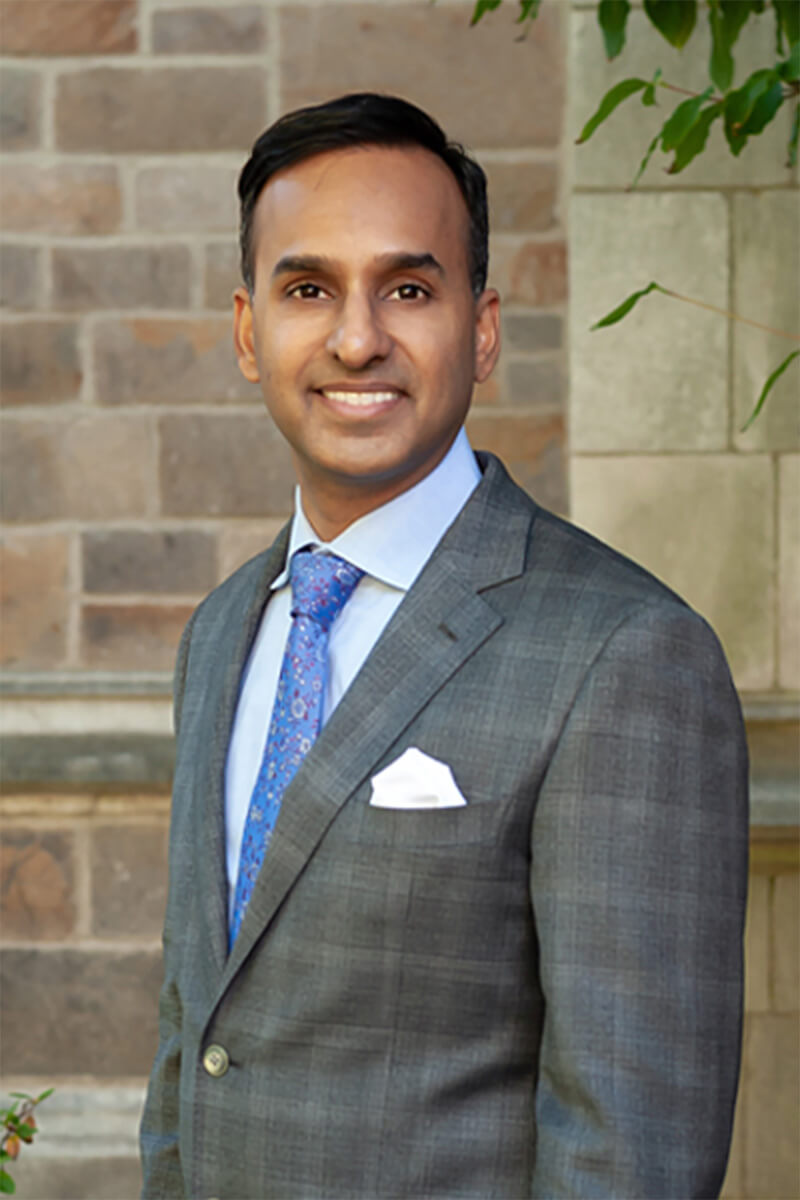
Behind the pledge is Dr. Pramit Malhotra, a double board-certified plastic surgeon running Balance Hair Restoration out of Ann Arbor, Michigan. That credential matters more in hair restoration than people assume. A lot of clinics in this space rely heavily on technicians, with a physician who might stop by for the critical incision stage and little else. A plastic surgeon who attaches his own name and surgical training to the full procedure is a genuine point of difference. The site builds much of its identity around Dr. Malhotra, and that is the right call.
Range of surgical techniques offered
The surgical menu at Balance Hair Restoration is broad and described in concrete terms. FUE (Follicular Unit Extraction) and FUT (Follicular Unit Transplantation) are both on offer, which already puts the practice ahead of clinics that push one method on everyone regardless of donor situation. Beyond those two approaches there is long hair FUE, a hidden donor technique aimed at minimizing visible scarring, and artistic hairline design treated as its own discipline. That last one is easy to underrate. A transplant can have perfect graft survival and still look wrong if the hairline is drawn without an eye for how it should age, so calling out design as a deliberate step rather than an afterthought is reassuring.
Female-specific hair restoration care
Female hair restoration gets its own billing at Balance Hair Restoration, which is less common than it should be. Women lose hair in patterns that differ from male balding, and naming female patients specifically suggests the practice does not treat them as an edge case. The site says it serves adults across a wide age range, from people noticing early thinning to those dealing with significant loss or wanting a hairline redesigned outright. That spread is plausible for a surgeon-led practice and does not read as overreach.
Inside the clinic's technology platforms
On the technology side, Balance Hair Restoration runs NeoGraft and the ARTAS robotic system. These are recognized platforms in the field, not invented branding, and the site gives them a dedicated overview section so a prospective patient can read what each does before a consultation. I appreciate that the medical, non-surgical treatments are framed honestly as either a standalone route for the right candidate or as maintenance after surgery. Hair loss is progressive and a transplant alone is rarely the whole story, so setting that expectation up front is the kind of candor that tends to be missing from glossier competitors.
For evidence of results, Balance Hair Restoration offers a before-and-after photo gallery plus video testimonials from patients. Photo galleries in this industry deserve some skepticism, given how lighting and angles can flatter a result, but a video testimonial is harder to stage. The combination gives a visitor more than one way to evaluate the work, and a "Why Us" page rounds out the pitch, laying out the specific case for choosing Balance Hair Restoration over the many alternatives in cosmetic surgery. Whether the arguments there land will depend on how they compare to whatever a competing clinic puts forward.
Contact information and social media
Contact information is plainly presented: a phone number and full street address in Ann Arbor sit on the page without any hunting, and the practice links to Facebook, Instagram, YouTube, and Twitter. For a surgical clinic where a patient is deciding on a procedure that costs several thousand dollars and involves recovery time, that kind of transparency sets a reasonable baseline of trust. It sounds unremarkable until you notice how many medical-aesthetic sites bury the basics behind a lead-capture form.
Independent reviews and ratings
Outside opinion lines up with the self-presentation. On Birdeye, Balance Hair Restoration carries 61 reviews at a five-star rating, a meaningful volume for a single-surgeon hair clinic and a strong average to go with it. RealSelf, a platform that cosmetic-surgery patients use extensively for research, lists the practice with multiple patient reviews as well. The clinic keeps its own testimonials page, and those are presented separately from the independent platforms, so the third-party feedback stands on its own. None of this guarantees an individual result, but the pattern of independent feedback is consistent rather than contradictory or absent.
Questions to ask before surgery
The ordinary caveat for any elective surgical decision applies here too: a website, a pledge, and a bank of five-star ratings are the start of due diligence, not the end. Graft growth percentages depend on donor quality, technique, and individual aftercare, and no two scalps respond identically. The pledge is a commitment to make things right, which is different from a guarantee that nothing will ever fall short. A serious candidate should ask at the consultation how the 80 percent figure is tracked and verified, and what "work to resolve the outcome" means in practice before agreeing to a procedure.
What pushes Balance Hair Restoration into the recommendable column is the alignment between its claims and its proof. A board-certified plastic surgeon, a varied set of procedures, named technology platforms, female-specific care, and a deep bank of independent reviews all point in the same direction. Balance Hair Restoration is not coasting on adjectives. It tells you who does the work, what equipment is involved, and what standard it holds itself to, then backs it with patient feedback you can find elsewhere. The breadth of options means Balance Hair Restoration can handle a first-time FUE candidate and a complex hairline redesign with equal seriousness, and the published evidence is strong enough to recommend taking that closer look.
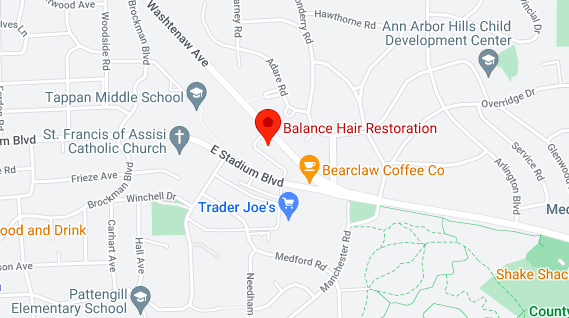

Business address
Balance Hair Restoration
2320 Washtenaw Ave, Ste 100,
Ann Arbor,
MI
48104
United States
Contact details
Phone: (734) 913-5100