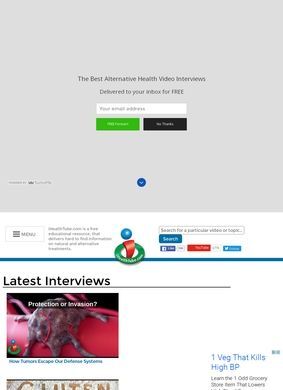
Someone has heard that coconut oil cures something, or that a doctor on a podcast said cancer can be starved by diet, and they go hunting online for the long-form version of that claim. iHealthTube is built to catch exactly that search. It is a free video platform stacked with interviews where physicians, authors, and natural-health advocates talk through topics like nutrition, heart health, disease prevention, and assorted alternative treatments. The whole thing runs on a simple promise: watch a doctor explain, in their own words, an approach that mainstream medicine either ignores or dismisses.
How to find videos in the library
The library is genuinely large, and the navigation respects that. You can browse "All Videos," drill into topic categories, or filter by the contributor doing the talking. Search works. If you arrived because one specific phrase lodged in your head, food and nutrition, heart health, coconut oil, you can probably find a clip aimed at it within a minute. iHealthTube also pushes its content to a parallel YouTube channel, so the experience extends past the site itself for anyone who prefers watching there.
Free access through ads and donations
None of it costs money to view. iHealthTube is ad-supported and leans on viewer donations through PayPal and Patreon to keep going. That model shapes the feel of the place: it is less a polished commercial product than a long-running passion project that has accumulated a deep back catalogue. For a viewer, free access to that volume of material is the clear draw, and the topic-and-contributor structure makes the depth usable instead of overwhelming.
Fact-checkers have flagged medical claims
This is the part a careful visitor cannot skip past. iHealthTube itself carries a disclaimer that it is not a medical site and cannot replace professional medical advice, which is the right thing to post and worth taking at face value. But the outside picture is harder. Media Bias/Fact Check rates iHealthTube as an unreliable source for credible medical and scientific information. Science Feedback has flagged specific content on the platform as incorrect. Those are not casual opinions from anonymous commenters; they are assessments from organizations whose entire job is grading the reliability of health and science claims, and they land on the same side.
External credibility assessments from independent reviewers
So the tension is built in. A platform whose appeal is "hear treatments mainstream medicine overlooks" is, by design, going to feature claims that fact-checkers contest. Whether that is a feature or a warning depends entirely on what the viewer wants from it. As a record of what natural-health practitioners and authors are saying, iHealthTube does its job and has the volume to back it up. As a place to make decisions about an actual illness, the independent reviewers are telling you to be cautious, and there is no honest way to wave that off.
Facebook following and review aggregator scores
The outside reputation picture is sparse and mixed. The Facebook page has gathered roughly 58,327 likes, which says the audience is sizeable, though follower counts measure reach, not accuracy. A low-credibility review aggregator scores it 32 out of 100 across 45 reviews, but the aggregator itself is not a source to lean on heavily, so that number deserves little weight in either direction. No ratings turned up on Google, Trustpilot, Yelp, or BBB, which leaves the serious external verdict resting on the fact-checkers rather than on a star average.
Contact options for the site
On reaching the people behind iHealthTube, there is an email address and a contact form, both accessible through the navigation even if neither is parked front and center on the landing page. No phone number or physical address surfaced. For a content site funded by ads and donations, a form plus an email is a reasonable level of contact, and the absence of a published street address is unremarkable for this kind of operation. The content reliability is the real concern, not the contact setup.
Archive size and navigation clarity
Set against comparable free health-video sites, iHealthTube has two genuine strengths: the size of the archive and the clarity of how it is organized. A viewer who already knows they are stepping into the alternative and natural-medicine space, and who treats every clip as one practitioner's view rather than settled fact, will find plenty to watch and a straightforward way to navigate it. The donation and ad model means the lights stay on without a paywall, which keeps the whole library open to anyone curious.
Limitations of using iHealthTube for diagnosis
The counterweight is permanent and unavoidable. The independent bodies that grade this material have not been kind, and the site's own disclaimer quietly agrees that the videos are not a substitute for a doctor. Someone using iHealthTube as entertainment, as a survey of a particular health philosophy, or as a starting point for questions to bring to a real clinician is on safe ground. Someone using it to self-treat a diagnosis is leaning on a source that fact-checkers have specifically called unreliable, and the deep catalogue does nothing to change that.
Know the difference between interview and verified claim
The practical read on iHealthTube comes down to expectations more than features. The platform has real content in real volume, the navigation is clean, and access is free. What it is not is vetted medical information, and the organizations whose job is to check have said so explicitly, citing specific videos as incorrect. The viewer carries the burden of telling the difference between a compelling interview and a verified claim, because iHealthTube will not do that sorting for them. The archive is deep and genuinely searchable, but depth is not the same as reliability. Use it to understand what a movement believes, and keep the actual medical decisions in the hands of a clinician who can actually weigh the evidence.