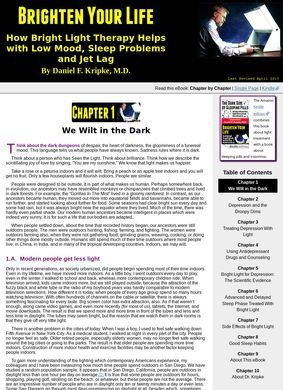
What you get at Brighten Your Life is a single, substantial ebook on bright light therapy, written by Daniel F. Kripke, M.D. and published free of charge. The full title is "Brighten Your Life: How Bright Light Therapy Helps with Low Mood, Sleep Problems and Jet Lag," and the text was last revised in November 2019 after an original 1997 copyright. There is nothing to buy here and no upsell to a clinic or product. The entire reason the site exists is to put one doctor's accumulated reading of the research in front of anyone who wants it, and that narrow purpose shapes everything about how the resource reads.
Three reading formats
The book is offered in three formats, and the choice is more useful than it first looks. You can read it chapter by chapter, take it as one long single page, or download a printable PDF. Each suits a different reader: the chapter view for someone working through it across several sittings, the single page for searching by keyword, and the PDF for anyone who wants a copy they can mark up or hand to a relative. It is a small piece of thoughtfulness from an author who clearly expected Brighten Your Life to be used, not skimmed once and closed.
Light therapy for depression and beyond
Content runs to at least five chapters, and the spine of the argument is laid out early. Kripke opens with why humans need bright light at all, framing it through both our evolutionary past and the realities of modern indoor life, where many people now spend most daylight hours under weak artificial lighting. From there the book moves into treating depression with light, then sets light therapy alongside antidepressant drugs and counseling, acknowledging those alternatives exist.
How light compares to drugs and counseling
That comparison is the part I found most worth the time. A lesser version of this subject would push light as a cure and leave it there. Brighten Your Life takes the harder path of weighing it against established treatments, drawing on peer-reviewed literature, American Psychological Association reviews, and controlled studies. It also separates seasonal from non-seasonal depression, which is a distinction casual coverage of "winter blues" tends to flatten. A reader gets the evidence for each case, not a single blanket claim.
The later chapters widen the scope past mood into sleep problems, shift work, and jet lag. These are the applications most people will recognise from their own lives, and grounding them in the same body of research as the depression chapters keeps the whole thing consistent. Brighten Your Life does not switch registers between its clinical and its everyday material. That consistency makes it easier to trust across the board. The structure is also coherent in a way you notice only when it is absent elsewhere: each chapter builds on the prior one without repeating the same set of claims in new language.
One detail worth noting is how the book handles the comparison between light therapy and medication. It does not argue that light is superior, nor does it dismiss drugs. It lays out the evidence and leaves the reader equipped to have an informed conversation with a clinician. That is a harder thing to pull off than it looks, because the obvious temptation for any health text is to oversell its own subject matter.
Author credentials and research backing
The credibility of a free health text rests almost entirely on who wrote it and what they cited, and on both counts Brighten Your Life is on solid ground. Kripke is named throughout, the references are extensive, and the citations point to real controlled studies and recognised review bodies. For a subject where the internet is thick with supplement sellers and confident anecdote, having a named M.D. and a visible trail back to published work counts for a great deal. The 2019 revision date also tells you the author kept returning to Brighten Your Life rather than posting it once in the late 1990s and walking away.
Behind the site sits Brighten Your Life, Inc., a Sarasota, Florida entity. Synapse and Patsnap connect the organisation to drug pipelines, patents, and NIH grant funding, and list around a hundred associated clinical results. That points to a genuine research footprint, not a hobby page. Dun and Bradstreet also lists the company as a real Sarasota business. None of those sources carry ratings or customer reviews, so the institutional record confirms the entity without telling you how the public has received the book itself.
On outside opinion, a search turns up no notable third-party reviews, no star ratings, no review counts on any consumer platform. That absence is not damning for a resource of this kind, since an academic ebook does not collect Yelp pages the way a restaurant does, but it does mean a visitor is judging Brighten Your Life on its own contents and citations, with no crowd verdict to fall back on. Anyone who values peer signal over the text itself should know that going in.
Contact is the clearest weakness. There is no phone number, no email, and no mailing address anywhere on the landing page or in the body of the site. The author's name and a copyright notice are all that identify the people behind Brighten Your Life. For a site selling nothing, this matters less than it would for a vendor, and the corporate registration is traceable through third-party databases if someone really needs it. Still, a reader with a question or a correction has no obvious route to reach the author.
No sales, no product pushes
What Brighten Your Life does not do is also worth saying plainly, because it is part of the appeal. Nothing is for sale. No lightbox brand is pushed, no affiliate links sit at the bottom of each chapter, no newsletter gate stands between you and the text. In a corner of the web where light therapy advice usually arrives bundled with a product to buy, this is the rare case where the writing is the entire offering.
There are limits a careful reader should keep in mind. The text was last touched in 2019, so the most recent few years of research are not reflected, and on a fast-moving clinical topic that gap is real. It is also one author's synthesis, however well sourced, and not a substitute for talking to a physician about your own depression, insomnia, or medication. Brighten Your Life is upfront about all of this, which only adds to the impression that it was written to inform, not to sell a treatment.
Weighed as a whole, Brighten Your Life earns credibility through its author, its citations, and its refusal to sell anything. It loses a little ground on stale revision dates and the complete absence of a contact route. The three reading formats, the careful split between seasonal and non-seasonal evidence, and the chapter-by-chapter progression all point to real care in the assembly. Read the chapter comparing light therapy with drugs and counseling, take the printable PDF and any questions it raises to a doctor, and treat Brighten Your Life as a starting point rather than a final answer.