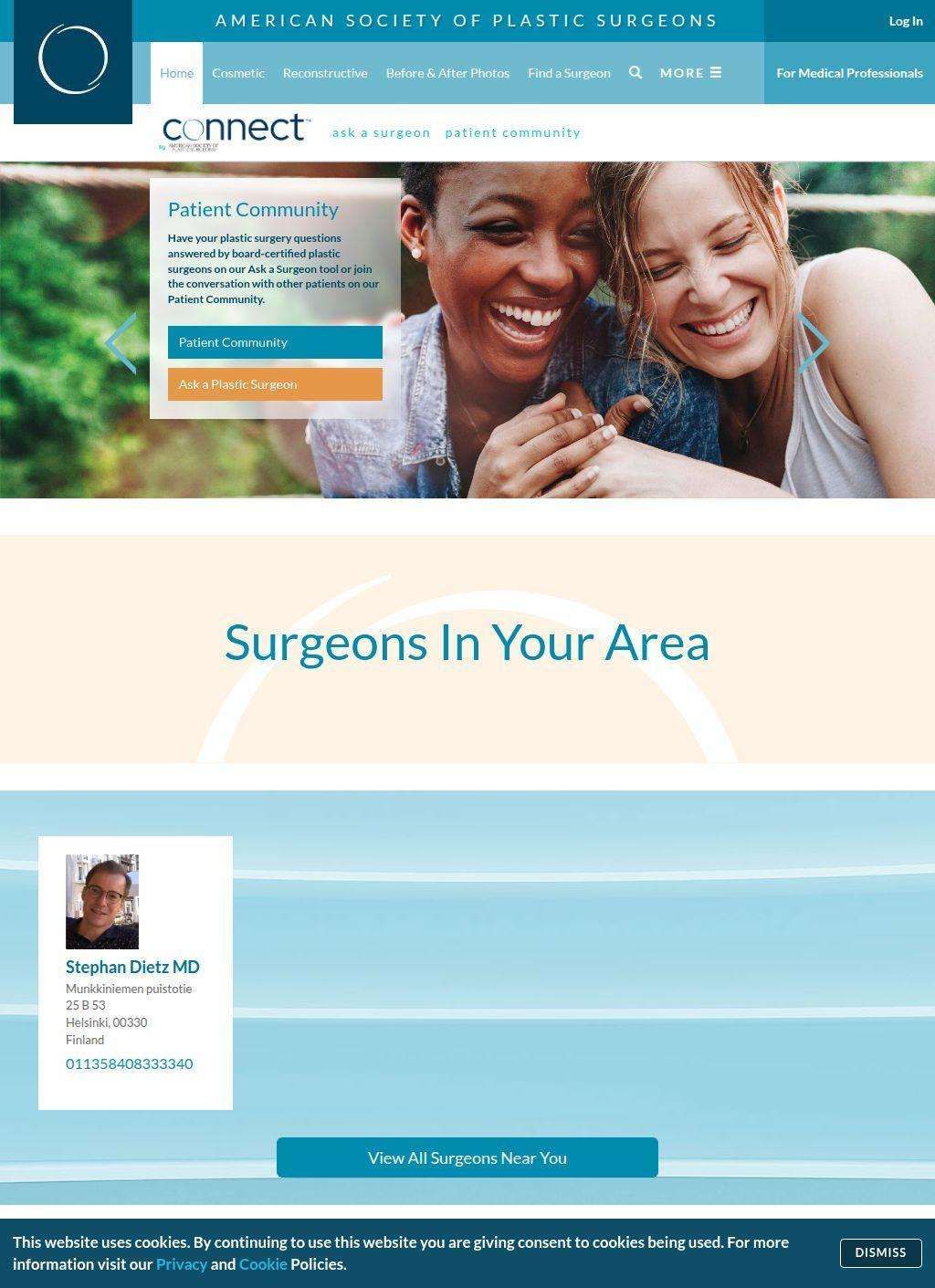
Board certification in plastic surgery has one primary gatekeeper in the United States, and that body runs the site being reviewed here. The American Society of Plastic Surgeons is the national professional association for board-certified plastic surgeons, and its website is built to serve two very different audiences at once: patients weighing a procedure and the medical professionals already working in the field. For a listing linked to tummy tuck research, the relevant content is genuinely easy to reach, because abdominoplasty sits inside a much larger procedure library that the organization maintains and keeps current.
Cosmetic and reconstructive procedure pages
The patient-facing side is where most readers will spend their time. Each cosmetic procedure gets its own detailed page, and the range is wide: breast augmentation, rhinoplasty, facelifts, liposuction, and the abdominoplasty content that brought this listing into a tummy tuck category. Reconstructive surgery is covered with equal depth, with pages on breast reconstruction, cleft repair, hand surgery, and scar revision. That pairing is easy to overlook but worth noting. Plastic surgery is publicly associated with cosmetics far more than with reconstruction, and the American Society of Plastic Surgeons corrects that by giving both sides equal weight on the page, with reconstructive work presented alongside cosmetic procedures at every level of the site.
Finding a board-certified surgeon
The tool a prospective patient will use most is the surgeon-finder. It lets a visitor search for member surgeons by location, turning an abstract goal (find someone qualified) into a concrete shortlist tied to a specific city or ZIP code. Membership in the American Society of Plastic Surgeons is not automatic; it carries specific requirements around training and board certification. For a procedure as significant as abdominoplasty, that filter has real practical value.
Interactive tools for patient education
Beyond the locator, the site provides an "Ask a Surgeon" feature for submitting a medical question, before-and-after photo galleries, 3D animations showing how individual procedures work, and a library of video resources. A Patient Community forum gives people a place to compare notes with others who have already gone through the same surgery. These tools go considerably further than text alone. A visitor can watch a procedure animated, look at real outcomes, and submit a question before booking anything. The animations do particularly concrete work for someone trying to picture what a tummy tuck involves before they ever sit in an exam room.
Two additional features are worth attention. Spanish-language procedure content is available, which extends the reach of the material to patients who would otherwise be parsing clinical descriptions in a second language. The patient safety guides are written to teach rather than reassure: they explain what board certification requires and how to evaluate a surgeon's credentials, which is exactly the information a first-time patient tends not to have in advance.
Statistics and publications from the association
The American Society of Plastic Surgeons also functions as a publisher and record-keeper for the specialty. The American Society of Plastic Surgeons releases annual plastic surgery statistics and trend reports, the figures that journalists and researchers cite when describing how procedure demand shifts year over year. It runs news articles alongside those numbers. For anyone wanting to understand the broader context around a procedure, that data has obvious value beyond the procedure page itself.
On the professional side, the American Society of Plastic Surgeons publishes Plastic and Reconstructive Surgery, the flagship peer-reviewed journal of the specialty. That single fact tells a reader a good deal about where the organization sits in the field. A body that publishes the discipline's primary journal is the place clinical knowledge is gathered, reviewed, and circulated, not a marketing operation summarizing work done elsewhere. The site also carries membership resources, continuing education, and publications aimed at member surgeons directly.
Setting clinical guidelines for surgeons
The advocacy role fills in the picture. The American Society of Plastic Surgeons sets clinical guidelines and pushes for patient safety standards in the specialty. The same body teaching a patient how to evaluate a surgeon is also the body setting the standards those surgeons are measured against. That alignment gives the safety guidance a credibility a standalone consumer site cannot replicate, because the advice comes from the organization that writes the rules, whose clinical guidelines underpin the very standards the safety guidance explains.
A practical note for the tummy tuck reader: the abdominoplasty page is one entry in a deep catalog, so the surrounding context is strong. A visitor can read the procedure detail, look at galleries, watch the animation, then jump to the surgeon locator and pull up certified surgeons nearby. The path from learning to acting is short and stays inside one source the whole way. Few resources in this space connect those steps as directly.
Reputation in medical journalism
Outside reputation adds some context. Third-party review platforms do not aggregate ratings for the American Society of Plastic Surgeons in the way they would for a clinic or practice, which is expected for a professional association. The organization's standing in the field is established through the journal it publishes, the statistics it releases, and the guidelines it sets, none of which depend on consumer review counts. Independent coverage of the American Society of Plastic Surgeons in medical journalism and health reporting is consistent and does not raise concerns.
The one caveat is scope rather than quality. This is a national association, so the material is educational and general by design. The American Society of Plastic Surgeons will tell a reader what a tummy tuck involves, how to evaluate a surgeon's credentials, and where certified practitioners work, but it will not quote a price or describe one specific surgeon's approach. That is the appropriate division of labor: the American Society of Plastic Surgeons hands a patient the framework and a verified shortlist, and the individual appointment fills in the specifics. Using this site as a starting point is the right approach, and the published evidence supports that conclusion without reservation.
Business address
American Society of Plastic Surgeons
444 East Algonquin Road,
Arlington Heights,
Illinois
60005-4664
United States
Contact details
Phone: (847) 228-9900