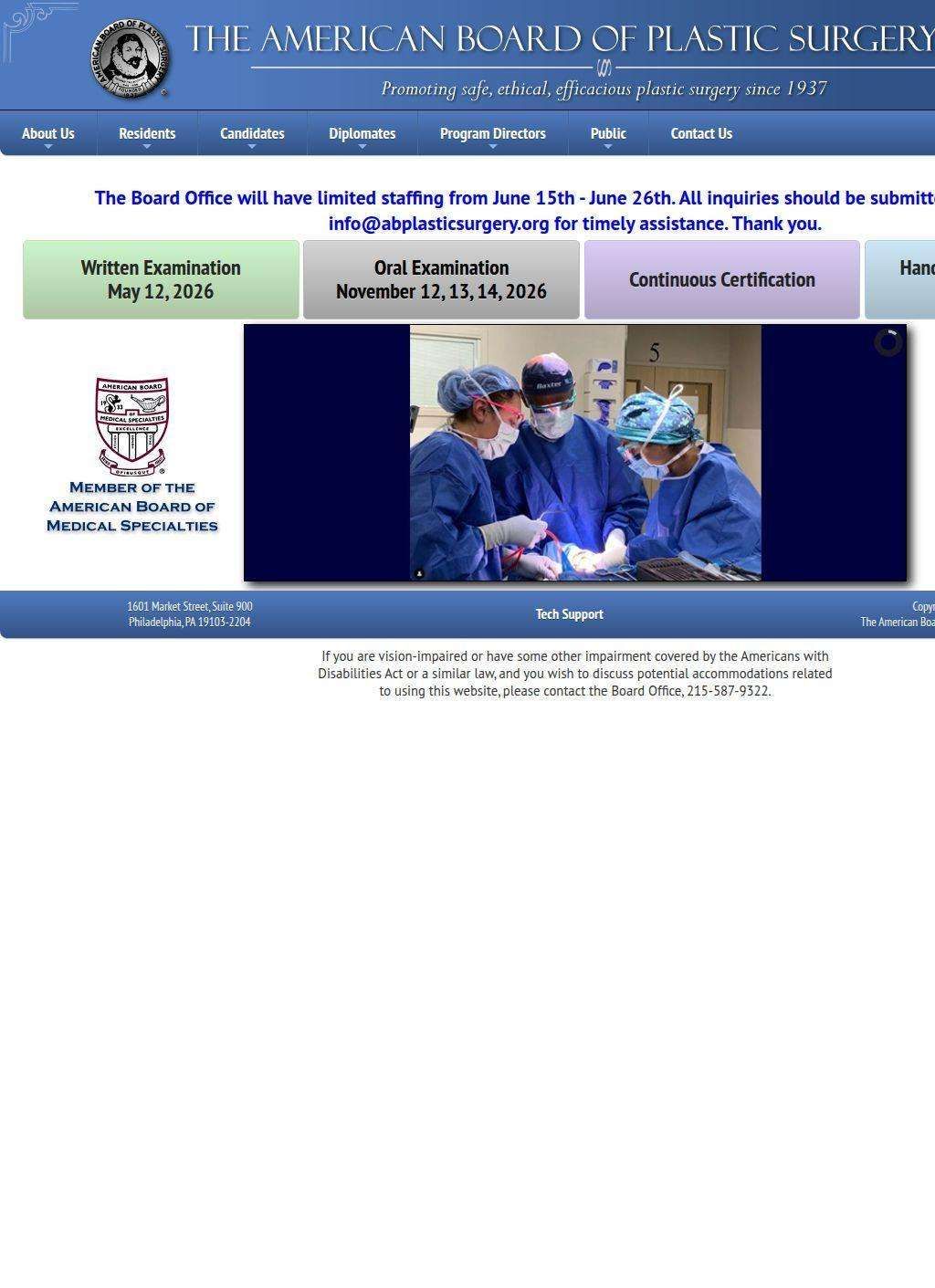
Patients sitting in front of a plastic surgeon have no easy way to know that the credentials on the wall mean what they claim to mean. The American Board of Plastic Surgery answers that question directly, because it is the body that certifies plastic surgeons in the United States and the place where that certification can be checked. For a category like abdominoplasty, where the surgery is real and the people performing it vary widely in training, that distinction matters. The site exists to define and verify the credential, and it does that without much ceremony.
Certification and diplomate status
The core of the work is certification. Candidates who complete accredited training and pass the required examinations earn diplomate status, and the American Board of Plastic Surgery administers both the written and the oral exams that lead there. Certification is not a one-time stamp either. There is a Continuous Certification program that asks diplomates to keep up with continuing medical education and periodic assessment so the credential stays current rather than frozen at the date it was first awarded. A separate Hand Surgery Certificate sits alongside the main pathway as a subspecialty credential, which tells you the American Board of Plastic Surgery treats hand surgery as its own distinct competence rather than folding it into general plastic surgery.
Continuous certification requirements
Most of the material on the site is built for people inside the profession, but one feature points outward. A surgeon verification tool lets anyone type in a name and confirm whether that plastic surgeon holds current board certification. This is the part of the American Board of Plastic Surgery that is most useful to a prospective tummy tuck patient, and knowing it exists before booking a consultation is worth the thirty seconds it takes. A surgeon may advertise impressive things; the verification check cuts through that by giving a yes or no answer tied to the board's own records.
Surgeon verification tool
What makes the tool credible is that it draws on the same authority that issues the certification in the first place. There is no second-hand list or aggregator standing between the patient and the source. The American Board of Plastic Surgery knows who its diplomates are, and the lookup reflects that directly. For abdominoplasty specifically, where some practitioners operating in the cosmetic space hold different qualifications or none in plastic surgery at all, a single trustworthy check is more useful than it might first appear.
What the verification check reveals?
The verification result is narrow by design, though. It tells you about board status and little else. It does not speak to a particular surgeon's complication rates, their experience with one procedure over another, or how a given clinic actually runs. A patient still has to do the rest of the homework. The American Board of Plastic Surgery confirms a baseline of training and examination, which is the floor, not the full picture.
Four portals for different users
Beyond verification, the site organizes itself around four groups, and the structure is clear once you see who each portal serves. Residents in accredited training programs get eligibility requirements and registration guidance, the entry point for anyone working toward certification. Examination candidates find exam formats, practice materials, and deadlines, the practical scaffolding for sitting the tests. Certified diplomates have their own area to manage the Continuous Certification program and register for the hand surgery exams. Program directors are given resident-tracking tools, which keeps the institutions that train surgeons tied into the same system that the American Board of Plastic Surgery uses to manage the credential itself.
That four-way split tells you something about how the American Board of Plastic Surgery understands its job. It is the gatekeeper at the certification exam, but it also stays involved across the full arc of a surgeon's career, from residency through ongoing recertification. The resident-tracking tools for program directors are a quieter sign of the same thing, since they let training programs and the board share a view of who is progressing and whether requirements are being met along the way.
The educational side rounds it out. There are FAQs, policy documents, and other resources covering how the process works, what is required, and what the rules are at each stage. This is dry reading, but it is the kind of reference material that a resident or candidate genuinely needs, and the American Board of Plastic Surgery is the correct place for it to live. Policy that governs certification should come from the organization that grants the certification, and here it does.
For someone researching a tummy tuck, the practical value of the American Board of Plastic Surgery is concentrated in that one verification check, with the rest of the site serving the profession it regulates. Knowing a surgeon is a current diplomate is a real and meaningful filter and should be the first thing a patient confirms. It still leaves harder questions open: how skilled this particular surgeon is at this particular operation, how they handle complications when they come, and whether board status alone should ever carry a decision that ends up on the operating table. The American Board of Plastic Surgery cannot answer those. What it can do, it does with clarity.
Business address
The American Board of Plastic Surgery, Inc.
1601 Market Street, Suite 900,
Philadelphia,
Pennsylvania
19103-2204
United States
Contact details
Phone: 215-587-9322