Someone considering lip fillers usually arrives with one nagging worry: will this look natural, and is the person holding the syringe qualified? That anxiety is the gap the American Academy of Dermatology fills better than nearly anything a search throws back, because its consumer pages on injectable fillers are written by the same profession that performs the procedure. The site does not sell treatments or push a clinic. It explains, in plain clinical language, what fillers do and what they cannot do, and then steps back.
How dermal fillers restore facial volume
The filler content here is straightforward and useful. It describes how dermal fillers restore lost fullness to the face, lips, and hands, and it walks through the specific jobs they are used for: plumping the lips, softening deep creases, rebuilding volume in the cheeks and under the eyes, smoothing fine lines, diminishing the look of scars, and lifting drooping corners of the brow or mouth.
Practical facts about results and insurance
That list is broader than the lip-focused category this entry sits in, which is genuinely helpful, since anyone weighing lip work tends to start wondering about the rest of the face within the same five minutes. The site also makes two practical points that a sales-driven page tends to bury or skip entirely: most filler types produce immediate results with no required downtime, and cosmetic filler treatments are not covered by insurance. Those are exactly the two facts a first-timer needs before booking a consultation.
Authority from dermatology professionals
What gives the American Academy of Dermatology its authority on this subject is who stands behind it. It is the largest professional membership organization for dermatologists in the United States, and the consumer content reflects that origin. There is no breathless before-and-after gallery, no countdown to a discount. The information reads like guidance written by clinicians who would rather a patient understand the procedure than be talked into it. For a treatment area as crowded with marketing as cosmetic injectables, that restraint is the whole point.
Skin conditions and procedures beyond fillers
The public-facing library extends well past fillers. The American Academy of Dermatology publishes clinical information across a wide range of skin conditions and cosmetic procedures, so a reader who landed on the filler page because of a wedding or a milestone birthday can keep reading about skin health more generally without leaving the same source. The American Academy of Dermatology covers enough ground that skin questions rarely stay neatly inside one topic. A person curious about lip volume often also has questions about sun damage, scarring, or the practical difference between what a board-certified dermatologist and a medspa technician are trained to handle.
Membership services for board-certified dermatologists
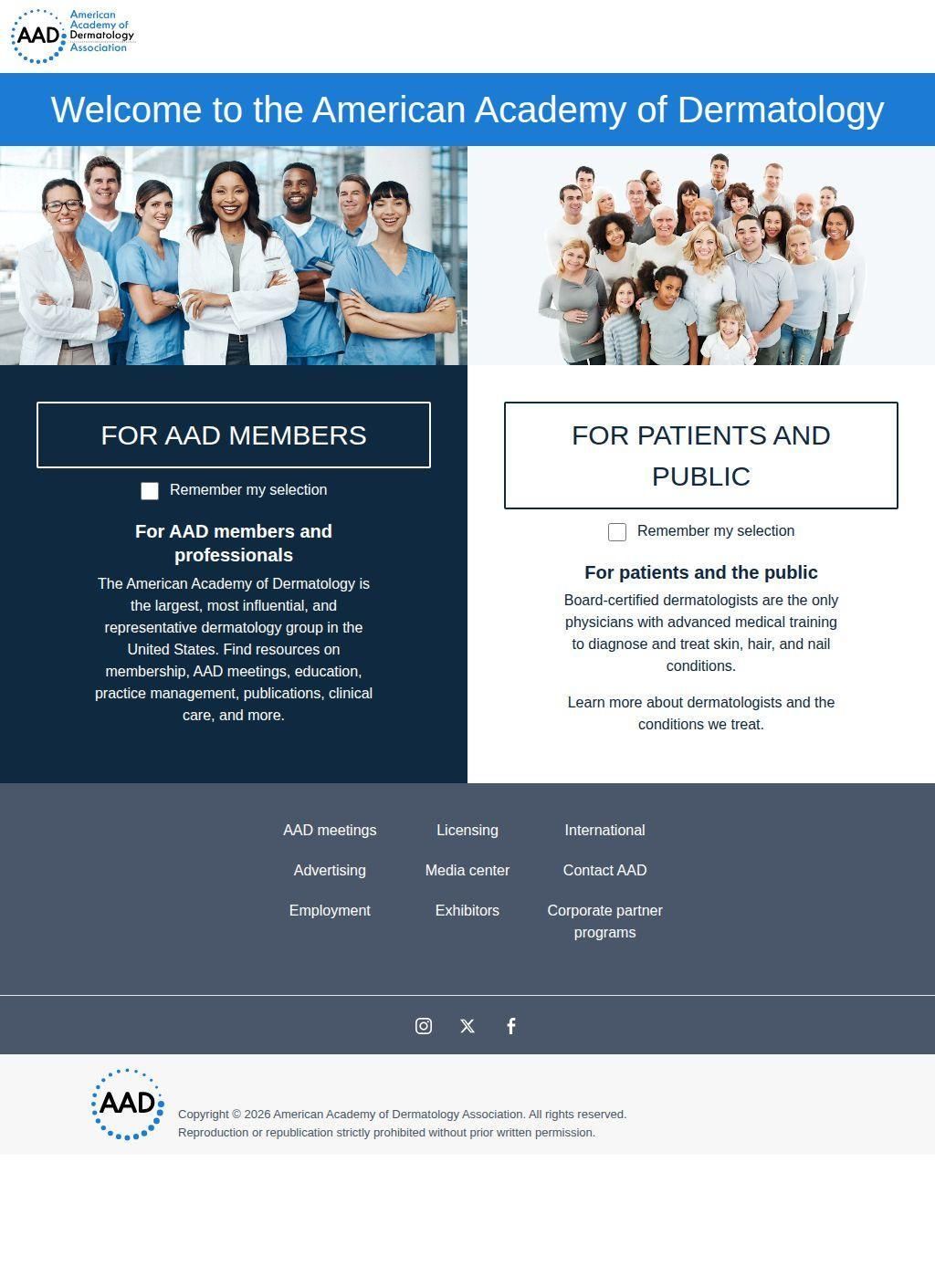
It is worth being clear that this is a dual-purpose site, and the half aimed at the public is the smaller half. The bulk of the American Academy of Dermatology exists to serve its members. The organization provides membership services, continuing medical education, practice management resources, publications, employment listings, and international resources for board-certified dermatologists. It runs an annual conference, with the 2026 meeting set for Denver in late March, and it operates corporate partnership, advertising, and exhibitor programs alongside a media center and a licensing section.
None of that is aimed at a patient researching lip fillers, and a casual visitor will scroll past most of it. A member-oriented announcement can sit close to a consumer article without any clear signal that the audience has shifted. Anyone coming purely for filler guidance should expect to ignore a fair amount of professional overhead.
The clinical caution embedded in the American Academy of Dermatology material is the part worth pointing a friend toward. Because the content comes from the specialty itself, it consistently frames fillers as a medical procedure with real considerations, not a casual beauty errand. The repeated emphasis on board-certified dermatologists is more than decoration. It is the single most useful filter a patient can apply when choosing who injects their face, and the American Academy of Dermatology is one of the few neutral places that explains why that credential exists and what it covers. For lip fillers specifically, where the difference between a subtle result and an obvious one comes down to the injector's skill and judgment, that guidance has genuine practical value.
There are limits. The site informs, it does not treat, so a reader still has to take the knowledge elsewhere and find an actual practitioner. The filler page is an explainer, not a provider directory, and it will not tell anyone what a syringe costs in their city or which products a given clinic stocks. It sets expectations and defines vocabulary, then hands the decision back to the reader. For some that will feel incomplete. For the purpose of getting educated before a consultation, it is close to ideal. The American Academy of Dermatology also maintains accounts on Instagram, Twitter, and Facebook under the @AADskin handle for anyone who prefers to follow along that way, though the substance lives on the main site.
So the verdict is honest rather than glowing. This is not a clinic, and nobody should arrive expecting to book an appointment. As a first stop for understanding what lip and dermal fillers are, what they realistically achieve, and what questions to bring to a qualified dermatologist, the American Academy of Dermatology is hard to match, precisely because it has nothing to sell on the procedure. The consumer section is narrower than the professional machinery surrounding it, and the filler page stays general where some readers will want specifics.
But the trade is fair. A patient who reads the American Academy of Dermatology material before walking into a consultation will ask sharper questions and be far harder to oversell, and for a cosmetic treatment that depends entirely on the injector's training, that preparation is worth more than any glossy clinic page.
Business address
American Academy of Dermatology Association
9500 W Bryn Mawr Avenue, Suite 500,
Rosemont,
Illinois
60018
United States
Contact details
Phone: 888-462-3376