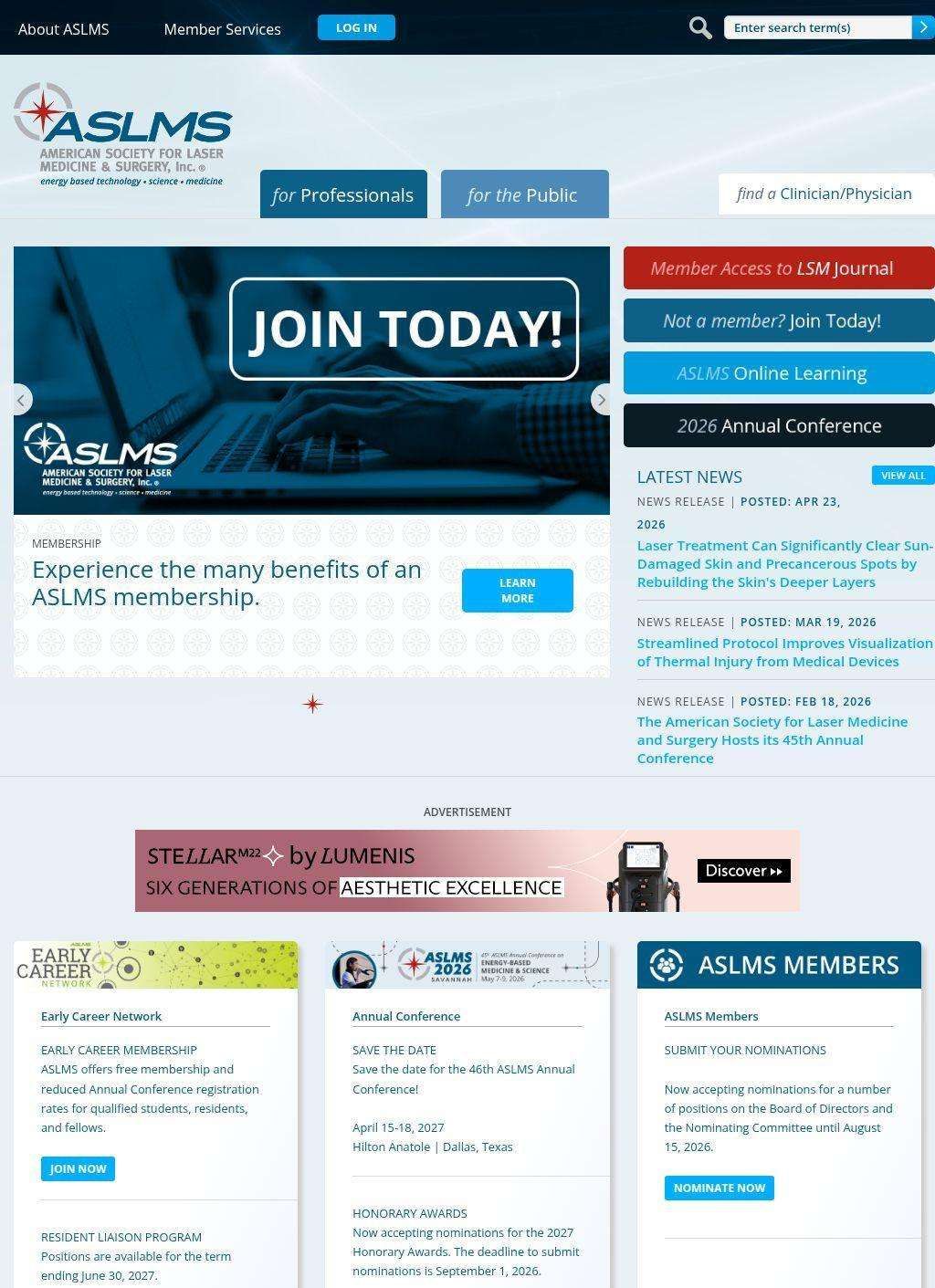
A clinician who has just bought a fractional laser, or a dermatology resident about to perform their first skin resurfacing case, runs into the same wall fairly quickly: where do the actual standards live? Device manufacturers supply their own manuals, conference talks scatter across the calendar, and patients ask questions that go past any single brochure. The American Society for Laser Medicine and Surgery exists to be the place those threads come together, and it describes itself as the world's largest scientific organization devoted to medical laser and energy-based applications.
Scope across medical specialties
That breadth is the first thing worth understanding. The society does not confine itself to cosmetic work. Its scope runs across dermatology, surgery, ophthalmology, and the laser skin rejuvenation procedures that brought many readers to this category in the first place. So a vascular surgeon using lasers for one purpose and an aesthetic practitioner doing photorejuvenation are, in principle, served by the same body. The American Society for Laser Medicine and Surgery treats lasers as a cross-specialty tool rather than the property of any one field, and the membership structure follows from that: tiers exist for physicians, surgeons, nurses, allied health professionals, researchers, residents, and students.
Annual conference with CME credit
The spine of the organization is its annual scientific conference, which carries continuing medical education credit. For a practitioner who needs CME anyway, that is a practical reason to engage beyond simple curiosity. Pair the meeting with the society's peer-reviewed journal, Lasers in Surgery and Medicine, and you get the two halves of how a serious clinical field keeps itself honest: a place to present findings in person and a place to publish them where peers can pick them apart. The journal is not a newsletter. It is the kind of primary literature a researcher cites and a careful clinician reads before changing practice.
Research funding for early-career scientists
Around that core sit the research grants and awards aimed at early-career scientists. Energy-based medicine advances through small, specific studies that nobody funds if a field does not deliberately seed them. By directing money toward people early in their careers, the American Society for Laser Medicine and Surgery is doing the unglamorous work of keeping a pipeline of investigators alive. The online learning courses round this out for members who want structured study between annual meetings.
Mentorship and preceptorship programs
There is also a mentorship and preceptorship track that connects trainees with experienced practitioners. Laser work is hands-on and unforgiving of guesswork: wrong fluence or wrong wavelength on the wrong skin type produces real harm. A preceptorship that puts a learner beside someone who has run thousands of treatments is a sensible answer to a problem that reading alone cannot solve.
Clinical guidelines and safety standards
What gives the society its weight is the standards of clinical care and practice guidelines it publishes. This is the answer to the clinician staring at a new device and wondering what good practice looks like. Guidelines from a broad professional body carry more authority than a single vendor's recommendation, and they give a practitioner something to point to when a protocol is questioned. For a field where regulation varies and where non-physicians sometimes operate powerful equipment, having a recognized reference point for safety and competence is genuinely useful.
Transparent governance and leadership
Governance, leadership, and the organizational history are documented openly on the site, which fits how a credible nonprofit should operate. You can see who runs it and how it is structured, and that transparency is part of why guidance from the American Society for Laser Medicine and Surgery carries the standing it does. The American Society for Laser Medicine and Surgery is not asking to be taken on faith; it lays out its own machinery.
Patient resources and provider locator
Patients are not an afterthought here, which is less common than it should be among professional bodies. A physician locator tool lets someone seeking laser treatment find a provider, and the American Society for Laser Medicine and Surgery explicitly counts the general public among the audiences it serves. That dual orientation, toward both the practitioner and the person on the table, is one of the more thoughtful aspects of how the organization positions itself. The same body that sets the standard also helps a patient find someone likely to follow it.
For working members there is a career center as well, a specialty-specific job board that surfaces roles a general listing tends to bury. None of these pieces is flashy on its own. Taken together they describe an organization that touches the field at most of the points where it actually operates, from the bench to the conference hall to the treatment room.
Outside the American Society for Laser Medicine and Surgery's own site, independent ratings are sparse. A search across Google, Trustpilot, and similar platforms turns up no aggregate review count for the American Society for Laser Medicine and Surgery as an organization, which is typical for a professional membership body and not a consumer-facing service. The society's standing in the field rests on its publication record, its conference history, and citations in clinical literature, not on star ratings, and by that measure it has a stable, decades-long presence. The journal Lasers in Surgery and Medicine is indexed in major databases, which is a concrete, verifiable indicator of academic credibility.
What the organization actually provides
It is worth being clear about what the American Society for Laser Medicine and Surgery is not. It is not a clinic and not a product. Someone hoping to book a laser facial directly will land in the wrong place, though the locator points them onward. The value here is upstream of any single appointment: the research that validates a technique, the guidelines that govern how it is done, and the education that keeps the people doing it current.
A clinician or trainee already working with medical lasers should treat the American Society for Laser Medicine and Surgery as a primary professional home: read the practice guidelines, check the conference dates for CME planning, and consider whether a preceptorship fills the gap in hands-on experience. A patient researching laser skin rejuvenation should start with the physician locator and the public-facing material, then walk into a consultation with a clearer sense of what evidence-based laser care is supposed to look like. The society publishes enough to make that preparation possible.
Business address
American Society for Laser Medicine and Surgery, Inc.
100 N. 72nd Ave.,
Wausau,
WI
54401
United States
Contact details
Phone: (715) 845-9283