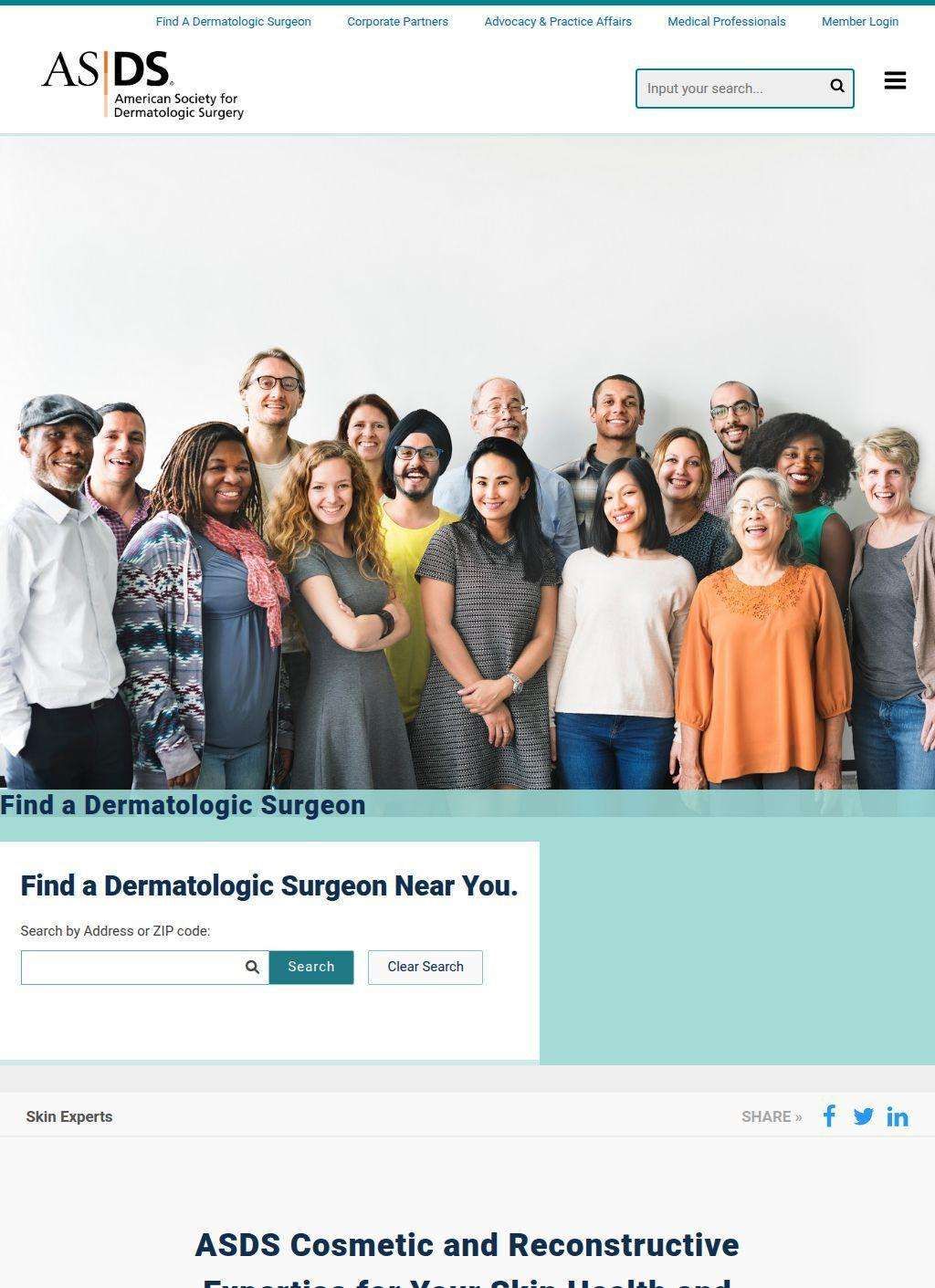
Who sets the bar for the doctors performing laser resurfacing, fillers, and skin cancer surgery, and where can a patient read about those procedures without wading through a clinic's sales copy? That is the gap the American Society for Dermatologic Surgery fills. As the national professional association for board-certified dermatologic surgeons, it addresses two audiences at once: patients doing their homework, and the physicians who belong to the organization. For someone arriving from a search about laser skin rejuvenation, the appeal is simple. The information comes from the body the specialists themselves answer to.
Patient education and skin condition library
The patient-facing material is the half most general readers will care about, and it is broad. There is a skin condition library covering acne scars, aging skin, birthmarks, vitiligo, and a long list of other conditions, none of it framed as a pitch for a single practice. Treatment explanations span laser procedures, injectables such as botulinum toxin and dermal fillers, surgical excisions, non-invasive body contouring, and skin cancer treatments. Skincare guidance is sorted by age, running from newborns up through people over fifty, which is a sensible way to organize advice that genuinely changes across a lifetime. On top of that sit skin cancer self-exam instructions and screening resources, the kind of preventive material that costs nothing to read and occasionally catches something serious early.
Finding a board-certified surgeon
One feature deserves specific mention because it does what the surrounding articles cannot. The "Find a Dermatologic Surgeon" locator lets a member of the public search for a board-certified physician by location. That tool turns the whole site from passive education into a next step: you learn what a fractional laser treatment involves, then you can look for someone qualified to perform it. That connection between information and a vetted physician is the practical payoff of the American Society for Dermatologic Surgery maintaining the resource rather than a commercial clinic doing it. For the laser skin rejuvenation category this listing falls under, the site covers resurfacing, laser hair removal, photodynamic therapy, and other light-based treatments, and pairs that coverage with guidance on choosing a qualified practitioner. The equipment is only ever as safe as the hands operating it.
Member resources for physicians
The other half of the American Society for Dermatologic Surgery points squarely at clinicians, and it is substantial. Members get login access to continuing medical education alongside practice management tools for the business side of running a clinic. There is annual meeting registration, advocacy and policy resources, and corporate partnership opportunities. None of this is flashy, and it should not be. A professional medical association builds its standing by serving its members and informing the public, and the breadth here points to an organization doing both without padding the offering to look larger than it is.
Clinical volume and procedure statistics
The scale claim is striking in a way that is easy to skim past. Members of the American Society for Dermatologic Surgery collectively perform over ten million cosmetic procedures and roughly three and a half million skin cancer treatments every year. That figure is not decoration. It tells you the membership is large, active, and concentrated in exactly the procedures a visitor to this entry might be researching, which gives the recommendations on the site a base of real clinical volume instead of marketing claims.
Separation of patient and professional content
The two audiences do not bleed into each other, which is worth noting because many association sites get this wrong. Patients get plain-language explanations and a way to find a doctor. Professionals get the membership machinery, the meetings, and the policy work. A reader looking for laser rejuvenation guidance is not going to stumble into practice management pages by accident, and a member chasing CME credits is not stuck scrolling through consumer skincare copy. That separation is harder to get right than it looks, and the American Society for Dermatologic Surgery gets it right.
Membership scale and organizational standing
Outside reputation is harder to gauge. A search across major review platforms turns up no aggregated consumer ratings for the American Society for Dermatologic Surgery as an organization, which is normal for a professional association rather than a consumer-facing business. The site itself does not appear in a business directory as a local service, though it does appear once in this one as an educational and referral resource. What you can check is the membership count, the annual procedure volume, and the depth of the clinical content, and those are consistent with an organization that has been operating at scale for decades.
What this resource does not provide?
If there is a limit to what the American Society for Dermatologic Surgery offers a patient, it is the obvious one. This is an education layer and a referral mechanism, not a treatment provider. The site will explain what fractional laser resurfacing involves and help you locate a certified surgeon, but the actual consultation, the pricing, and the procedure all happen elsewhere, at the individual physician's practice. That is the correct division of labor for an association, and it is worth setting expectations before someone arrives expecting a storefront.
From research to qualified practitioner
A visitor sent here from the laser skin rejuvenation category will leave in a good position. The American Society for Dermatologic Surgery gives clear, clinically grounded explanations of laser and light-based treatments, a credible route to a board-certified practitioner, and a condition library that treats skin health as more than a cosmetic concern. It does not provide the local, transactional detail of any single clinic, so it works best as the research stop you make before choosing a provider. For the narrow question of laser rejuvenation it answers more than enough, and the depth of the condition coverage extends the value well past laser work into broader skin care. As a reference for understanding these procedures and screening for qualified hands, the American Society for Dermatologic Surgery is about as solid a starting point as the specialty has.
Business address
American Society for Dermatologic Surgery
1933 N. Meacham Road, Suite 650,
Schaumburg,
IL
60173
United States
Contact details
Phone: 847-956-0900