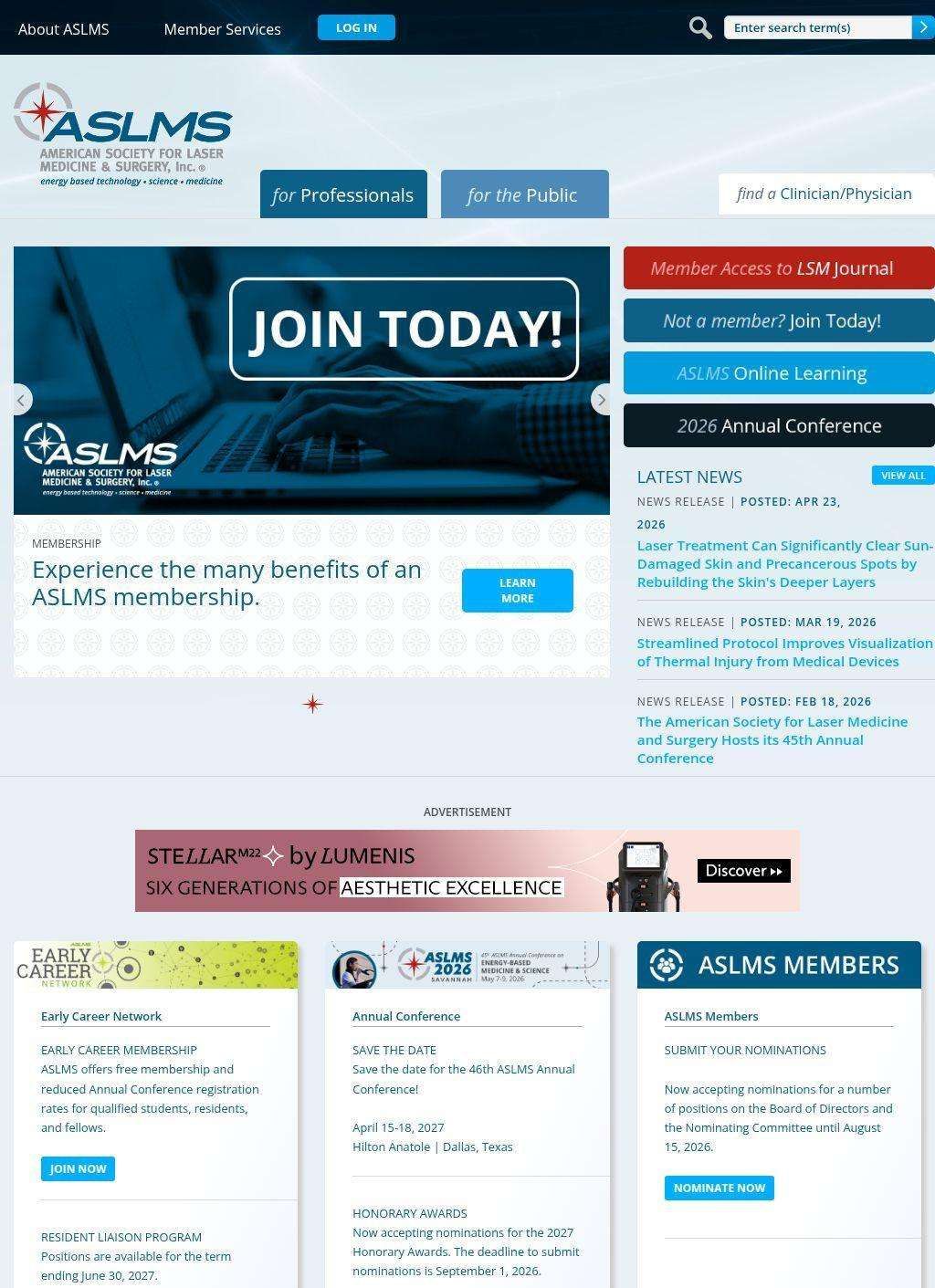
Forty-six annual conferences is a long run for a specialty body, and the American Society for Laser Medicine and Surgery has already posted April 15-18, 2027 in Dallas as the next one. That kind of forward scheduling is a telling detail: it says the organization treats its flagship gathering as a fixed institution, not an event it reconvenes when convenient. Alongside the conference sits a peer-reviewed journal, accredited continuing education, research grants, and a set of published safety standards. For a clinician working with lasers or intense pulsed light, the more useful question is less whether the American Society for Laser Medicine and Surgery is credible and more whether what it publishes and teaches is genuinely useful inside a working practice.
Lasers in Surgery and Medicine journal
Start with the journal, because that is where a society earns or loses its standing among the people it claims to represent. "Lasers in Surgery and Medicine" is the peer-reviewed title the American Society for Laser Medicine and Surgery puts out, described on the site as the leading scientific journal in its field. That is a bold claim, but the existence of a continuous peer-reviewed record matters to anyone trying to determine whether a given energy-based technique rests on evidence or on vendor enthusiasm. A physician weighing a new IPL protocol has a defined place to look. The American Society for Laser Medicine and Surgery includes journal access in membership, which folds the literature into the overall package instead of charging for it separately.
Accredited continuing education programs
The education side is broad and aimed at people who treat patients rather than people studying the field abstractly. Online continuing medical education is accredited by the ACCME, so the credits count toward the requirements clinicians have to meet. A dedicated Laser Aesthetics Course covers the cosmetic and dermatologic end of the field, where IPL and light-based treatments get heavy clinical use. Beyond formal coursework, the American Society for Laser Medicine and Surgery runs mentorship and preceptorship programs, which is the harder and more personal form of teaching that a conference slide deck cannot replace. Pairing a newer practitioner with someone who has logged years on these devices tends to shape how a person practices long after the program ends.
Research funding for early-career professionals
Research funding is part of the offering too, including student grants for early-career professionals. A field built on devices that manufacturers are eager to sell needs an independent source of funding for people asking whether those devices do what is claimed and at what risk. Student-level grants show that the American Society for Laser Medicine and Surgery is trying to develop the next generation of investigators, rather than serving only the established names already circulating in the literature. Whether the grant pool is large enough to make a meaningful dent in the field is not something the page settles, and that is a fair thing to wonder about before reading too much into it.
Safety standards and practice guidelines
Safety is the throughline that gives the rest of it weight. The American Society for Laser Medicine and Surgery publishes standards of practice and safety guidelines for laser and energy-based procedures. That work is the part of what the American Society for Laser Medicine and Surgery does that should interest the general public as much as it interests clinicians.
Lasers and IPL devices can burn, scar, and damage eyes when handled carelessly, and the gap between a competent provider and a reckless one is not always visible to a patient choosing a clinic. A society that codifies standards gives the field a reference point. Published guidance does not enforce itself; a standard only helps when a provider has read it and chosen to follow it, but having the document exist and be findable is the precondition for any of that to work.
Membership is tiered, with higher levels bundling journal access, conference discounts, and online content. The detail worth noting is free membership for students, residents, and fellows. For people early in training who tend to have the least money and the most to gain from exposure to a specialty, removing the cost barrier is a sensible and quietly generous move. It lowers the friction for a curious resident to attend a course or read the literature before deciding whether this niche fits what they want to do.
Who can join this organization?
The American Society for Laser Medicine and Surgery draws an unusually wide membership for a specialty body: physicians and surgeons, but also dentists, nurses, allied health professionals, researchers, and students. Lasers cut across a lot of clinical territory, so the breadth makes sense, though it raises the practical question of whether one organization can speak with equal authority to a dermatologist doing IPL and a dentist working with a soft-tissue laser. The international resources hub and the partnerships with collaborating societies show that the American Society for Laser Medicine and Surgery is aware of how scattered the field is and is trying to connect some of it instead of claiming to own the whole subject.
Career resources and member engagement
A career center with job listings and a member portal at my.aslms.org cover the practical, day-to-day reasons members stay engaged between conferences. The American Society for Laser Medicine and Surgery keeps a presence on Facebook, LinkedIn, Twitter, YouTube, and Instagram. The YouTube channel has obvious potential for a field that is so procedural and visual, though the page gives no sense of how deep that video library runs.
Patient information about laser treatment
For the general public, the value is narrower but genuine. Someone considering an IPL or laser treatment and wanting to understand what a responsible provider should know can use the American Society for Laser Medicine and Surgery as a reference for what good practice looks like. The patient-facing treatment information is pitched at exactly that reader. It will not tell someone which clinic down the street is competent, but it gives them a vocabulary and a baseline of expectations to bring into a consultation.
No third-party review presence turned up in a public search for the American Society for Laser Medicine and Surgery, which is common for a professional membership society. Reputation in this context lives in the clinical community's opinion of the journal and the guidelines, not in star ratings.
Put together, the American Society for Laser Medicine and Surgery does the things a specialty body is supposed to do: publishing the research record, accrediting education, funding new work, and setting safety standards. It covers the clinical, the academic, and the cautionary sides of a field that needs all three, without the breathless tone that energy-based aesthetics so often attracts. The annual conference, the journal, and the practice standards each give a clinician a concrete reason to engage, and the free student membership lowers the cost of entry for the people who most need it.
What the site leaves open is depth. A clinician can see that courses, grants, and guidelines exist, but the page is a front door, not the rooms behind it. How current the American Society for Laser Medicine and Surgery safety standards are, how rigorous the CME modules feel in practice, how competitive the research grants turn out to be: these are things a prospective member has to test from the inside.
Business address
American Society for Laser Medicine and Surgery, Inc.
100 N. 72nd Ave.,
Wausau,
WI
54401
United States
Contact details
Phone: (715) 845-9283