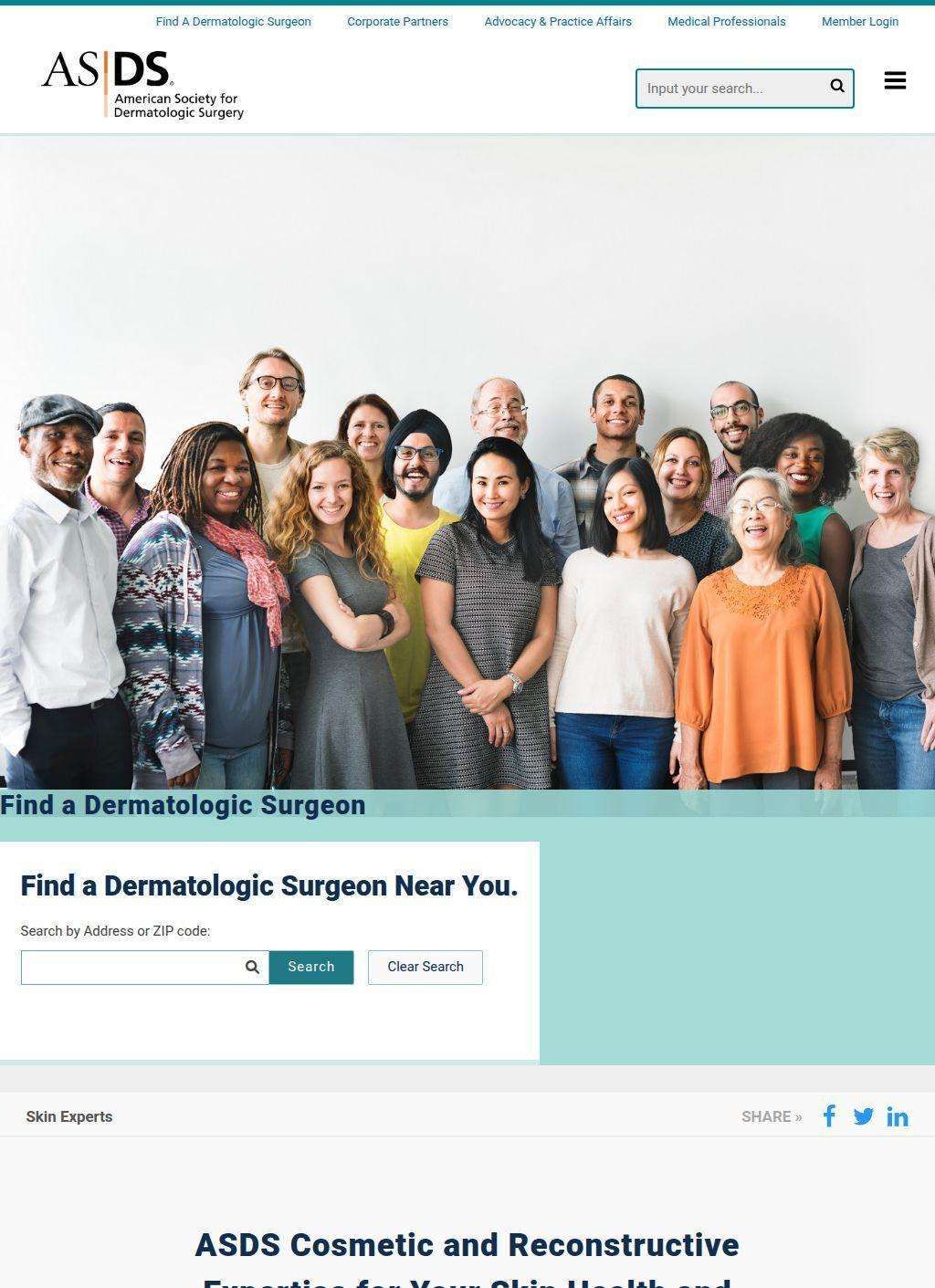
Running from a single domain, asds.net functions as two sites in one skin. Half of it is patient-facing education on dermatologic procedures, skin conditions, and skin cancer prevention; the other half is a professional hub for the surgeons who are members. The American Society for Dermatologic Surgery does not try to blur that line. The structure keeps the two audiences apart, and it works because neither group needs to wade through content aimed at the other.
Patient education organized by life stage
Patient material is where most casual visitors land. The American Society for Dermatologic Surgery organises it by life stage, which is an arrangement worth noticing: the same condition can appear under different sections depending on whose skin is being discussed, from newborns through adults over fifty. Under that frame, the condition library covers acne scars, aging skin, birthmarks, skin cancer, and more. Treatment explainers run alongside, covering laser therapies including intense pulsed light, chemical peels, Mohs surgery, microdermabrasion, dermal fillers, and injectables. For a reader who arrived here through an interest in IPL specifically, the site gives context rather than a pitch: it frames IPL as one option among several and explains what it suits, which is the honest way to present a procedure that works for some skin concerns and not for others.
Skin cancer awareness takes priority
Skin cancer gets more attention than the cosmetic material does. Prevention guidance, screening information, and early-detection education are pushed forward across the patient sections, and that emphasis says something about what the American Society for Dermatologic Surgery considers its public responsibility. A visitor who came in looking for resurfacing or pigment correction will pass through skin cancer content whether they intended to or not. The cosmetic and medical sides share the same shelf, and the organisation does not pretend they are unrelated.
Finding a qualified dermatologic surgeon
The "Find a Dermatologic Surgeon" tool is the practical backbone of the patient experience. It lets visitors search by location for board-qualified members, and because membership in the American Society for Dermatologic Surgery carries a credential threshold, the results are filtered in a way a plain web search cannot replicate. A person reading about Mohs surgery for the first time can move directly from the treatment explainer to a list of qualified practitioners in their area. That connection between learning and acting is the clearest thing the site does well.
From treatment explainer to directory
The locator also explains why the educational content is pitched as it is. The explainers do not promote a single clinic or procedure. They describe what a treatment does, who it suits, and what category of specialist performs it, then hand the reader off to the member directory. Informational first, consultation-oriented second. That sequence is a reasonable order for medical content to follow, and the American Society for Dermatologic Surgery sticks to it throughout.
Inside the professional membership section
The professional side is a different audience wearing the same domain. Membership enrollment, continuing medical education, advocacy and practice affairs, and the annual meeting including registration are all housed here, alongside corporate partnership opportunities. None of it is dressed for patient eyes, and there is no reason it should be. A surgeon renewing credentials or registering for CME is not the same visitor deciding whether a chemical peel suits their skin, and the society keeps the two journeys from colliding.
The CME offering and advocacy work also clarify what the American Society for Dermatologic Surgery does beyond publishing. Setting standards for cosmetic and reconstructive dermatologic procedures, representing the specialty in policy matters, and running continuing education for members are the functions that give the patient locator its credibility. The member directory is worth searching because membership means something, and the professional section is where that meaning is sustained.
Field updates for members
News and field updates round out the publishing. The society posts developments relevant to dermatologic surgery, which prevents the site from reading as a static reference and gives returning professionals a reason to check back between annual meetings. It is the lightest content area, but it fits an active membership organisation, not a brochure left to sit.
Reaching patients through social media
The social presence is wider than expected for a medical society. The American Society for Dermatologic Surgery runs accounts across Facebook, Twitter, Instagram, YouTube, and TikTok under the @ASDSSkinMD handle, a spread that few professional associations bother to maintain. TikTok in particular points toward a younger audience for skin health and prevention content. For an organisation whose public work leans heavily on skin cancer awareness, reaching people where they already spend time online is a reasonable extension of the education mission. The video channels give the treatment explainers a format beyond text.
What holds the whole site together is a consistency of purpose. Every patient-facing page steers toward a qualified surgeon. Every professional page maintains the credential that makes those surgeons worth finding. The American Society for Dermatologic Surgery is not trying to be a general skin care publication or a single clinic's marketing arm. It is a membership organisation that publishes enough public education to make its directory useful and enough professional resource to keep its members engaged and current.
Why aren't there consumer reviews?
A search for the American Society for Dermatologic Surgery turns up no significant independent review presence on consumer platforms. That is not unusual for a professional medical association: its audience is primarily physicians and patients seeking referrals rather than reviewers weighing in on a service experience. The organisation's standing in the field is reflected in its longevity and in the membership threshold backing the locator, not in star ratings.
For a patient, the most useful pairing on the site is the condition library alongside the locator: read what a treatment involves, then find a qualified practitioner to deliver it. The life-stage organisation means the same procedure can appear under more than one section, so searching the treatment or condition name directly is faster than browsing by age group. The skin cancer material will be hard to scroll past on the way, which, given the society's emphasis, is plainly deliberate. The American Society for Dermatologic Surgery built a site that reflects what the organisation does, and for the audience it serves, that focus holds up.
Business address
American Society for Dermatologic Surgery
1933 N. Meacham Road, Suite 650,
Schaumburg,
IL
60173
United States
Contact details
Phone: (847) 956-0900