Running the American Academy of Dermatology through a search is the obvious move for anyone trying to understand whether the site is a credible reference on IPL therapy or just a large organization with a public web presence. Independent ratings across health and consumer platforms are sparse, which is not surprising for a membership body rather than a clinic, but it does mean reputation has to be read from what the organization publishes and from the standing of the credential it awards rather than from aggregated patient scores.
Professional organization for dermatologists
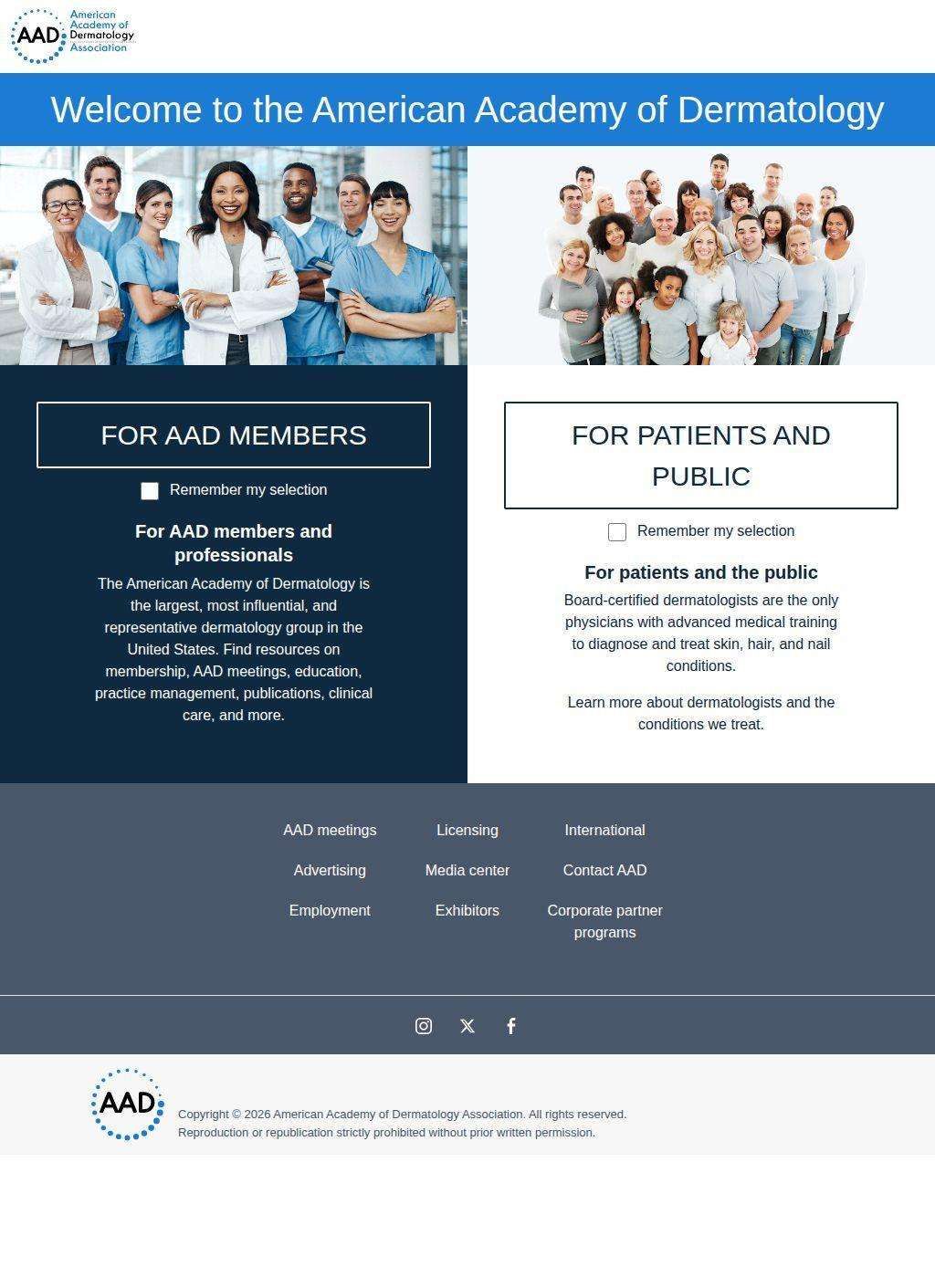
Filed here under intense pulsed light therapy, the American Academy of Dermatology is the professional body for dermatologists in the United States. Its website divides its attention between two very different visitors: the clinician who treats skin disease for a living, and the ordinary person trying to work out whether a rash, a mole, or a persistent patch of redness is worth a doctor's time. Most organizations pick one of those audiences and let the other fend for itself. This one tries to hold both, and the way it splits that attention tells you a lot about what to expect when you arrive looking for anything related to laser and light-based skin treatment.
Patient education and physician directory
The site is not a clinic and does not sell a procedure. What it offers instead is the layer underneath: plain-language patient education about skin conditions, and a directory tool that lets you search for a board-certified dermatologist by location. For someone weighing an IPL session for sun damage, broken capillaries, or pigmentation, that combination is genuinely useful. You can read up on the condition you actually have, then find a credentialed physician nearby who can tell you whether light therapy is the right call or a waste of money. The public-facing material leans toward caution and accuracy over excitement, which is exactly the tone you want from the group that certifies the specialty.
Resources for medical professionals
The professional half of the American Academy of Dermatology is larger and, frankly, denser. Membership management, continuing medical education, clinical care publications, practice management guidance, and an employment board sit alongside international programs and corporate partnership resources. There is a media and press center, advocacy material aimed at policy and patient access, and promotion for the AAD Annual Meeting, with the next edition set for Denver from March 27 to 31 and its own exhibitor registration track. None of that is aimed at a patient, and that is fine. It simply means a casual visitor will scroll past a good deal of content written for people with an MD after their name.
Strengths and limitations for IPL research
Partly, and honestly that partial answer is the honest result. If the question is "what is intense pulsed light, and who should perform it," the site points you in the right direction without overselling. The find-a-dermatologist tool is the strongest practical feature, because a board certification check is the single most reliable filter a patient has against an undertrained operator with a device. The American Academy of Dermatology runs that certification credibility as its whole reason for existing, so a referral flowing from this source has a foundation a random listings page cannot offer.
Where it falls short of the category label is depth on the procedure itself. IPL gets treated as one option within a broader conversation about treating skin conditions, not as a topic the site has chosen to map out in detail. You will not find pricing, device comparisons, or a step-by-step account of what a session feels like, because that is not the job the American Academy of Dermatology set for itself. A reader hoping for a consumer guide to the treatment will leave with good context and a path to a real doctor, but without the granular how-to they might have wanted.
That gap is a positioning choice, not a flaw. The American Academy of Dermatology is a credentialing and professional organization first, and a patient resource second. Its patient content exists to steer people toward qualified care, so it stays general on purpose. Judged against what it sets out to do, the material is solid. Judged strictly as an IPL therapy resource, it is more of a trustworthy on-ramp than a destination.
Bilingual outreach and social media
The bilingual reach of the public material and the @AADskin social presence across Instagram, Twitter, and Facebook widen the front door a little, which helps the people most likely to delay seeing a dermatologist. For an organization this size, that outreach is not decorative. It is part of how a national specialty body moves people from worry to a real appointment, and it is one of the more quietly effective things the site does.
Navigation challenges on the homepage
One practical caution: the sheer breadth of the American Academy of Dermatology site can work against a first-time visitor. The same homepage that serves continuing education, meeting logistics, and advocacy can bury the two things a patient came for. The search-a-dermatologist tool and the condition library are both there and both good, but you may have to hunt past professional content to reach them. A tighter split between the clinician portal and the public entrance would make the patient experience noticeably smoother.
Set against the IPL category it sits in, the verdict is a measured yes with an asterisk. The American Academy of Dermatology will not teach you the mechanics of a light treatment or compare clinics on price. What it does deliver is reliable groundwork and a vetted path to a qualified physician, which is arguably the more important half of the decision. Open it early in the research process, then go somewhere more procedure-specific to fill in the gaps the American Academy of Dermatology deliberately leaves.
Business address
American Academy of Dermatology Association
9500 W Bryn Mawr Avenue, Suite 500,
Rosemont,
IL
60018
United States
Contact details
Phone: (847) 330-0230