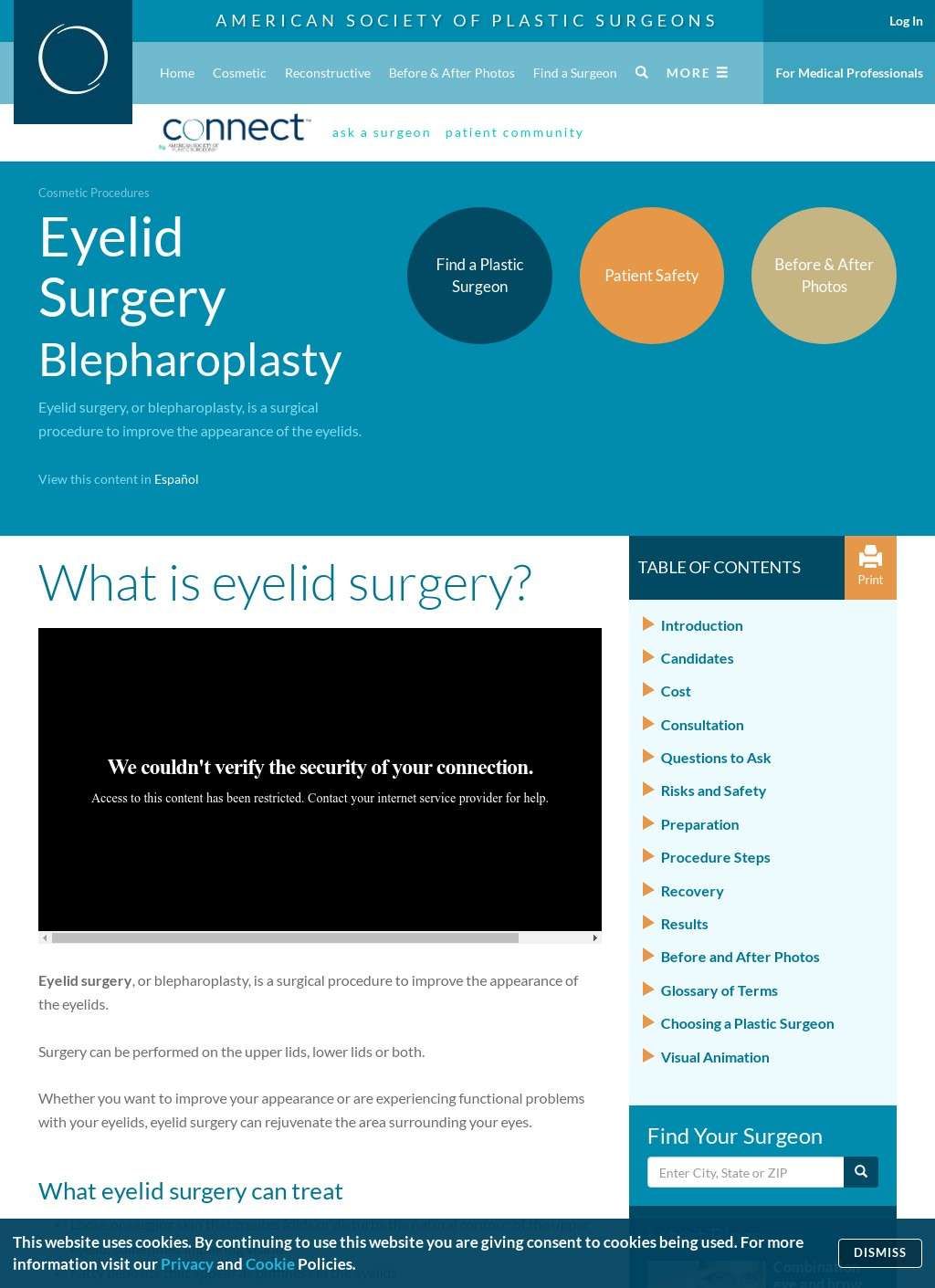
Blepharoplasty pages on plastic surgery sites usually run to a definition, a warning to consult a doctor, and a stock photo. The American Society of Plastic Surgeons takes a different approach. The page opens by defining the surgery in plain terms and then immediately names six distinct conditions it addresses: loose skin that folds over the upper lid contour and can reach the point of affecting vision; fatty deposits that read as puffiness; under-eye bags; drooping lower lids that expose white below the iris; excess lower-lid skin with fine wrinkles; and functional eyelid problems that go beyond cosmetic concern. That list is doing real work, because it lets a reader figure out fairly quickly whether their own concern is even in scope before reading further.
Defining blepharoplasty through six specific conditions
The structure runs to fourteen sections, and they are sequenced the way a patient's thinking tends to move. Candidacy sits near the front. Cost follows. Then consultation guidance, a set of questions to put to your surgeon, risks and safety, how to prepare, the steps of the procedure itself, recovery, and what results look like. Cost figures, recovery timelines, and the specifics of risk live in their own linked subsections, which keeps the main page readable while still pointing somewhere concrete for detail. I find that split sensible, since piling every dollar amount and healing milestone onto one screen usually buries the part a given person came to read.
What pushes the American Society of Plastic Surgeons page past a generic explainer is how the candidacy material connects back to those six conditions. A person staring at puffiness is told plainly that fatty deposits can be the cause; someone bothered by lower lids that sag and show white below the iris sees that named as a recognized indication. The functional category is worth noting too, because eyelid skin heavy enough to crowd the field of view turns the surgery into something more than appearance work. The American Society of Plastic Surgeons does not blur that line, and the distinction is a useful anchor for a reader who is still unsure whether to pursue a consultation at all.
Organizing information around patient decision-making
The consultation guidance and the list of questions to ask a surgeon reinforce the same posture. Instead of selling the procedure, the page hands the reader a script for interrogating it. That is a different relationship to the subject from what most procedure pages offer. It is consistent with what the American Society of Plastic Surgeons represents: the largest plastic surgery specialty organization in the world, writing for patients rather than for booking appointments.
Consultation guidance and surgeon questions
Beyond the written sections, the American Society of Plastic Surgeons folds in a board-certified surgeon locator, which is arguably the most useful feature on the page for anyone who has read enough and now wants a real name. Patient safety information and a financing link through CareCredit mean the money question gets an answer route with a clear next step, rather than a bare figure with no path forward.
Locating board-certified surgeons and financing options
The media is more than filler. On the American Society of Plastic Surgeons page, a before-and-after photo gallery sits alongside a visual animation of the procedure and educational videos that compare blepharoplasty to a brow lift. That comparison is a thoughtful inclusion, because the two get confused often, and someone convinced they need eyelid surgery may actually be looking at a brow issue instead. Blog content on hooded eyes and on subtler eye rejuvenation rounds out the resource, pulling in readers who are not yet committed to surgery at all.
Comparing blepharoplasty with related procedures
A glossary of terms and a separate block of surgeon-selection guidance close the loop on the reference side. The American Society of Plastic Surgeons places both near the end of the page: the glossary quietly raises the floor for a confused reader, and the selection guidance pairs naturally with the locator tool. Together, these elements give a reader enough context to know what they are deciding before they pick up the phone, and that is harder to achieve than it looks on a single-procedure page.
If there is a limitation, it is structural: the landing section deliberately stays high-level, so a reader who wants exact prices or a day-by-day recovery chart has to click through to subsections. That is a reasonable trade-off, and the American Society of Plastic Surgeons marks those links clearly enough that the click is not a guessing game. The depth is present; it is spread across subsections, not condensed onto one screen.
Across fourteen sections, the American Society of Plastic Surgeons treats blepharoplasty as a decision with several moving parts: candidacy, cost, recovery, risk, and surgeon choice, each given its own room. The animation, the comparison videos, and the locator all move a reader from a vague concern about their eyelids toward a concrete next step. Read the full page, use the locator, and the practical questions, what the surgery addresses, what to ask, and how to find someone board-certified, have clear answers.