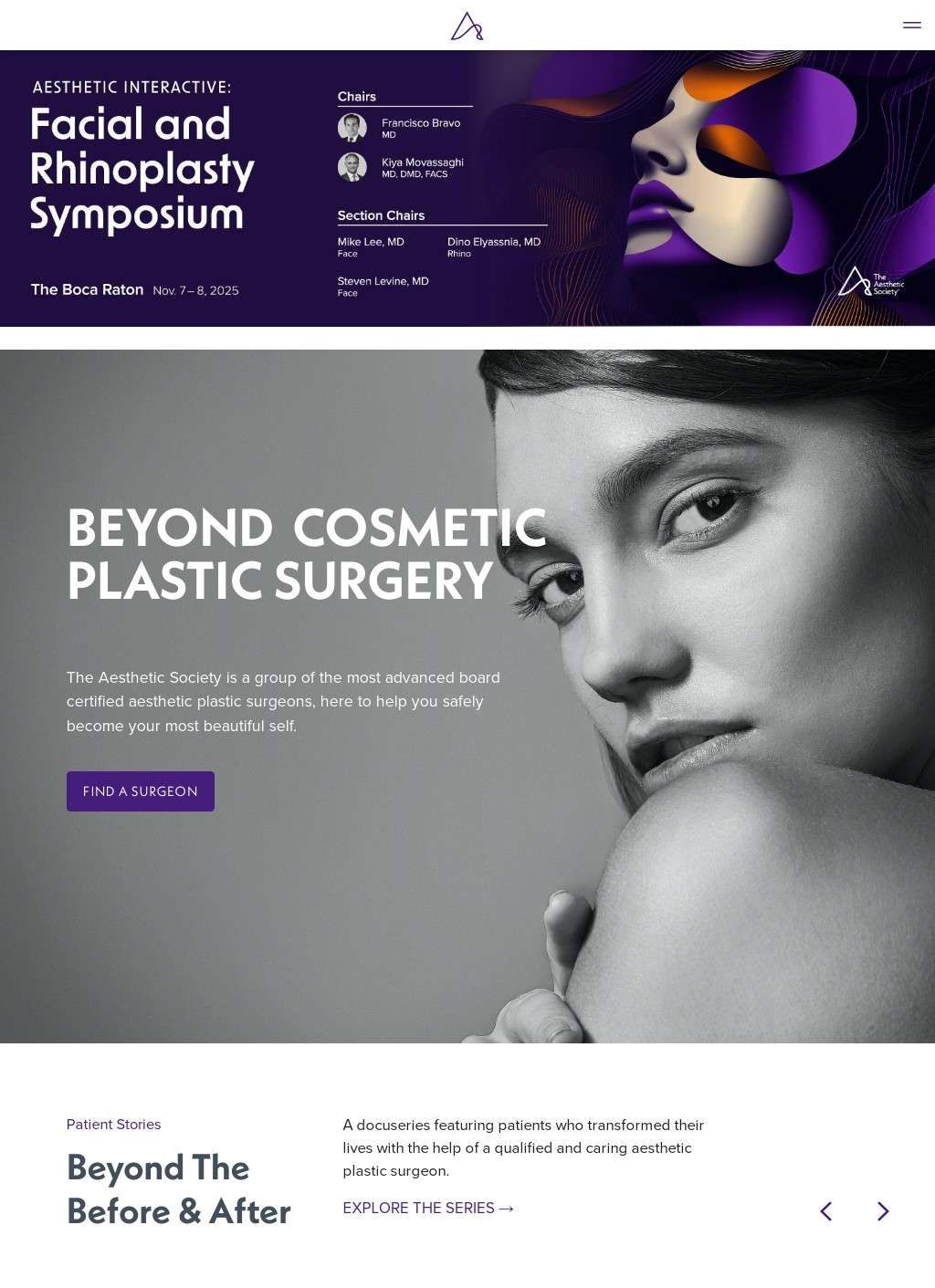
A surgeon locator drawing from more than 2,200 board-certified aesthetic plastic surgeons is where most visits to The Aesthetic Society begin, and it justifies that entry point. Most profiles carry before-and-after photo galleries, so a prospective patient can look at actual outcomes before booking a consultation. That single tool reflects what the rest of the site is built around: connecting people who are weighing surgery with practitioners who have cleared a specific credentialing bar, then giving those people enough to ask sharp questions once they sit down across from a doctor.
Finding board-certified surgeons
The Aesthetic Society organizes its procedure library by area. Breast work sits alongside reduction and lift inside its own category, while the wider menu covers Body procedures like tummy tuck, liposuction and contouring, Head and Face options including facelift, rhinoplasty, brow lift and eyelid surgery, a Genital section for labiaplasty and vaginoplasty, and a Skin and Hair group covering Botox, fillers and laser treatments. The guides read like reference material, not advertising. They explain what a procedure involves, what recovery tends to look like, and how costs and financing typically break down. That grounding is what most people lack when they first start searching.
Procedure guides organized by body area
Beyond the reference material, The Aesthetic Society runs an "Ask a Surgeon" Q and A platform where questions get answered by members, and it lets registered users track consultations through an account. Safety guidelines run throughout, which fits the organization's actual role. This is the credentialing and educational body standing behind board-certified aesthetic plastic surgery in the United States, and it sets the standards that define who qualifies for membership. A patient using the locator is, in effect, filtering for surgeons The Aesthetic Society itself vouches for.
Q and A platform with member responses
The professional side of the operation is substantial and worth understanding from a patient's perspective, because it explains why the consumer guidance reads differently from what a clinic or manufacturer publishes. The Aesthetic Society produces Aesthetic Surgery Journal, a peer-reviewed publication, and offers its members continuing education, credentialing context and access to industry resources. The annual statistics it releases on cosmetic procedure volumes across the country are widely cited. When a society maintains a research journal and trains its own membership, the procedure pages it writes for the public tend to reflect current clinical practice rather than marketing fashion.
Research journal and professional standards
There is also a docuseries on the site, "Beyond The Before and After," which leans toward the patient-experience side of cosmetic surgery and adds something past clinical text. It is a softer companion to the harder reference content, and whether it helps depends on how a given visitor absorbs information. Some people want the recovery timeline in plain paragraphs; others want to watch a story. The Aesthetic Society covers both angles, and the photo galleries tied to surgeon profiles do more practical work than the video for anyone trying to judge what results look like in practice.
Video content exploring patient experience
What makes this a less-than-frictionless resource is the breadth itself. A visitor arriving specifically to research breast augmentation has to navigate a site that is simultaneously serving body contouring patients, facial surgery patients, the professional membership, the journal readership and the press following the annual statistics. The depth is considerable, but the front door asks you to know roughly where you are headed. The consultation tracking and account features are useful to a committed user and largely invisible to a first-time browser, so a good chunk of the platform's value sits behind sign-in and only pays off once someone is genuinely in the surgery-planning process.
How does the site serve different visitors?
The before-and-after galleries deserve a second mention because they carry an honest limitation worth naming: they show selected outcomes from member surgeons, so they are illustrative of what is possible without being a controlled sample. The Aesthetic Society does not hide the qualifications behind membership, and the safety and recovery material is more candid than the glossy tone the wider cosmetic industry usually adopts. Still, a careful reader should treat the galleries as a starting point for conversation with a surgeon, not a guarantee of outcome. That caveat falls on the patient as much as on the organization.
Before-and-after galleries and their limits
Taken together, The Aesthetic Society is a serious, well-stocked resource for anyone researching aesthetic surgery, and the breast category in particular benefits from sitting inside a credentialing apparatus that includes a peer-reviewed journal and a vetted surgeon network. The platform is strongest as a vetting and education tool and weaker as a quick-answer destination, since the volume of material and the account-gated features reward patience over a casual five-minute browse. Past the curiosity stage, with a specific procedure in mind, The Aesthetic Society is one of the more authoritative places to start. The surgeon locator alone justifies the visit; the depth behind it is what separates The Aesthetic Society from a general health information site.