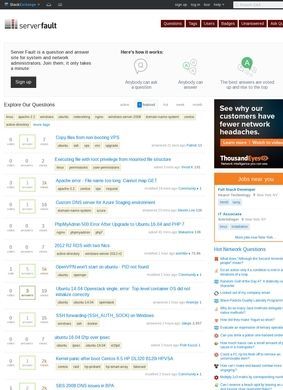
Almost everything on Server Fault was written by the people who use it, not by the company that runs it. The site is a question-and-answer board for professional system administrators, and the value sits entirely in the archive of problems that working IT staff have already hit and solved. Stack Exchange Inc. operates the platform, but the content comes from network engineers, DevOps practitioners, and sysadmins posting real configuration headaches and answering each other. Part of the wider Stack Overflow network, Server Fault narrows the focus to the server side of the job, which gives it a different character from the general programming forums next door.
Community-built knowledge for system administrators
The scope is deliberately tight. Questions cluster around server configuration, network administration, and the operating systems that run in production: Linux, Windows Server, the BSDs. It spreads from there into virtualization, the major cloud platforms (AWS, Azure, GCP), DNS, firewalls, storage, and databases as they behave under server loads. Containerization shows up heavily, with Docker and Kubernetes among the recurring topics. Someone troubleshooting an nginx reverse proxy at 2am, or trying to work out why a Windows domain controller is misbehaving, is the intended visitor. That specificity is the whole point, and it keeps answers from drifting into vague generalities. Server Fault is not useful to someone looking for a general-purpose computing forum, and it does not try to be.
Server configuration, networks, cloud platforms
Finding things relies on the tagging system, which is the practical backbone of the site. Posts are filed under technology tags such as linux, apache, nginx, windows-server, docker, and kubernetes, so a reader can pull everything on a single tool without wading through unrelated threads. Combined with the search, this turns years of accumulated questions into something closer to a reference than a chatroom. Most people who land on Server Fault arrive through a search engine, read an accepted answer, and leave without ever signing in. The platform supports this by keeping all content publicly indexed and readable without an account, which is a reasonable design choice for a knowledge base that genuinely wants to be found.
Finding answers through tags
The mechanics that govern quality are worth understanding before relying on the answers. Each question can draw multiple responses, the community votes them up or down, and the person who asked can mark one answer as accepted. The accepted tag and vote totals are the main indicators of whether a solution held up, though a highly upvoted answer that is not the accepted one sometimes ages better than the one the original poster chose. Reading the comments under an answer often reveals caveats, edge cases, or a warning that a command works on one distribution but not another.
How voting determines answer quality
The voting is not infallible. Popular answers can lag behind changes in the underlying software, and a well-phrased but outdated fix can keep collecting votes long after it stopped being the right approach. On Server Fault, the vote count tells you the answer was useful to many people; it does not tell you when those people last ran it.
Outdated solutions can still accumulate votes
Contribution runs on a reputation economy. Users earn points and badges for asking good questions and writing answers that get upvoted, which over time grants them moderation abilities and raises their standing with other readers. Posting requires a free account, and a single Stack Exchange network login carries across the related sites, so a programmer already active on Stack Overflow can answer a server question without registering again. All of the content is licensed under Creative Commons, meaning the answers can be quoted and reused elsewhere with attribution, a detail that explains why fragments of Server Fault threads turn up across so much of the technical web.
Reputation system drives participation
Beyond the core Q&A, a few supporting pieces round out how the place works. There is a Help Center that lays out what counts as an on-topic question, how to write one that will get answered, and how the voting and reputation systems function. Real-time chat rooms exist for discussion that does not fit the question-and-answer format. A separate meta site, meta.serverfault.com, handles governance: arguments about which questions belong, how moderation should work, and changes to site policy. For a newcomer, the Help Center is the part most worth reading first, because the community enforces its scope rules firmly and a question that strays outside them gets closed quickly.
Strict moderation enforces on-topic standards
That strictness is the double edge of the model. The same gatekeeping that keeps the Server Fault archive clean and on-topic also makes it unforgiving toward people who phrase a question loosely or ask something moderators judge too broad. A question can be put on hold, marked as a duplicate, or closed before anyone tries to answer it, and that experience drives some first-time askers away. The flip side is that the surviving content is dense and accurate in a way few open forums manage. For someone consuming answers rather than posting them, none of this friction is visible; for someone hoping to ask, the closure rate is the first practical obstacle.
Questions face closure for scope violations
There is also the question of currency. Server administration moves fast, and a fix that was correct against an older release of a tool may quietly stop working. Server Fault handles this better than many comparable sites, because answers can be edited and the community does revise them, but the volume is so large that not every old thread gets maintained. A reader has to check the dates on a question and its answers, look at whether the software versions mentioned still match what they are running, and weigh the comments rather than trusting the top result on faith. The accepted answer was accepted by one person solving one problem at one moment, and enough moments have passed since some of those accepted answers were written that the version in question is now end-of-life.
Checking dates matters for older answers
What Server Fault offers, taken plainly, is a large and mostly well-filtered archive of production-grade server knowledge built by people who do this work for a living. For reading and searching it is among the stronger places on the web for this specific subject matter, precisely because the contributors are practitioners and the voting process removes the worst of the guesswork. For participating, the bar is higher than a casual newcomer expects.
The closure of off-topic or underpowered questions is a real feature, not a theoretical one, and anyone hoping to ask should read the Help Center before posting. Outside reputation for Server Fault is reflected in its broad reach in search results and its position inside the Stack Exchange network, where it has accumulated a large body of indexed content over many years. No independent review counts are available, which is common for a technical reference site of this kind.