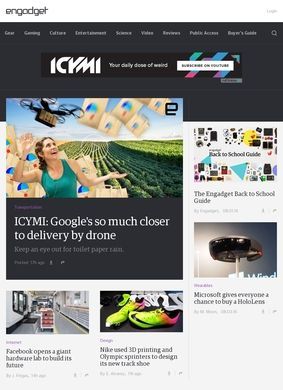
Buying guides are the part of Engadget that justify a bookmark. Pull up the laptop guide or the headphones guide and you get a ranked set of picks with a clear "best for" framing, broken out by use and budget, and updated as new hardware lands. That is the practical core of what the site does: it sits between a press release and your wallet, and it tries to answer the one question most readers have, which is what to buy and whether the new thing beats what they already own.
Daily news and product reviews
The publication runs two distinct engines side by side. One is daily technology news, organised into sections for AI, apps, computing, mobile, social media, and a transportation strand that leans heavily on electric vehicles. The other is product coverage: full reviews and buying guides for smartphones, laptops and PCs, gaming hardware, headphones, wearables, cameras, tablets, and home products. That split is worth understanding because it tells you how to use Engadget. If you want to know what Apple announced this morning, the news side handles it. If you want to know whether a given pair of wireless earbuds is worth the money against three competitors, the reviews side is built for that, and it is the stronger of the two.
Ecosystem-specific coverage
Coverage is also organised around the companies that dominate consumer technology, which is a sensible way to navigate when a single firm touches a dozen product lines. There are dedicated landing areas for Amazon, Apple, Google, Meta, Microsoft, and Samsung, so a reader tracking one ecosystem can follow it without wading through everything else. Gaming gets the same treatment, with separate streams for Nintendo, PC, PlayStation, and Xbox. A console-only reader and a PC-build reader want different things, and Engadget does not force them into one undifferentiated feed.
Entertainment and security sections
Beyond the obvious gadget beats, the site reaches into entertainment, with sections for television, movies, and streaming, and into security, where it covers cybersecurity stories and maintains VPN coverage. VPN guides have become a staple of tech publishing because they are commercially lucrative and genuinely useful in roughly equal measure, so it is worth reading any such guide with that dual nature in mind. There is also a forward-looking strand grouped under a "Tomorrow" banner that gathers science, space, and robotics. That section is where Engadget stretches past the immediate shopping question into research and engineering stories that will eventually become products, giving the site a slightly broader remit than a pure gadget blog.
Podcasts, newsletters, searchable archives
Format variety is one of the quieter strengths here. Alongside written articles, Engadget produces podcasts and newsletters, and it keeps a searchable editorial archive that goes back years. Technology coverage ages fast, but being able to dig up the original review of a device from several generations ago is exactly what you want when deciding whether to upgrade or hold. Few outlets keep their back catalogue this accessible, and for anyone researching a long-lived product line, Engadget functions as a reference rather than a stream of disposable posts. The newsletters condense the firehose of daily coverage into something digestible, which is a fair acknowledgement that nobody reads every post on a site this size.
Scope of consumer electronics testing
It is worth being honest about what the reviews are and are not. Engadget reviews consumer electronics, the mainstream stuff most people will plausibly buy: phones, headphones, laptops, smartwatches, mainstream cameras. It is not a deep niche instrument lab, and it does not pretend to be. The value is in breadth and consistency. The same general standards apply across categories, the verdicts are stated plainly, and the buying guides do the legwork of comparison so you are not reading ten separate reviews and trying to reconcile them yourself. For a general reader weighing a purchase, that consistency beats exhaustive lab testing from a specialist site covering just one category.
Corporate ownership and sister publications
The ownership history is part of how to read the site, and it is no secret. Engadget passed through Yahoo and Verizon before landing with its current operator, Static Media, and it now sits alongside sister publications including Jalopnik, BGR, SlashGear, TVLine, and Sciencing. That stable shapes the editorial footprint: cars, more gadget news, television, and general science all live next door. A reader who values knowing who stands behind their information can find that lineage stated openly, which is more than can be said for a lot of content farms operating in the same space.
Affiliate revenue in buying guides
If there is a criticism to register, it is the same one that applies to almost every large commercial technology outlet now. Buying guides and product roundups are tied to affiliate revenue, and the sheer volume of "best of" content across the industry means a reader has to apply some judgement about which recommendations are driven by genuine testing and which are driven by what is easy to monetise. Engadget is not unusual in this, and its track record and longevity work in its favour, but the smart way to use any guide of this type is to treat the top pick as a strong starting point and to read the reasoning behind the ranking. The reasoning is usually there.
A search for Engadget on platforms like Trustpilot returns no significant consumer review presence. That is expected for a media publication rather than a service provider. Engadget's credibility comes from its publishing record, its longevity through multiple ownership changes, and the volume of long-term readers who return to it, none of which shows up as a star rating anywhere.
Engadget versus The Verge
Against a direct competitor like The Verge, the choice comes down to temperament. The Verge leans harder into culture, design, and the broader politics of technology, with a louder editorial personality and a heavier emphasis on commentary. Engadget is the more utilitarian of the two: less interested in the cultural argument, more interested in telling you which gadget to buy and why, with buying guides that are easier to act on and an archive that is easier to mine. A reader who enjoys technology as a beat to follow may prefer The Verge's voice.
Practical tool for purchase decisions
A reader who shows up with a specific purchase in mind, or who wants to track one company's hardware over time, will get more done at Engadget. That practical bent has kept it relevant across several corporate handovers, which is a cleaner endorsement than any single review cycle could offer.