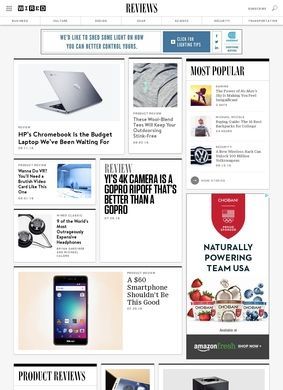
Someone about to spend money on a laptop, a camera, or a set of earbuds, and unwilling to take the manufacturer's word for any of it, is the reader this section is built for. Wired: Latest Reviews is the product-testing arm of WIRED, and its register is hands-on, not spec-sheet recital. A review of wireless earbuds on Wired: Latest Reviews will tell you what the battery delivered after a week of commuting, how the case sits in a pocket, and whether the companion app is worth opening twice. Staff journalists and contributing editors put consumer technology through real use before passing a verdict.
Product categories covered
The catalogue is broad. Smartphones and laptops are the staples, but Wired: Latest Reviews also works through cameras, audio gear, wearables, smart home devices, software, and streaming services. If a category of consumer electronics exists, there is a fair chance someone on the desk has tested an example and written down what happened. The reviews are bylined work, not anonymous filler, and each takes a position: buy this, skip that, wait for the next version.
Buying guides pair with verdicts
Two formats sit alongside the individual reviews. Buying guides collect the verdicts into something a reader can act on without working through twenty separate pieces, so a guide to the best laptops under a given price hands over the editors' shortlist directly. How-to articles cover the practical side. The curated recommendations narrow a crowded field down to a handful the editors stand behind, which shows comparative thinking a lone review can only gesture at. The guides update as new products land, so the advice does not calcify into last year's picks.
Editorial skepticism behind the verdicts
There is a stated editorial point of view across all of it. Wired: Latest Reviews has never presented itself as a neutral spec aggregator, and the reviews carry the skepticism the magazine brings to its feature reporting. Reviewers will call a gadget overpriced, half-finished, or pointless, and that willingness is what gives the positive write-ups any value. Reading about a product whose maker would dearly love a glowing notice, that is the part worth having.
Beyond gadgets to broader tech coverage
The reviews do not stand alone. Wired: Latest Reviews is one wing of a publication whose coverage spans artificial intelligence, cybersecurity, space, biotechnology, transportation, business, and the points where technology meets politics. That context feeds the product writing in useful ways. A reviewer assessing a smart home camera who also works the security and privacy beat brings questions a pure gadget site tends to skip, such as what the device does with your data and who can see the footage.
WIRED still publishes a print magazine, and the long-form, investigative habits of that side shape the digital work. The reviews are short by the standard of a feature, but they come from an outfit that reports instead of summarising. The institutional backdrop is the genuine differentiator: a verdict on Wired: Latest Reviews sits inside an editorial operation with decades of accountability, a print legacy, and reporting reach that runs well past the gadget desk. That does not make any single review the best ever written about a given device, but the work answers to a system of editorial standards instead of floating loose.
Three decades of archive depth
WIRED has been running since 1993 and has belonged to Conde Nast since 1998, which puts a long-established technology, science, and culture title behind every entry. The archive reaches back across three decades. A reader who wants to trace a product line's history across its full run, beyond the latest model, will find the depth of Wired: Latest Reviews hard to match elsewhere.
Free tier versus paid subscription
The access model is plain enough to describe in a sentence. Content is free and ad-supported, with a paid subscription, WIRED+, that strips the ads and opens the full archive. For occasional readers of Wired: Latest Reviews, the free tier covers it. For anyone digging back through years of coverage on a particular technology, the subscription is where the archive access starts to pay off.
The audience is wider than the gadget-obsessed. General consumers come to make a single purchase well. Technology enthusiasts read to stay current. Professionals in tech and science fields use it to track tools and trends adjacent to their own work, and policy-minded readers come for the way the publication threads technology through regulation, security, and society. The product reviews are the entry point for many of them, even where the deeper feature reporting is what keeps them.
Where broad coverage falls short
Breadth has a cost. Because Wired: Latest Reviews covers so many product categories, no single niche gets the obsessive, forum-level depth a dedicated camera site or a specialist audio publication can offer. A professional photographer chasing the last word on autofocus tracking should expect to want a more specialised second opinion past Wired: Latest Reviews, and probably a third. The same applies to anyone whose purchase turns on one narrow technical question that a generalist desk will not chase to the floor. For that reader, this is a starting point, not the final reference.
The other limit is structural, not a fault: the reviews are written for people making decisions, and less for people who already know exactly what they want. The framing on Wired: Latest Reviews stays fixed on whether a thing is worth the money and the time, which is the right question for a reviews section to keep asking, but it means the deep specialist will often hit the edge of what a single review wants to do.
What makes Wired's reviews stand out?
Plenty of outlets review the same phones and laptops, and many post their verdicts faster. The case for reading Wired: Latest Reviews instead rests on the editorial standing underneath it rather than on speed or sheer volume. The buying guides are the most practical way in: they distil the accumulated testing into comparative advice, and clicking through to the full reviews gives the reasoning behind each pick. Together they form a fuller picture than the typical consumer-tech site manages, and the back catalogue lets a reader follow a product line across its whole history. That combination is what Wired: Latest Reviews trades on.
A solid generalist source for consumer tech, strong on editorial credibility and archive depth, but not the place to settle a specialist question on its own.