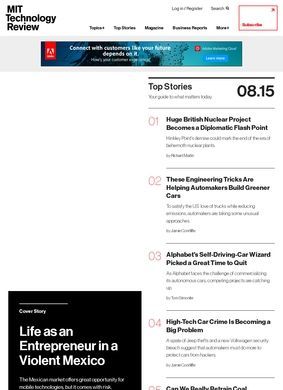
Readers hit a wall the moment a new technology starts mattering to their job: a model release, a gene-editing trial, a grid-scale battery claim, and the open web answers with a thousand near-identical hot takes, half of them recycled press releases. The pull of MIT Technology Reviews is that it sits one layer up from that noise. It reports on emerging technology and then does the harder part, which is explaining what the development means for business, for policy, and for the people who end up living with it. That second half is where most coverage gives up, and it is the reason MIT Technology Reviews still gets cited years after a given story runs.
Topic verticals and editorial voice
The site is an independent media company founded in 1899 and owned by the Massachusetts Institute of Technology. The lineage matters less as a credential than as an explanation of tone. The writing assumes you can handle a real argument and a few numbers, and it does not flatter the technology it covers. Content on MIT Technology Reviews is sorted into clear topic verticals: artificial intelligence, computing, biotechnology and health, climate change and energy, engineering, space, and a policy and culture strand that catches everything technology touches once it leaves the lab. Public rating platforms carry no meaningful profile for MIT Technology Reviews, which is expected for a subscription media brand and not a local service.
Across those verticals the formats stay varied enough that the homepage rarely feels like one long feed. There are long-form features that take a single subject apart over several thousand words, straight news reporting on the day's developments, explainers that exist to make a complicated idea legible, and interviews with the people doing the work. The annual "10 Breakthrough Technologies" list is the recognizable set piece, an editorial bet on which advances are genuinely going to reshape practice, and it tends to set the terms for a lot of conversation once it lands each year. That willingness to commit to a ranked, defensible call is a big part of why MIT Technology Reviews has the reach it does.
Subscription plans and print magazine
Plenty of the journalism is open, and a curious reader can spend a long afternoon on MIT Technology Reviews without paying anything. The paywall sits in front of the full digital and print archive, which is where the depth concentrates. A subscription buys the print and digital magazine, published as monthly issues, with thematic editions such as the July/August 2026 "The Engineering Issue" giving each month a center of gravity instead of a loose pile of articles. For someone who reads this material as part of their work, the magazine is the spine and the website is the daily supplement.
Email is the other way MIT Technology Reviews reaches people, and it is handled with some care. The newsletters are curated by topic, and the standout is "The Algorithm," a weekly send focused on artificial intelligence that does the useful job of separating genuine progress from the marketing cycle that now surrounds the field. Podcast and audio content extends the same reporting into a listening format, and the live events and conferences put the editors and their sources in front of an audience that wants to ask questions in person.
Live events extend the reporting
Those gatherings are not a side activity bolted on for marketing; they tend to feature the researchers and executives the publication has been writing about, which means the reporting and the live programming feed each other. A reader who follows a topic on MIT Technology Reviews can often watch the same thread get argued out on stage a few weeks later. A "What's Next" series leans deliberately forward, mapping where particular technology trends are heading instead of only narrating what already happened.
How the publication funds its journalism
It pays to be plain about how the operation funds itself, because MIT Technology Reviews does not pretend otherwise. Alongside subscriptions, the site carries advertising and a set of custom content and sponsorship products, including branded content and video storytelling produced for clients. That commercial layer is visible, and a careful reader will want to keep the sponsored material mentally separate from the newsroom's own reporting. The line is generally marked, and the editorial work stands on its own terms, but the presence of paid storytelling is a real characteristic of MIT Technology Reviews and not a footnote.
A pitch portal for outside contributors
A "Write for Us" pitch portal invites outside contributors, which is how a publication of this size keeps pulling in specialists who know a narrow subject better than any staff generalist could. For a researcher or working technologist with something specific to say, that is a concrete route into MIT Technology Reviews, and it points to an editorial mix that stays open to outside expertise rather than running entirely on staff bylines.
Who the writing is for
The intended readership shows through in nearly every choice. Technology professionals, researchers, business leaders, policymakers, and innovation-minded general readers are the people the writing is pitched at, and the assumed baseline of knowledge is set accordingly. That cuts both ways. If you want a quick consumer verdict or the kind of entry found in a business directory, MIT Technology Reviews is the wrong address. If you want to understand why a particular advance in computing or biotechnology is going to reshape an industry, the depth is the point and the reason to keep coming back to MIT Technology Reviews.
The breadth also pays off in a way that is easy to miss when you read one article at a time. Because MIT Technology Reviews covers AI, climate, space, and biotech under one roof, the connections between fields surface naturally. A story about energy demand touches the AI vertical; a piece on biotechnology runs into policy and regulation. Coverage that stayed in a single lane would miss those collisions, and the collisions are frequently where the interesting questions live. The policy and culture strand does a lot of quiet work here, since it is the place where a technical advance gets measured against law, money, and public reaction rather than treated as a closed engineering problem.
There is also a consistency to MIT Technology Reviews that is easy to take for granted. The same editorial standard applies whether the subject is a speculative space venture or a near-term shift in chip design, and that evenness is what lets a reader trust a story on a topic they cannot personally fact-check. A reader who builds a habit around MIT Technology Reviews is buying that reliability as much as any single article.
Set MIT Technology Reviews next to Wired, the obvious alternative for a reader weighing where to spend their attention, and the difference comes into focus. Wired covers a wider cultural sweep and writes with more flash, and for many readers that is exactly the appeal. MIT Technology Reviews trades some of that range for a tighter focus on the research and its consequences, with the institutional backing to chase a serious story past the headline. A reader who wants technology framed as culture and lifestyle may prefer the former; one who wants the engineering, the evidence, and the policy stakes taken seriously will find more here, and the print magazine gives that reading a permanence a scrolling feed never quite manages.