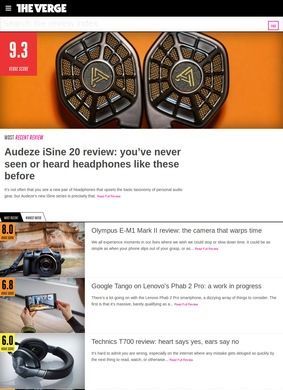
Launched in 2011 out of Lower Manhattan under Vox Media, The Verge built its reputation as a publication that treats technology as a cultural subject, not a spec sheet exercise. The Verge: Reviews is the product-review section of that operation, and it is where the site files its actual verdicts on consumer hardware: phones, laptops, tablets, headphones, wearables, televisions, and the growing pile of smart home gadgets that promise to run your lights and lock your doors. The coverage leans toward the products people are most likely to be shopping for, which in practice means a lot of Apple, Samsung, and Google, with the rest of the field filled in as new gear arrives.
How reviews are structured and presented
What you get at The Verge: Reviews is more than a score and a spec table. The pieces are hands-on, written by staff journalists and editors who have spent real time with the device. They sit alongside buying guides, how-to articles, and editors' choice features that try to answer the practical question of which model to buy. A single review tells you whether one phone is good; a buying guide tells you where it lands against everything else in its class. The Verge: Reviews keeps both of those things within easy reach, and the combination is harder to do well than it looks.
Guidebook organizes products by category
In 2017 the team built something called Guidebook, an organized hub that slices the review output into product categories and pins the top-rated picks at the top of each one. The sections get updated as new models land, so the recommendations are meant to move with the market rather than go stale the moment a successor ships. It is a sensible structure for a section that produces a high volume of overlapping coverage, and it spares a reader from digging through a chronological feed to find the current best laptop or the headphones worth the money.
Reviews within broader tech coverage
The Verge: Reviews does not exist in isolation. It sits inside a publication that treats technology as a cultural and behavioral subject alongside breaking news, long-form investigations, and its own awards. A review of a smartwatch here might carry an awareness of how the device changes the way people behave, setting that alongside the chip speed and battery life instead of treating those specs as the whole story. For a reader who wants that human framing and the hardware verdict together, the context is a real asset.
The flip side is that the surrounding editorial machine can pull focus. The same publication chasing industry developments and behavioral commentary is the one telling you which tablet to buy. A shopper who only wants the verdict has to navigate past a lot of adjacent coverage to reach it. Guidebook is clearly the answer The Verge came up with for that problem, and it works well enough, but the section is part of a bigger, busier operation. Whether that reads as depth or distraction depends on what you came for.
Editorial voice and institutional credibility
The voice helps. Because the work comes from named staff who cover these companies year-round, the reviews tend to carry opinions rather than hedge them, and they are willing to be skeptical of a product that markets itself well. That editorial confidence is what separates The Verge: Reviews from the roundups that dominate so much of the buying-guide world, where a recommendation often feels reverse-engineered from a shortlist someone else decided on. A reader skimming a business directory listing for a credible tech-review source will find The Verge: Reviews has genuine institutional weight behind it.
Format options across platforms
The Verge: Reviews is also worth looking at for its format range. The same evaluations get pushed through video on the YouTube channel and through podcasts, so a verdict can arrive as a read, a watch, or a listen depending on preference. For a camera comparison or a hands-on with a foldable phone, video carries detail that prose struggles to convey, and having both formats produced by the same editorial team keeps the judgment consistent across them.
Coverage extends beyond flagship devices
Smartphones and laptops are the obvious anchors, but The Verge: Reviews also covers tablets, headphones, wearables, TVs, and smart home devices with the same hands-on approach. A household trying to decide between competing smart speakers or a first pair of true wireless earbuds will find the same level of attention that the flagship phones get. That is not always the case at outlets that pour their effort into headline products and treat the rest as secondary.
Editorial organization supports consistency
Editorial structure backs this up. The publication runs with an editorial director and supervising producers, so The Verge: Reviews is a coordinated operation, not a loose collection of freelance posts. That organization shows in how the buying guides stay aligned with the individual reviews and in how the pinned picks in Guidebook reflect the current state of the testing.
Scope limitations for niche products
It is fair to name the limits. The Verge: Reviews is consumer-tech first, and it is not the place to go for deep enterprise hardware, scientific instruments, or niche professional gear that falls outside the mainstream shopping conversation. The focus on the big brands is a strength for most readers and a gap for a few. Someone hunting for an obscure product in a small category may find the coverage simply does not extend that far, because The Verge: Reviews follows where consumer attention goes.
Industry insight from beat reporters
For tech culture readers, the section doubles as a window into the industry. The reviews are written by people who also cover the companies making the products, so a verdict often carries a thread of the broader story: where a platform is heading, what a feature says about a company's strategy, how a device fits the longer arc the same writers are tracking elsewhere on the site. That continuity is one reason The Verge: Reviews outperforms a standalone review farm over time.
Outside reputation is limited in the sense that The Verge as a whole carries the brand, and most reader discussion about The Verge: Reviews happens under the umbrella of the publication. Structured third-party ratings specific to the review section are not easy to locate separately; the section's standing comes through the publication's broader readership and industry recognition, with no standalone aggregate score available for it.
The practical reader test is straightforward. If you are weighing a major phone, laptop, or pair of headphones from a name-brand maker, The Verge: Reviews will almost certainly have a thorough, opinionated, recently maintained take, available in whatever format suits you, and slotted into a buying guide that puts it in context. Push past the popular categories and the depth thins considerably, because the section was never built to cover the long tail. Read The Verge: Reviews for what it does well, and keep a second source handy for the gear it was never built to cover.