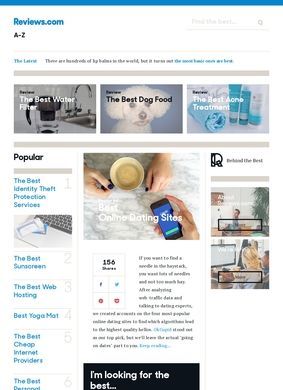
Reviews.com lets you type in a state and it will narrow its home security or broadband rankings to providers that actually operate where you live. Plenty of comparison sites skip that step, which leaves the basic problem unsolved: a national "best of" list is useless if half the companies listed do not serve your zip code. The site splits its attention across four areas: insurance, home security, internet and TV, and a catch-all for entertainment and utilities that leans heavily on streaming. Each of those gets provider write-ups, buyer's guides, and side-by-side comparison tools.
Insurance, home security, internet coverage
The insurance section is the broadest, spanning home, auto, life, and home warranty coverage. That is a sensible cluster to lead with because these are exactly the purchases where a confused buyer spends real money on the wrong product. Alongside the provider write-ups sit explainer articles on insurance concepts, home improvement, and data privacy, so someone who does not yet know what they are shopping for has a place to start before hitting the ranked lists. The educational layer is genuinely useful, more than SEO padding around an affiliate funnel, though that funnel is certainly there.
Insurance section spans home, auto, life
Home security gets its own dedicated track, covering both the hardware systems and the monitoring providers behind them, which are two decisions people often conflate and later regret. The internet and TV vertical handles broadband and television providers, where the state filter pays off most obviously since cable and fiber footprints change street by street. The fourth bucket, entertainment and utilities, is the loosest of the four and mostly tracks streaming services. It feels like the area where Reviews.com is still finding the edges of what belongs, but the streaming coverage itself is current enough to be worth a glance when you are weighing one subscription against another.
How Reviews.com tests and ranks providers
On methodology, Reviews.com makes claims that are easy to state and harder to verify from the outside. The About page describes an "evidence-first" approach, says the in-house editorial team tests the services it writes about, documents repeatable methods, and cites verifiable sources. It also name-checks alignment with Google's quality review guidance. Those are the right things to say. Whether the testing behind a given home warranty ranking is as rigorous as the page implies is something a reader has to take partly on trust, since the depth of any single test is not always laid out in the write-up itself. The intent reads as serious; the proof varies by article.
Affiliate commissions drive the business model
The business model is an affiliate one, and to the site's credit the disclosure sits plainly in the footer. When a user clicks through to a listed insurer or internet provider and signs up, Reviews.com earns a commission. That arrangement is standard for the comparison category, and the disclosure is the honest minimum. It is still worth keeping in mind while reading, because a ranking that pays the publisher when you pick the top result is never fully neutral, however careful the stated methodology is.
Testing process and affiliate model can coexist
To be fair, the affiliate model and a real testing process can coexist, and plenty of trustworthy outlets run on commissions. The thing to watch is whether the "best" pick consistently happens to be the highest-paying partner. Nothing on the surface of the site proves that is the case, but the structure means a careful reader should cross-check a top recommendation against an independent source before putting money down on a multi-year contract or an annual premium.
State filtering separates this site from generic lists
The state-level filtering deserves a second mention because it is the feature that most separates Reviews.com from a generic listicle. Broadband availability and home security service areas are intensely local, and a tool that prunes the list to what you can actually buy saves the reader from the usual dead ends. It is a practical touch that shows someone on the team understands how people actually shop for these services.
Contact information and transparency gaps
Where Reviews.com is lighter is on its own contact presence. There is a feedback email in the footer, encoded to fight spam harvesters, plus social links to Facebook, Twitter, and Instagram. No phone number, physical address, or prominent contact page turns up anywhere on the front of the site. For a publisher that asks readers to trust its testing of insurers and security companies, a clearer "who we are and where to reach us" route would do more for the credibility of Reviews than another buyer's guide. The feedback email covers the basic need, so this is a soft mark rather than a dealbreaker, and the spam-conscious encoding is reasonable enough.
Trustpilot rating and external reputation
Outside reputation is the part that gives pause. On Trustpilot, Reviews.com sits at 2.7 out of 5, a "Poor" rating, though it rests on only six reviews. Six is far too small a sample to treat as a verdict on a site of this size, and a handful of frustrated users can drag an average down fast. The number is a caution flag, not a conviction, but it does mean the volume of independent praise is low. Anyone hoping to find a chorus of satisfied users vouching for the recommendations will not find one there.
Put the pieces together and Reviews.com lands as a competent, well-organized comparison resource with genuine strengths and real soft spots. The location filtering is smart, the topic coverage is coherent, and the educational articles add value beyond the ranked lists. The affiliate model is disclosed but baked in, the identity and contact details are lighter than ideal, and the external reputation, what little of it has been logged publicly, is weak. None of that makes the site useless. It makes it a starting point rather than a final authority.
Using comparison tools with a shortlist ready
One practical note for anyone planning to use the comparison tools: the structure rewards a reader who already has a rough shortlist. The buyer's guides do a decent job of teaching the vocabulary of a category, but the real payoff comes from running two or three candidate providers through the side-by-side view and reading the individual write-ups closely. Skimming the headline ranking and clicking the first link is the lazy path the affiliate model quietly encourages, and it is the path most likely to leave a reader feeling the recommendation was not really theirs. Reviews.com is worth opening with that caveat firmly in mind, and its top pick should be checked against at least one other source before any money changes hands.