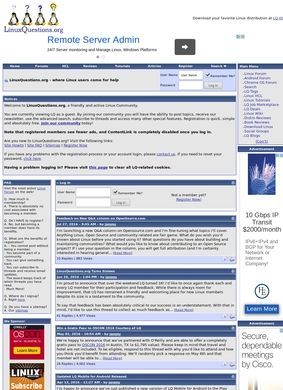
Where does someone turn when a fresh Slackware install hangs on boot and the official manual has quietly run out of answers? For roughly two decades, the reply for a great many people has been Linux Questions, a large public forum organized around Linux and open-source software. It is a peer community, not a paid help desk. Volunteers, hobbyists, and career administrators answer each other in the open, and the pile of answers they have left behind has grown into something close to a reference work.
The structure of Linux Questions is old-fashioned in the best sense: threaded discussion boards, sorted by topic.
Some of those boards are distribution-specific, with separate homes for Ubuntu, Fedora, Debian, Slackware, Red Hat, and SUSE, so a question about a package-manager quirk lands in front of people who run that exact system every day. Others cut across distributions entirely. There are boards for networking, for programming and scripting, for hardware compatibility, and for security, plus a general help section for problems that refuse to fit a tidy category. A Debian networking bug and a Fedora one can demand completely different fixes, and this split keeps those conversations from blurring into each other.
The upshot is that a beginner and a kernel hacker can share the same site without stepping on one another. Someone stuck on why their Wi-Fi dies after suspend can post to a hardware thread; a developer arguing over a shell-scripting edge case has a place too. The forum layout, plain as it is, does the sorting work that a single sprawling comment section never could.
Beginners are not treated as an afterthought. The "Linux Newbie" section exists precisely so that someone posting their first terminal error does not have to wade into a thread thick with kernel-module debugging. That one design choice tells you plainly who Linux Questions is built for: everyone, from the person who just wiped their laptop to the sysadmin chasing a race condition at three in the morning.
What sits alongside the forums
The discussion boards are the core, yet they are surrounded by material that has accumulated over years and gives the place its real depth. Threads on Linux Questions going back more than twenty years stay searchable, which means a problem someone hit in 2008 may already have a documented fix sitting there, waiting to be found again. That kind of longevity is rare on the modern web, where forums tend to disappear or get swallowed into some bigger platform.
None of it hides behind a paywall. Linux Questions is free to read and free to join, and that is part of why the archive kept swelling while so many paid support portals came and went. Age here is a feature, not a liability. The historical Q&A threads work almost like sediment: each solved problem is left in place, dated, and reachable through search, so the answers compound instead of expiring.
Plenty of Linux writing elsewhere assumes the newest release and quietly rots the moment it ships; here the old threads stay useful because someone can add a follow-up years later.
The hardware compatibility list
One of the more practical pieces is the members' HCL, a Hardware Compatibility List assembled by the community itself. Before buying a wireless card or a printer, a reader can check whether other users actually got it working, and how much wrestling it took. Real reports from people running the gear beat a manufacturer's vague "Linux supported" sticker every time, especially for the awkward stuff: obscure printers, laptop trackpads, budget network chipsets.
It is the sort of institutional memory that a scattered set of blog posts can never quite match, and Linux Questions has been collecting it steadily for years, one honest entry at a time.
Reviews, blogs, and the Members Choice Awards
Beyond troubleshooting, there is a Reviews section covering distributions and software, member blogs, a "Success Stories" corner for people documenting what finally clicked, a browsable members list, and even a jobs and employment board for Linux-related roles.
Linux Questions also runs periodic surveys, the most visible being the annual Members Choice Awards, where users vote on their favorite distribution, desktop environment, and similar categories. Those results have been cited around the wider Linux world for a long time as an informal read on what the community genuinely runs day to day, and they give Linux Questions a pulse that reaches past the ordinary question-and-answer traffic.
Is any of this polished? Not especially. The interface looks like the forum software it is, and the value lives in the accumulated text, not the paint. A search for outside reviews of Linux Questions on general rating sites turns up nothing organized, no Trustpilot page or app-store style score, which is normal for a volunteer forum that has never needed to sell anything. Its standing rests instead on twenty years of public threads that anyone can read and judge for themselves, which is a kind of reputation in its own right, if not the kind a star rating captures.
What Linux Questions offers, then, is breadth plus history: coverage running from a first nervous install through advanced scripting and security work, backed by an archive deep enough to serve as a knowledge base in its own right. A real thread beats a glossy tutorial that skips the messy parts, and on that measure it holds up well. The one caveat is inherent to any volunteer forum, Linux Questions included: an answer depends on who happens to be around and willing, so a genuinely obscure question can sit quiet while a common one draws three replies within the hour.
A single tidy article might not fit an exact setup. A decades-deep conversation among people who already hit the same wall usually does, and that is the trade Linux Questions has been offering for twenty years.